Valerie Byron
© Copyright 2026 by Valerie Byron

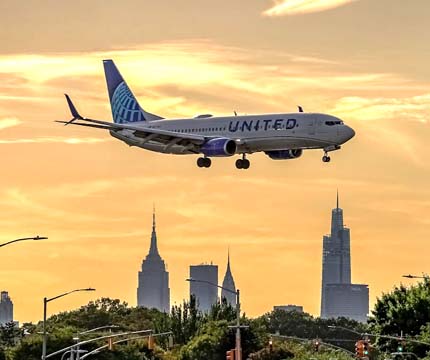
Photo of airplane landing in New York by Shui Miles on Unsplash.
|
A One-Way
Ticket Valerie Byron © Copyright 2026 by Valerie Byron |
Photo of airplane landing in New York by Shui Miles on Unsplash. |
In the mid-1970s, I had a baby, a four-year-old, a full-time job and a household that apparently operated as an unofficial refuge for anyone having a difficult time. A down-on-his-luck friend of my husband? Come on in. An ex-boyfriend of mine who came to visit and forgot to leave? Apparently, we accommodated those too. Bill was remarkably tolerant. Looking back, perhaps we both needed supervision.
We had a pool, a Jacuzzi and a Manhattan Beach address that suggested considerably more money than our bank account could confirm. People thought we were wealthy. We were simply generous, with poor boundaries and a nice postcode.
Then we met Juraj.
Bill had taken his car for repairs in Santa Monica and stopped at a restaurant for something to eat. There he struck up a conversation with a young man from Czechoslovakia who spoke perfect English and was a violinist between engagements. Bill arrived home full of enthusiasm. Juraj, pronounced “Your-eye,” was fascinating, talented, charming and, of course, invited over.
Juraj had no car, so I’m still not sure how he found his way to Manhattan Beach, but near Christmas, there he was. He brought beautiful ornaments for our tree, taught us to prepare dishes from his homeland and thoroughly captivated us. We had many lively dinners together before he went to stay with a friend in Laguna Beach and found a job at Tower Records. When his friend was away, he invited us down for a weekend at the beachfront house. We took Vanessa and left baby Nick with a babysitter because he wouldn’t stop crying. Looking back, perhaps Nick had instincts the rest of us lacked.
After that, we drifted out of touch. By about 1991, Juraj had become a pleasant memory. Then the telephone rang.
He had lost his job, had no money and had been thrown out by his friend. He had nowhere to live. Bill looked at me. I looked at Bill. My sensible instinct was to offer him some money.
“Go and get him,” I said. “Bring him back here.”
There are moments in life when you wish someone would gently place a hand over your mouth. This was one of mine.
Bill went to collect him, and Juraj installed himself in our son’s bedroom. How he fitted into that little twin bed remains a mystery. He was a large man, both physically and in personality, and neither seemed designed for compact accommodation.
At first, it was fun having him around. Then he started smoking. I had given up in 1986 and become one of those former smokers who could detect a cigarette being lit in another ZIP code. Juraj settled into a routine of eating, smoking and being there. Always there.
I thought a job would help. After some effort, he was hired at Tower Records in Hollywood. Wonderful! Except he still had no car. So I drove him to work from Manhattan Beach and went back to collect him. Apparently, alongside my full-time job and family responsibilities, I had opened a complimentary chauffeur service.
On one journey home, I suggested that his colleagues might be friendlier if he stopped behaving as though he knew everything about music and they knew nothing. He screamed at me and called me a selection of names that did very little to improve my opinion of either his manners or his musical expertise. Being insulted in your own car by someone you’ve driven miles to collect gives you plenty of time to reconsider your charitable outlook while keeping your eyes on the road.
By then, it was clear he had to leave our house. I rented him an apartment near Fairfax and Wilshire, furnished it and paid four months’ rent. Our son got his bedroom back. I could breathe without encountering cigarette smoke. For a few weeks, we had peace.
Then Juraj telephoned. His teeth were killing him. He had no insurance. Naturally, I arranged for him to see my dentist and paid the bill. By now I had provided accommodation, furniture, transport and dentistry. All that was missing was a small plaque acknowledging my contribution.
After three months, he was fired from Tower Records. Bill and I finally reached the same conclusion at the same time. Enough. Juraj had friends in New York, and we offered to buy him a ticket there.
The words “one-way” had never sounded so beautiful.
He accepted. We never heard from him again, though we eventually learned that he had returned to his homeland, married and had a child.
Years later, when I wrote about him on Facebook, that ticket seemed like the perfect ending. I even advised anyone offered Christmas ornaments by a charming violinist to keep the spare room to themselves. Then I found myself wondering where Juraj had gone after New York. I looked him up and discovered that the part of his life I knew least about had happened before Bill ever stopped for lunch in Santa Monica.
In a newspaper interview, Juraj recalled fleeing Czechoslovakia at nineteen after watching the Soviet-led invasion unfold on television in August 1968. An elderly Czech couple agreed to carry his violin to Zagreb. By the time he reached them, he said, he was covered in mud and blood from a journey that included hiding on and beneath railway carriages. With help from strangers, he made it to Vienna and eventually to Canada.
There he washed dishes and cars for a pittance and practised his violin at night with hands exhausted from manual labour. He won a place in Canada’s National Arts Centre Orchestra, studied at the Royal Conservatory in Brussels and performed across North America. He recalled walking into a living room one morning and being introduced to John Lennon. He later returned to Slovakia to care for his father and went on to teach, work in music broadcasting and earn a doctorate in music.
I shared what I’d found in a second Facebook post. I confess I was a little miffed that the interview contained no mention of us. John Lennon made the cut, but the Fee family didn’t. I kept looking and found a man on LinkedIn named Sebastian Scott. I sent him a tentative message asking whether his father was the violinist Bill and I had known.
He was. And Sebastian, writing from Bratislava, had already found and read both Facebook posts.
My heart sank. I thought of the joke about the spare room and wondered what it had felt like to read it when the man at the centre of it was your dad.
Sebastian told me about walks through the city and trips to the bakery for his favourite desserts. His father made sure his clothes were neat and his hair was combed, and proudly told anyone who would listen what a wonderful son he had. Sebastian remembered sitting with him for hours, learning to form his letters carefully. When money was scarce, Juraj sold some of his treasured possessions to provide for him.
Sebastian was still young when his father died. There were stories he never got to hear and questions he never got to ask. At eighty-four, I know how much of grief lies in all the tomorrows you expected to have with someone.
Then Sebastian thanked us for helping his father. He even apologised for how things had ended. I wanted to reach through the screen and hug him. We had helped Juraj because we wanted to. His son had nothing to apologise for.
Sebastian knew about the stubbornness. Juraj could stop speaking to his own brothers after an argument, which gave me the small comfort of knowing I was in good company. He also remembered his father talking about friends who had helped him. Most of the names had faded, but he remembered someone called Charles and a story about an enormous grizzly bear in Canada. To a little boy, I imagine, the bear was always going to have the advantage.
Some of the comments beneath my posts had been unkind. Sebastian had read those too. He gently asked me to consider how little we can know of another person’s struggles. I thought of how much I’d wanted a mention in the newspaper interview and how little room I’d made for Juraj in my own account once I’d got to the part about the cigarettes.
I wrote back and told Sebastian I wished I’d been a little kinder. I thanked him for telling me about the hours he’d spent learning to write with his dad. And I told him that if he ever came to California, our home would be open to him. He has a Cocker Spaniel called Charlie. I have one called Pumpkin Prairie. We’d have plenty to talk about.
Sebastian had already said he’d love to meet me someday. He’d ended his letter with a line that made me laugh out loud.
“And don’t worry, I don’t smoke!”
I’d bought his father a one-way ticket and thought that was the end of it. Now here I was, hoping his son would come to visit.