Taking My Father To See The Sea
Luo Chao
© Copyright 2026 by Luo Chao
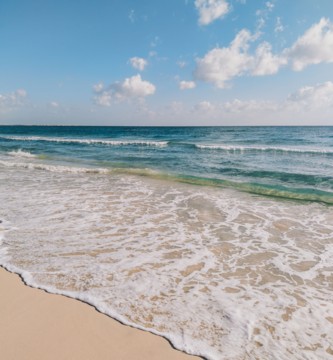
Photo by Amine Mayoufi at Pexels.
Taking My Father To See The SeaLuo Chao © Copyright 2026 by Luo Chao |
Photo by Amine Mayoufi at Pexels. |
I was twenty-eight, working in a city in the south. I had lived near the coast for a few years, and every time I called home, my father asked the same two questions. "Are you eating on time?" and "Is the weather warm there?" Then he would hand the phone to my mother.
One autumn I bought two tickets for the slow train and went home to get him. My mother packed him a bag as if he were crossing the whole country by himself. Boiled eggs, steamed buns, a thermos of hot water, two towels. She told him to wear two pairs of pants because the south was wet and he caught cold easily. She told him not to talk to strangers. My father stood in the doorway and let her talk, holding his old cloth bag, and when she finished he said, "I am going with my own son. I will be fine."
The night before we left, he laid out his good clothes on the bed three times. His good jacket, the dark one he wore to New Year dinners, a clean shirt, his only pair of shoes without holes. My mother folded and refolded them. She packed and unpacked the cloth bag until the eggs were arranged exactly so. My father did not say much that evening. He fed the chickens an extra handful of grain, and he stood in the yard for a while looking at the roof, as if he were asking the house to wait for him.
At the village station the platform was just a slab of concrete with one bare bulb over it. My father carried his bag on his back with a rope, the way he carried sacks of wheat. When the train came in, green and breathing steam, he took a step back from the noise of it. I had to wave him forward.
On the train, he could not sit still. The old green carriage swayed and banged all night, but he did not sleep. He kept his face near the window. When we crossed a wide river in the dark, the lights of a bridge sliding over black water, he pressed his forehead to the glass and said, "That is a lot of water." When morning came and the fields turned green with rice instead of wheat, and water stood in every field like small mirrors, he said, "They can plant two crops a year down here. No wonder. The land never rests." A woman across the aisle gave him an orange. He held it for a long time before he peeled it, turning it over in his hands, because he had only ever eaten the small tangerines that grew in our yard. He ate it slowly and saved half in his pocket for later, the way he always saved things.
Twice the train stopped at small stations and sellers came up to the windows with baskets, calling out roasted sweet potatoes and boiled corn. My father bought a sweet potato, hot enough to pass from hand to hand, and split it down the middle with his thumb and gave me the bigger half. Everything seemed to amaze him, even the food rolling past on a cart down the aisle.
The closer we got to the coast, the more moisture came into the air, until the window fogged up and the breeze that slipped through the crack smelled like salt. My father wiped the glass with his sleeve and asked, "Is that the sea?"
"Not yet," I said.
At last the train passed a long bridge. Below us the water opened up wide and gray, and beyond it I could not see the other side. My father pressed both hands against the window. He did not say anything for a whole minute. Then he said, in a small voice, "There is no bank over there."
We took a bus to a quiet fishing town, and then I walked him along a concrete path over the dunes to a beach that almost nobody used. When we reached the top of the last dune and the whole bay opened in front of us, my father stopped walking.
The sea was blue-green that afternoon, rolling in long and slow. Small white boats sat far out on the water. Gulls crossed the sky and cried. My father set his bag down in the sand without looking at it.
I have thought about that moment many times. A man who had worked with dirt his whole life, who measured every field with his steps, stood in front of something he could not measure. He could not say where it ended.
He walked down toward the water. When the first small wave reached his feet and pulled back around his shoes, he took a quick step backward, like a boy. Then he laughed at himself. He pulled off his shoes and rolled up his trousers, and he walked in until the water came to his knees. A bigger wave came and wet the bottom of his shirt. He did not care.
He bent down, scooped a handful of water, and tasted it. He made a face. "It really is salty," he said. "All the way out there, all of it."
"That is the sea, Dad."
"I believe it now," he said.
We walked along the beach. He stopped at every shell and picked it up, held it to his ear, then gave it to me to listen to as well. Neither of us could hear much over the wind, but he was certain there was a sound inside. He filled one pocket with shells and then a second, choosing each one slowly, turning it over, keeping the ones with the cleanest colors and handing the others back to the waves. Later, back home, my mother told me he kept those shells on the windowsill above his bed and wiped the dust off them.
When his trousers got wet, he did not roll them down. He just walked along the wet edge of the water with the cloth tied up around his knees, his feet sinking a little into the sand with each step. He said the sea felt warm on top and cold underneath, and he laughed every time a wave came up higher than he expected.
Near the harbor we met an old fisherman mending his nets. My father squatted down beside him. The two of them could not speak the same dialect well, and in the end they hardly spoke at all. My father just watched the old man's hands work, the way the rope went in and out, and after a while the fisherman handed him a length of rope and showed him a knot. My father, who could tie a knot that would hold a load of grain through a rainstorm, learned it in one try. The fisherman nodded. They squatted together for another ten minutes, two old men with dark hands, mending net in the sun.
At a noodle stand on the wharf we had seafood noodles. My father poked at the small shrimp in his bowl and said, "We can just pull these out of the water and cook them?" I told him yes. He ate his bowl and then half of mine. He said the fish tasted better than the fish in the canal at home, and he was right, although the canal fish were what we had.
Late in the afternoon the tide came in, climbing the sand faster than I expected. My father watched the waterline move and asked me where it went at low tide. I did my best to explain the moon and the tides. He listened with his head tilted, the way he listened when a man from the seed company came to the village to talk about new fertilizer. When I finished he said, "So the sea breathes in and out, twice a day."
"That is a good way to put it."
"All that water," he said, "and it still keeps track of the moon."
He did not want to leave. When the sun went low and turned the water orange and gold, he stood with his back to the wind and watched until the light went out of the sky. I had to pull his sleeve twice.
On the train home he slept for almost the whole way. His head rocked against the window, and his mouth was open, and he looked tired and happy. His cloth bag, lighter now, sat on his knees.
After that trip something changed at home. My father still worked the fields the same as always. But on quiet evenings, when the men gathered in the village to talk, he would tell people about the sea. How it had no bank across. How the water tasted. How an old fisherman on the wharf had shown him a knot. He told it every time like it was new.
One evening he said to me on the phone, "All the water in our village is inside something. In a canal, in a pond, in a well. You can always see the edge." He paused. "Out there, there is no edge. You stand and look, and you understand the world is bigger than you thought."
The next year I took him to the mountains, and he liked those too. But he always came back to the sea. He said the mountains you can look at, and you climb them, and you come down. The sea you just stand in front of.
Last summer my mother called. She said the geese had gotten into the canal garden and eaten a row of greens, and your father stood there waving a stick and laughing, he did not even chase them properly. Then she put him on. He told me the wheat had come in well. He told me he was eating on time and the weather was warm enough. Before he hung up he said, "When are you coming home? And next time," he said, "let us go somewhere I have not been."
Chao
Luo writes from Bozhou, Anhui Province, China, where he works as a
security guard and writes stories and essays in his off hours. His
work has appeared
in various
Chinese literary publications and contests. His first story in
English, "The
Wrench," is on the Storyhouse website. It is a
biographical story about his grandfather. He is
interested in the ordinary moments of family and rural life.