The Wrench
Luo Chao

© Copyright 2026 by Luo Chao
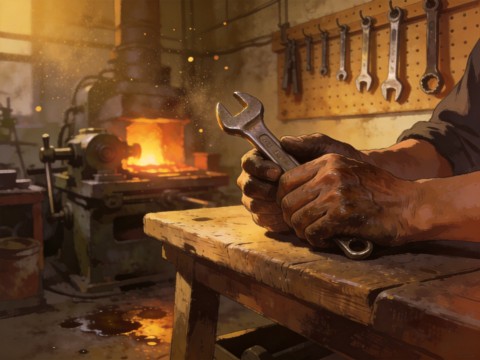
Photo courtesy of the author.
The WrenchLuo Chao © Copyright 2026 by Luo Chao |
Photo courtesy of the author. |
When I was seven, my mother took me to the plant to bring him lunch. I had never seen anything like it. The workshop was enormous, the ceiling so high it disappeared in a haze of steam and welding smoke. Metal clanged against metal. Somewhere a compressor huffed like a tired animal. Rows of lathes and drill press machines stood along the walls, and the floor was slick with oil that caught the fluorescent light in swirling patterns.
My father was standing at a vise, tightening something on a valve assembly. He looked different in the workshop—more focused, somehow bigger. His hands, which at home seemed clumsy when he tried to braid my hair, moved with a kind of confidence I had never seen. He selected a wrench from a row of them hanging on a pegboard, each one a different size, each one worn smooth in the handle from years of use.
"You see this one?" he said, holding up the largest wrench. It was nearly as long as my arm. "I made this. The factory-issued ones kept breaking on the old cast-iron fittings, so I heated a piece of steel in the forge and hammered it out myself. That was 1985. Still works."
He handed it to me. It was heavier than I expected, the steel warm from his hand. I could see the hammer marks on the handle, the metal slightly uneven where he had shaped it. It was the most honest thing I had ever held.
He opened a small drawer in his tool chest and took out something tiny—a miniature wrench, no bigger than my thumb, forged from the same steel. He had made it for me, he said, on his lunch break. I was seven years old and I thought it was the finest thing in the world. I put it in my pocket and carried it everywhere. It went to school with me. It went to the river where we caught minnows. It even went to bed with me, under my pillow.
My father was not a talkative man. He never told me he loved me. He never came to watch me play sports, because there was always a machine that needed fixing at the plant. But he made me a wrench the size of my thumb, and that said everything.
The fertilizer plant closed when I was in high school. The old buildings were torn down and a shopping center went up where they used to stand. My father was fifty-three years old, too young to retire fully, too old to learn a new trade. He took odd jobs—fixing a neighbor's leaky faucet, repairing a broken gate, unclogging a drain. He never charged anyone. When people tried to pay him, he waved them off and said, "It was just a loose fitting. Took five minutes."
After a while, people in the neighborhood started coming to him with things. Old clocks. Bicycles. A widow's sewing machine that had seized up twenty years ago. He fixed them all, slowly, patiently, in the small storage room behind our apartment building that he had converted into a workshop. The room smelled of the same oil and metal I remembered from the plant.
I remember one winter afternoon, an elderly woman from the building next door brought him a sewing machine. It was an old foot-pedal model, painted black with gold flower decals that were half worn off. She said it had belonged to her mother. She wanted to fix it so she could make clothes for her granddaughter, who was starting school in the spring.
My father looked it over, turning the handwheel, checking the tension. The needle was frozen. The belt had rotted through. Some of the internal parts were rusted.
"I can fix it," he said. "Give me two weeks."
He took it completely apart. There were over a hundred pieces, laid out on a towel in order like a surgeon's instruments. He cleaned each one with kerosene, polished the rusted parts with steel wool, replaced the belt with a new one he found at a hardware store across town. He oiled every joint, adjusted the timing, and put it all back together. When he pressed the foot pedal, the needle moved up and down with a smooth, even rhythm.
The woman cried when she saw it. She tried to give him money. He refused. She brought him dumplings instead, which he accepted.
I asked him once why he never charged people. He was wiping his hands on a rag, sitting on a stool in his workshop, surrounded by the tools he had accumulated over a lifetime.
"A machine that isn't running is a waste," he said. "Someone has to fix it. I know how. Why wouldn't I?"
That was the only explanation he ever gave.
My father is seventy-four now. His hands shake a little in the morning, though he would deny it. The storage room workshop is still there, but he spends less time in it. His eyes aren't what they used to be, and the tiny parts of old clocks frustrate him. When neighbors bring him things now, he sometimes asks me to hold the flashlight while he works.
I still have the miniature wrench he made me. It sits on my desk, next to my computer, the steel dark with age. Sometimes I pick it up and turn it over in my hand. I can feel where the hammer marks are, where he heated and shaped and tempered the metal on his lunch break in a factory that no longer exists.
I work as a security guard in a residential compound. I sit in a small booth and watch monitors and open gates for cars. It is not the kind of work that makes things. But every time I pick up that little wrench, I remember what my father's hands looked like when they were moving with confidence, and I think about the machines he fixed and the people he helped and the fact that he never kept a record of any of it. He just saw something broken and made it work again, and that was enough.
Maybe that is the only inheritance that matters.