
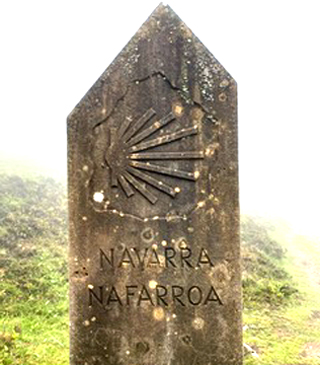
I walked this way ten years ago but could not go the way I wished — Napoleon’s Pass, the higher, harder way — because it was still blocked by snow that late April day and the only way open was the Valcarlos path, Charlemagne’s way across the Pyrenees, the safe way, and I had not come in search of safety. In that moment it was a disappointment and this has rankled, unreasonably, all these years but now I mean to make it right.
In those following years, I walked to Santiago twice again but started at different places. This time, I return to Saint Jean Pied de Port, the ancient town which marks the last stop in France before the path continues across the Pyrenees and on into Spain. This small town is lovely, picturesque and somewhat remote, inland from the Biscay coast, in the foothills of the mountains. Many thousands of people come here each year and most, I believe, stay but one night, then leave the next morning early and on foot and heading decidedly uphill, hoping to make good time over the mountains and on to Roncevalles, walking eight or nine hours, depending on their pace and stride and perhaps depending on their age. I may be the oldest this day, but I like to think I won’t be the last arriving there.
But a morning start means arriving the day before, so the restaurants and cafés do a brisk trade in the evening, and the air is filled with a sense of anticipation and, perhaps for some, a measure of unease for the challenge ahead. It is, after all, a notable thing to cross over a mountain range on foot, and no less remarkable for having done so before. But setting aside any apprehension and distracting myself with more interesting thoughts, I consider that I’m not only crossing a mountain range, I’m also crossing from one country to another, from France into Spain, and even more notable, I’m crossing the Basque Country, a nation manqué, a land which, long ago, contained another dominion, the Kingdom of Navarre, a dominion lost in time.
History speaks of many kingdoms, empires and principalities, but most disappeared long ago and only a few of these linger today in some vestigial form in Spain, Britain, Denmark, the Netherlands, Japan and a few others. These titled realms are quaint aberrations, for the most part harmless, which cannot always be said of today’s royal persons, whose antics sometimes make us wonder how they stubbornly hang on.
When some ancient kingdoms passed into myth they took with them the beliefs and customs linked to their kingships. Kings, in the common imagination, were almost mystical creatures, and even just a few hundred years ago, within the well documented past, there was the persistent belief that the touch of a royal hand could cure an illness. As a little boy in 1712, Samuel Johnson was touched by Queen Anne and this, he said, cured his severe case of scrofula. He certainly believed this and for the rest of his life was a firm Tory and devout Church of England man. And he always wore around his neck the small gold coin English monarchs customarily gave to persons they touched and cured; (we can see Johnson’s coin today at the British Museum.) Similarly, the kings of France, right up to the last one, King Louis XVI, performed the same ritual touch to cure illness, and he would also touch the abdomens of pregnant Frenchwomen to ensure the mother’s health and safe birth of her child, and the most experienced French midwives firmly held this belief. Who could doubt it?
These stray thoughts cross my mind as I cross these hills — real enough terrain, nothing mystical here underfoot — on my way across the Kingdom of Navarre. Today, most people know little about it, but up to the seventeenth century it was, as we now say, a thing. There were kings in this land between France and Spain, straddling the Pyrenees, and there were queens and princes, too. And now and then there might be a princess who could be married off to the king’s advantage, for, as the world knows, dynastic politics did not allow for romantic notions.
Which brings us to Princess Berengaria of Navarre — a mellifluous name, a name from a fairy tale! — but her tale ended badly. She married King Richard the Lionheart in 1191, but the groom, it seems, was not inclined to the company of women. We cannot say this with certainty, and historians of different persuasions dispute the point, but Richard’s coeur de lion may have beat more ardently for other men. As a matter of known record, his union with Berengaria produced no children nor any record of a pregnancy. They had their time together, and she accompanied her new husband part of the way on his voyage to Crusade in the Holy Land, perhaps an unusual honeymoon, but she never conceived a child, thus the idea held by some historians that the union was never consummated. Wounded in battle in 1199, he died in his mother’s arms, not his wife’s, which may tell us something. Queen Berengaria left no trace in the Plantagenet blood line and she was the only Queen of England who never set foot in her realm.
But another prince from her native land began the Bourbon lineage of France. King Henri III of Navarre joined his kingdom to the other when he became King Henri IV of France in 1589. His queen’s three brothers had died in quick succession, leaving their throne vacant, and the Salic law demanded that only the closest male heir could inherit, an opportunity which Henri seized. Some warfare ensued, to be sure, but he made good his claim. It’s a curious thing that one of the greatest kings of France began as a foreigner, and any gloire claimed by his successors had to recognize its debt to the Pyrenees mountains I cross this week.
Another monarch of sorts preceded me here, and this mountain pass still bears his name. Napoleon came this way and he was in a hurry, anxious to recover the failing campaign of French troops under the command of one of his less fortunate marshals. As the world knows, this did not end well. Napoleon’s trumped-up imperium would have lasted far longer if he had kept his armies at home and spared them the disgrace — to say nothing of the slaughter — they met in Spain, and later in Russia. But it takes no philosopher-king to reach this conclusion: would have, could have, should have.
Well, it’s extraordinary how one’s thoughts can wander far afield as one’s footsteps wander across another country. But I’m brought back to the present by the astonishing beauty of the scene before me, the rising road, the cloud-draped valleys promising rain and the promise kept. And then, the peak draws nearer and nearer still, until I am there, at the place I wished to reach ten years ago and finally reach today.
There’s much to be said for goals not yet met and striving to meet them while we can. I very much dislike the expression “bucket list” not least because it’s a cliché built on another before it, but also because it sets limits. Who can deny that a bucket has a bottom and indeed may have a leak where dreams may seep away? I prefer my wishes and undone deeds unlisted, in infinite numbers and, with each one done, I imagine the next.
Espinal - May 16, 2023