The First-Ever Love Story


Ezra Azra


(c) Copyright 2026 by Ezra Azra
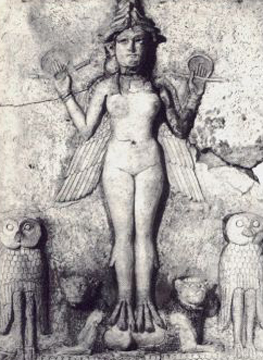
Image of a terracotta relief from the Old Babylonian period (now in the British museum) called the "Burney relief" or "Queen of the Night relief
Image of a terracotta relief from the Old
Babylonian period (now in the British museum) 
called the "Burney relief" or "Queen of the Night" relief

7


Nobody knows why there are so many stories about a person by the name of Lilith in Ancient Mesopotamian religion and secular folklore; nor if her story is fictive or biography.

The only known attempt, so far, to suggest an ethnicity of Lilith, is found in Ancient pre-Biblical Chaldean folklore.

The truly unique two facts about the name Lilith is that, first, so far, in world literature, it is the earliest female named in a story about romantic love, predating by centuries all other stories about romantic love in the ‘Romeo and Juliet’ genre.

Second, in Ancient Mesopotamian-Chaldean times, the name Lilith was the only name of a mortal in a story about true love involving a mortal and an immortal almighty God.

In religion, Ancient Mesopotamia was like modern India in that there were practically countless almighty Gods, female and male, worshipped by mortal humans.

This edition of the Lilith tale begins with one of Ancient Mesopotamia’s practically countless male almighty Gods named Enlil.

Lilith was a young mortal woman who worshipped Enlil. She was one of the acolytes in one of his Synagogues. Enlil fell in love with Lilith.

It is not clear why Enlil fell in love with Lilith. There is nothing special mentioned about her that would attract an almighty God’s attention among the many altar acolytes that served Gods in their Synagogues.

Immortals and mortals entering into romantic partnerships was not unusual in those times in the land of Mesopotamia. In fact, the prevalence of poverty and fatal illnesses in human mortal Communities made such partnerships most welcome among most mortals.

Of course, always, the Deity, female or male, had the upper hand in a romantic partnership with a mortal, female or male. As was to be expected, the almighty Deity did not need to be completely righteous in the partnership.

There are some stories in Mesopotamian folklore of such partnerships ending disastrously for the mortal, and not just because physical contact between almighty spirit deities and mortal life always resulted in the
instantaneous incineration triggered from within the mortal.

Enlil was a most righteous almighty Deity. When he became aware of his romantic desire for the mortal woman named Lilith, he was determined to hide it from her in order to let time reveal if his desire was merely temporary infatuation, as it was in most instances in almighty Deities lusting after mortal beings. This determination was discomforting because as time passed the strength of Lilith’s influence over Enlil grew stronger.

Enlil resorted to the way most popular to Deities when partnerships, romantic and other, with mortals ran into difficulties. That way was the mortal’s dreams while asleep.

Lilith, was an orphan from the earliest she could remember. In this she was the same as the majority of her female acolyte colleague parishioners. She, with other orphan acolytes, lived in rooms on the premises of a Synagogue.

Among the Synagogue’s orphan female acolytes, dreaming about being in a romantic partnership with a Deity was welcomed daytime adventure as it was a fast-asleep-in-bed-at-night adventure.

All thousands of Mesopotamia’s supernatural deities were aware of this, and most exploited the opportunities, sometimes for righteous accomplishments; sometimes for selfish evil ends.

Enlil being a truly righteous almighty spirit Deity, chose to not reveal himself to the mortal woman Lilith because it was a well known fact that in the presence of divinity, mortal being loses all capacity for free choice.

Enlil’s righteous love for Lilith insisted on her independence of responsible free choice in mutual matters. And so Enlil chose to engage Lilith in discussion in dreams while she was asleep.

No act in the infinite universe is as marvelously miraculous as the act of dreaming that is generated within a mortal brain on Earth. No act in the infinite universe; no, not even any most marvelously miraculous act of any almightily everlasting God.
Within dreams of sleep, even almighty divinity has no power to deprive mortal life of the right to freedom of independent responsible choice.

Within dreams of sleep, mortal contact with almighty divinity does not incur the consequence of instantaneous incineration triggered from within the mortal.

Enlil entered the dreams of Lilith many times over many nights because every adult knows that a dream repeated many times is indication that the dream is applicable to real occurrences beyond the dream. Enlil knew Lilith knew this.

In her dream, the same dream repeated many times over many nights, Enlil told Lilith he loved her, and said that if she agreed to marry him, he would leave this world for awhile to search the universe for an algorithm to turn her into an almighty immortal Deity, as he was.

Both of them knew that their marriage was impossible while Lilith was mortal.

It was a complimentary measure of her high rational intelligence that Enlil’s declaration of romantic love for her inspired in Lilith more apprehension than joy.

He told her that since he might be gone for centuries in Earth time, he had planted a magical Garden for her in a place he had named Eden. As long as she lived in that Garden, and ate the fruit therein, she would not age. When she found the Garden and entered it, he would begin his search beyond Earth for the algorithm.

Lilith found Eden. It was bordered by four mighty rivers, each as deep as an ocean. Before she crossed over into Eden, she planted fruit trees on the banks of the four rivers. Those trees outside of Eden would be how she would keep track of Earth time while Enlil was on his intergalactic search for an algorithm.

By heavenly time, it was less than a year before Enlil returned with the ingredient that turned Lilith into an immortal Deity.

On Earth, ten thousand centuries had passed. Enlil and Lilith were married, and they live happily ever after in Eden, eternally youthful.

By the time Enlil returned, all of the Ancient Mesopotamian Deities had abandoned Earth. Enlil and Lilith were careful to not be a part of any religion of worshippers, mortal and other.

Enlil and Lilith live to preserve perfect Eden, a mission that has to include keeping Eden hidden from all mortals; and, particularly, from all of Earth’s new Deities.


Contact Ezra
(Unless you type the author's name
in the subject line of the message
we won't know where to send it.)
Ezra's Story list and biography

Book Case

Home Page

The Preservation Foundation, Inc., A Nonprofit Book Publisher