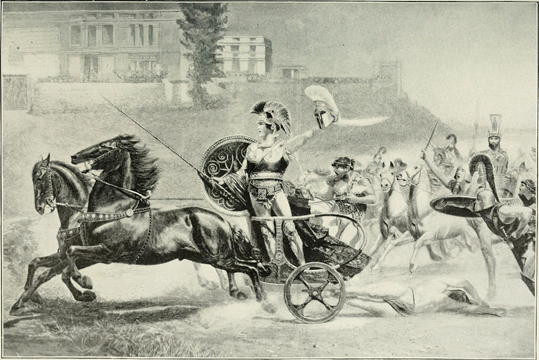
Achilles drags body of Hector around the walls of Troy courtesy of Wikimedia
Commons.
The
war between Greece, and Troy, is in year nine. The war will end next
year, with Troy's defeat. The Gods are taking sides. The war is not
going well for Troy.
Prince
Hector, greatest warrior of Troy, and eldest son of King Priam, has
fallen on the battlefield. It has been claimed that Hector killed at
least 31,000 Greek soldiers in 9 years. No soldier in recorded
history has equaled that record.
Poseidon,
the God who built the walls of Troy to stand forever, is almightily
displeased because Prince Hector was deprived a noble warrior's
honorable death.
Instead,
the other Gods allowed Achilles, greatest Greek warrior, to cowardly
assassinate Prince Hector while Prince Hector rested, unarmed and out
of armor, on the battlefield.
The
other Gods allowed Achilles to desecrate Prince Hector's body by
tying it to a horse and dragging it seven times around the City walls
of Troy.
The
King of Gods, almighty Zeus, has called a Conference of all the Gods,
to have the war discussed.
The
Gods enter from different directions.
Aphrodite
and Ares enter, locked in a furious sword battle. Other Gods have to
hastily step out of the way.
Apollo:
(Narrowly evading the fighters.) What is this, then? A metaphor for
sex?
Poseidon:
With those two, it probably is sex.
Apollo:
Well, better metaphor than a substitute, I say.
Poseidon:
With those two, why not both? (Chuckles among nearby Gods.)
Atropos:
(Stage-whispering to Clotho.) Eventually, they marry!
Clotho:
Easy to believe. Eventually, all marriages resort to such play: fore,
middle, and after.
Lachesis:
I heard the reason for their such foreplay. (Atropos and Clotho look
at her and speak in unison.)
Atropos
and Clotho: Do
let us in.
Lachesis:
She wants to have his baby; he's not keen.
Atropos:
Makes sense.
Clotho
and Lachesis:
(In unison, looking at
her.) Huh?
Atropos:
Vasectomy.
Clotho
and Lachesis:
(In unison.) You cannot
know that.
Atropos:
I and his surgeon, golf every Sunday.
Clotho:
Golf with his surgeon? Hah! Sounds to me a metaphor for sex.
(Atropos
winks at Apollo. Apollo gives her a thumbs-up permission to use his
words. She sends her thank-you to him by a wink through a thumb-index
finger circle gesture.)
Lachesis:
She surely wouldn't marry him if that vasectomy were fact.
Atropos:
If he had told her.
Clotho:
Yikes! Why would vasectomy guy marry her when everybody knows she is
a baby factory for so many others? Most likely every male here's been
her daddy once. At least.
Lachesis:
The attraction for him, then, could not have been a first-time thing.
Atropos:
Why not? She's a God.
With us Gods any
time can be engineered to be a first time.
(Apollo
has wormed his way to where they are. He stage-whispers to them.)
Apollo:
Care to hear my spiteful gossip?
Atropos
and Clotho and Lachesis: (In
unison.)
Apollo, best of Gods, to you we are all ears.
Apollo:
My sources tell me they have tried and tried so mightily for
pregnancy. All have failed.
(He
pauses as they struggle to be dignified in their suppressed evil
laughter.)
Apollo:
We have to get to know each other. Clotho? Right? (She nods coyly.)
Lachesis:
Apollo? Sweet Apollo? I am Lachesis. The younger sister to old
Clotho there.
Atropos:
By only seconds, sweet Apollo. We're
triplets. I'm the first. In every way I always come first. You get
my drift, good God?
Apollo:
Your drift is ever my anticipation, darling Atropos. Please drift
towards me whenever you please. You lovely ladies, reason God good
Ares has no children is because---.
(He
leans in and gestures them to lean in, too. They quickly and eagerly
jostle to lean in. He continues in a whisper.)
Great
Ares, God of war, has a low semen count.
(Clotho
looks at him, vacantly. Lachesis, in drop-jawed wide-eyed amazement,
looks at the audience, and mouths in pretend horror, "No!")
Atropos:
So, little, little sisters, what that means is almighty Ares, God of
war, is barren. (She smiles at Apollo. He mouths at her an
exaggerated "I love you.")
Lachesis:
That's so a private matter. How could you-----?
Apollo:
(Interrupting.) Sundays golf with his surgeon.
(Looks
at Atropos. She beams approval and blows him a kiss.)
Another
rumour is, God Aphrodite has suspicions, but God Ares won't submit to
testing.
Atropos:
You have impressive sources, sweet Apollo.
Apollo:
Only since I'm liberal with favors, Atropos, my sweet.
(Aphrodite
and Ares stop fighting. They back away warily from each other. They
take up opposite positions.)
Atropos:
(Smiling.) I have a favour to
request, great
God.
Apollo:
It's granted. Come into my arbor when this Conference is done, and
we will talk it over, over again.
(She
beckons him come closer; he promptly does. She whispers in his ear.)
Atropos:Please help
Princess Cassandra of Troy.
(He reacts in
disappointment and puzzlement.)
Apollo:
I'd love to help Princess Cassandra of Troy. I offered her a God's
eternal love---
(The
three Fates interrupt him in unison.)
Atropos
and Clotho and Lachesis:
We know.
Apollo:
I even offered for her mortal love I'd fight for Troy. She yet
refuses me! A God!
Atropos
and Clotho and Lachesis:
We know.
Apollo:
Then how else can I give her "help?"
Atropos:
She has a plan.
Apollo:
What plan?
Atropos:
Let us discuss it in your arbor, sweet Apollo, over, over again.
Clotho
and Lachesis:
The two of us there,
too.
Apollo:
The more the merrier.
Poseidon:
(Stentoriously.) Almighty Zeus approaches.
(Zeus
approaches ostentatiously from the auditorium, in loud fanfare. He
steps onto the stage, and ceremoniously turns to face the audience.)
Zeus:
You denizens of Eternity, I welcome you. We're here today because
Poseidon requested it. Poseidon. (Poseidon steps forward.)
Poseidon:
Your majesty, I give you thanks.(Addresses all.)
We
have a crisis, generated by ignoble actions by a few of us.
(Murmurings.)
I
built the walls of Troy for righteous life to find safe harbor as it
flourishes onward higher. Over a thousand years this purpose held. A
happy noble Nation, the people of Troy, near-perfect as no other. But
now threatened by the evil of a God.
(Poseidon
points aggressively at Aphrodite.)
God
Aphrodite there abetted Paris, Prince of Troy, to steal Helen, the
wife of Menelaus, King of Greek Sparta.
Evil
Paris and unrighteous Helen, now defile my Troy. My righteous walls
begin to tremble.
But
yet those walls stood firm because Prince Hector, elder brother of
evil Paris, urged "Let Helen Go."
Now
that the righteous Hector has been murdered by that dastard coward,
Greek Achilles, on the battlefield, the walls of Troy must fall.
(General
murmur of disappointment among the Gods.)
There
is no doubt the murder of the heir of Troy was engineered by some God
here.(Turns to Zeus.) I beg your majesty, the culprit be exposed and
punished.
(Bows
to Zeus, and steps back to his place. Aphrodite steps forward. She
curtsies to Zeus for permission to speak. Zeus gestures her
permission.)
Aphrodite:
Almighty Zeus, my thanks.
(Addresses
all.) I'm not responsible for deeds enacted by Prince Paris. I
merely gave him opportunity to exercise free will.
We're
all aware of how aggressive humans are about their right to freely
choose. I showed him Helen, Queen of Sparta. Both she and he, in
mutual freedom, chose to flee to Troy, abandoning her husband,
Menelaus, King of Sparta, and their children.
Venerable
Poseidon, all we Gods know that righteousness and evil to almighty
Beings as we, are merely as two different fruit; neither an
obligatory choice.
If
Paris, Prince, and Helen, Queen, have earned punishment from us, then
there are many in this awesome congregation, dallied and are
dallying, unrighteously with humans; they, as well, have earned, are
earning, punishment from us. Including you, almighty Zeus, meaning no
disrespect, your most excellent majesty.
(She
bows her head slightly to Zeus. He graciously acknowledges her
allegation. She addresses Poseidon.)
Good
God, Poseidon, I'm sorry your beloved Troy's in peril from within as
well as from without, but I remind you, Good Poseidon, we're here
forever long before we ill-advisedly created humans for our casual
random pleasures.
Always
remember, almighty Poseidon, humans are always mere minor
disposables. It is ungodlike shameful weakness when we take them
seriously. I know, because I have been guilty of that shame more
times than I care to admit.
(She
bows to Zeus before stepping back into her place. Apollo steps
forward. He looks at Zeus for permission. Zeus acknowledges him.)
Apollo:
Three cheers to you, Poseidon, for giving greatness to this
imperfect, mostly ugly, mostly evil, City of Troy, these many, many
centuries.
You
speak the truth that Hector was most righteous in proposing Troy "Let
Helen Go." But, Lord Poseidon, that's all it was. A mere
lip-level proposal, far from a noble brain.
Otherwise
great and righteous Hector failed. He easily and readily surrendered
to misguided blusterings of Trojan honour from his younger brother,
Troilus.
Troilus
who, while ostentatiously posturing about Troy's honour,
simultaneously himself engages in a demeaning love affair with fickle
Lady Cressida, a Commoner. He and his lady are as shameful and
disgraceful as Greek Helen.
I
unconditionally spurn, condemn, the cowardice that killed Prince
Hector. But, good God Poseidon, Prince Hector, too, himself was
coward to the natural Trojan righteousness when resolution in him
failed in his "Let Helen Go."
Hence,
surely, too, it was the shameful evil cowardice within him had a
share in bringing on his shameful death; and, sooner or later, the
downfall of Troy.
And
let us not forget, that Priam, King of Troy, himself did not support
his heir's "Let Helen Go."
I'm
sorry, God Poseidon, that the evil moral rot in Troy is too far gone
from your original intended purpose for the walls you built.
It's
my belief there is no righteous power in the Universe can save Troy
from the annihilation it has brought down on itself.
(Bows
his head to Zeus, before stepping back. Ares steps forward. Bows to
Zeus for permission. Zeus grants it.)
Ares:
This talk of righteousness and evil is irrelevant. As it's been
stated, we created Human creatures to be our toys. But forasmuch we
held them in our hands in making them, they have in them some
epithelial dustings of divinity. And so sometimes they, unavoidably,
show sparks they have potential to be Gods.
That
God among us spoke truthfully who said to Humans, 'It is written, ye
are Gods.'
But,
sadly, that potential's never proven to be more than mere potential,
guaranteed it will implode, eventually. Today it's Trojans. After
them there'll be Egyptians, Hindus, Macedonians, Medes, Mongolians,
Persians, British, Soviets, Americans.
These
Humans make me sick! Haec
ballio homines
male
me!
While
talking righteousness, there's nothing they love more than
hating-killing one another. The only creed that's universal in all of
them throughout their different histories, is the despicable Omne
pulchrum est in amore et bellum.
I
propose we Gods take sides and fight this war until there are no
Trojans and no Greeks alive to----
(Atropos,
Clotho and Lachesis creep up from behind. They force a sack over his
head. They drag him offstage, as he screams and struggles inside the
sack. Aphrodite moves with half an intention to help Ares, but
Atropos throws her a malevolent look makes Aphrodite step back before
turning and fleeing. Blackout. All exit in the blackout. Spotlight on
Zeus. Another spotlight on Hecate. Hecate is bewildered. She is
dressed in black.)
Zeus:
My lovely Hecate. You oblige me bring you here because you weren't
among us at the Conference.
Hecate:
My absence, mighty Zeus, was not in disrespect.
Zeus:
I don't allow what deeds might even seem to be, dear soul.
Hecate:
The pain of my regret for disappointing you, almighty Zeus, be with
me for eternity.
Zeus:
Most certainly it will.
(He
stretches out a hand towards her. She collapses to the ground, and
screams and writhes in pain. He lowers his hand. Her writhing and
screaming stop. She continues to show signs of pain.)
Now
share with me the reason for your absence, dear Hecate.
Hecate:
Great Zeus, I chose to spare myself hypocrisy by Gods. I see now I
was wrong. I should have chosen to endure to hear and see the
posturings, instead of risking seeming disrespect of you, good God.
Zeus:
As someone at the Conference observed, it's neither here nor there
what Gods decide to be. Almightiness exempts a God from obligations
and responsibilities.
Hecate:
I know, your majesty. And long before the time of Humans, I
chose
to be evil all the time. I am predictable. It's simplified my life.
More peaceful most of times, because the vast majority of Humans
choose to not have anything to do with me. I say good riddance. Worse
than their own sewage vermin is Humanity.
Zeus:
Of course I've known about your choice to be evil, but this is the
first time I am hearing it's your only choice forever.
Hecate:
Mortal life needs righteousness to triumph over evil. Human
imperfection's not the problem, Zeus, my Lord.
All
evil in the Universe is from Gods almighty using their almightiness
to either champion evil or allow it happen triumphant over
righteousness.
That
God who disembowelled good Orpheus.
That
God delighted in the shameful killing of Hippolytus.
That
God who pridefully declared, 'A lying spirit in his mouth I'll be';
'I'll bring an evil on his house'; 'Against thee I will raise up
evil.'
That
God of whom it was observed 'an evil spirit from his God did trouble
him.'
That
God gave Satan leave to persecute all-righteous Job.
(Spotlights
begin to fade, the one on Zeus, faster.)
I
am
the
source
of
universal energy
that
Gods and Humans
choose
to label Evil;
that
concomitant of life.
Wherever
there is life,
there
comes to being,
and
only there,
there
comes to being,
the
sentience
named
Evil:
(Spotlight
off Zeus. He remains onstage in the dark.)
That
truthful Snake
essential
to perfecting
Eden's
righteousness.
That
shellfish makes
its
priceless pearl
in
trying to protect
itself
from just one single
speck
of filth.
Alone,
and all alone,
that
righteous deed
inclusive
of my presence
is
the only truth
can
alchemize
into
an energy
produces
life
its
highest;
its
most beautiful.
I
am
the
necessary healthy
shadow
company
of
all reality
in
brightest sun-resplendent day.
(Blackout.
Dim spotlight comes up. Apollo enters into the light and addresses
the audience, reverentially.)
Apollo:
Prince Hector
was dishonorably killed. Almighty Zeus, my Father, granted my
request.
Prince
Hector’s mortal soul, freed from its mortal body, needs one
cycle of the Earth around the Sun to break away from this imperfect
world in order to become eternal in infinity. Before Prince Hector's
soul begins its journey through eternal glory, I will make certain
that the soul of cowardly Achilles will begin its journey, too; in an
opposite accursed direction into eternal nothingness.
(The
dimness instantly extends over the whole stage. The three Fates burst
in, masked. They surround Apollo. As they speak, they dance
aggressively against him. There can be music accompaniment. At first,
Apollo wins a few times. Gradually, they win more and more. A few
times he tries to flee, but they spell-prevent and spell-drag him
back.)
Apollo:
Who are you?
Fates:
(In unison.) Who are you?
Apollo:
I'm God, Apollo, Son of Zeus, almighty King of Gods. Get out, or
else---
Fates:
(In unison.) Or else naught you can do, Apollo, God, a Son of Zeus
almighty God.
Atropos:
We are the Fates. Apollo, God!
Clotho:
Were here before you Gods. Apollo, God!
Lachesis:
Will be here when you Gods have faded away into eternal hell! Apollo,
God!
Atropos:
We know full well just who you are. Apollo, God!
Clotho:
You shewed us in
your arbor, who you
are. Apollo, God!
Lachesis:
Over and over and over again, you shewed us who you are. Apollo,
God!
Apollo:
So many in my arbor so many, many times. I choose to not remember. I
am God. Apollo, God, a Son of Zeus, almighty King of Gods.
Atropos:
And this is good. Apollo, God!
Clotho:
Is good because it makes it easier to do what we are here to do.
Apollo, God!
Lachesis:
We're here to see you do not rip into Trojan Princess Cassandra as
you did into so many other women. Apollo, God!
Fates:
(In unison.) Do
come into my parlour,
said the spider to the fly; come into my arbor said Apollo on the
sly.
Apollo:
Out of my way!
(He
attacks, breaks free and flees, exits. They dash after him,
shrieking. Blackout.)
Troy
fell to the Greeks,
eventually. According to the Roman poet,
Virgil, that fall was temporary.
A
Trojan refugee, Aeneas, founded Rome on the banks of the river
Rubicon. Rome, the resurrected Troy, conquered Greece, and built an
empire lasted over a thousand years; like Troy.
Trojan
God Poseidon got revenge on Helen, eventually:
“He
sent a monster in the sea.
And
while she frolicked nakedly,
The
monster chomped her greedily,
But
upchucked her disgustedly
Because
she tasted bitterly. She
died alone in filth and agony.”
~The End~
Contact
Ezra (Unless
you
type
the
author's name in
the subject
line
of the message we
won't know where to send it.)