Youcai Luo
© Copyright 2026 Youcai Luo
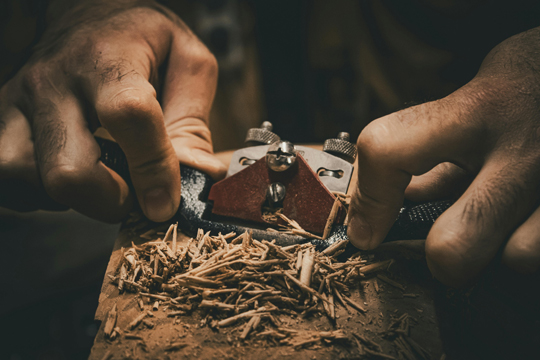
Photo by Gizem Toprak at Pexels.
| My Grandfather's Workshop Youcai Luo © Copyright 2026 Youcai Luo |
Photo by Gizem Toprak at Pexels. |
The blade was dull that day—intentionally, I suspect. He knelt beside me on the workshop floor, his calloused hand guiding mine along the wooden body of the tool. "Feel that?" he said. "This is how the wood talks back."
The wood did talk. A soft whisper of shavings curling upward, the scent of something green and alive filling my nose. My grandfather smiled, not at me, but at the bench where a rough oak plank was slowly becoming something else.
His workshop smelled like sawdust and tea gone cold. It occupied the back room of his house, a space barely bigger than a closet, yet somehow infinite. The walls were lined with hand tools—chisels, saws, planes, and a few things I couldn't name—that had been his father's and his father's father before that. Their handles gleamed amber from decades of palm oil and use.
My grandfather worked in the small town of Huanghu, where time moved slower than the carp in the pond behind the school. He built furniture for neighbors: tables for wedding banquets, coffins for the elderly (though he'd stopped taking those orders years ago, saying his hands weren't as steady as they used to be). He never advertised. People simply came, described what they needed, and came back weeks later to find it finished.
Every afternoon after school, I'd pedal my bike to his place. The gate always creaked the same way—once, quick, like a question—and I'd hear him humming something tuneless inside. Sometimes he'd be at the bench, sawdust settling on his shoulders like early snow. Sometimes he'd be reading the newspaper, glasses perched on his nose, tea steaming beside him.
He never seemed rushed. Ever.
"You want to learn?" he asked me once, when I was maybe eight or nine, standing in the doorway watching him joint a board.
I nodded.
"Then sit."
He pulled up a small stool—the kind he'd made years ago for his own children—and indicated I should join him at the workbench. The wood beneath my palms was smooth, almost warm. It felt alive in a way I couldn't articulate then and still can't now.
My grandfather worked slowly. Each stroke of the plane deliberate. Each cut measured twice before he committed. I'd watch shavings peel off like ribbons, curling into golden piles on the floor. He didn't talk much while he worked. When I asked him questions, he'd answer briefly, then return to whatever he was doing.
"The secret," he told me once, "is patience. The wood knows if you're hurried. It will fight you."
I didn't understand what he meant then. I thought he was just talking about carpentry.
When I turned fifteen, my parents moved us to a bigger city. Two hours away by train, though it felt like a different world entirely. The apartment was small, the neighbors noisy, the pace of everything frantic by comparison.
I visited my grandfather less often. Then, at nineteen, I went abroad for university, and the visits became phone calls, then emails, then occasional messages during holidays.
He was still in his workshop when we spoke. Still making things with his hands. The house had changed—electricity now, and a proper stove—but the smell of sawdust remained.
"You should come visit soon," he said during one of our calls. "I have something to show you."
I never made the trip. There was always something: exams, then jobs, then the exhausting machinery of adulthood grinding forward.
The job fell apart on a Tuesday.
I say "fell apart," but really it had been dying slowly for months. A project I'd poured myself into, cancelled. A promotion I'd been promised, given to someone else. My boss called me into his office—glass walls, motivational posters behind him—and explained, with the practiced gentleness of someone delivering bad news, that my position was being "restructured."
Restructured. The corporate euphemism for "you're out."
I drove home in silence. Sat in my apartment staring at the wall. The radiator ticked and groaned.
The rejection emails started arriving around the same time. I'd been writing—stories, essays, things I hoped might matter—and collecting rejections in a folder on my desktop. The folder grew. The rejections accumulated. Form letters and polite declines and sometimes nothing at all, just silence.
I stopped sleeping well. Stopped cooking. Subsisted on takeout and a vague sense of failure that settled over my days like fog.
My girlfriend at the time—I think she was still my girlfriend then—tried to help.
"You're being too hard on yourself," she said.
"You don't understand," I said. The teenage certainty in my own victimhood still embarrassing to recall.
She understood enough to leave, eventually. I couldn't blame her. I'd become someone who sat in the dark scrolling through job listings, sending applications into voids, waiting for the next rejection to arrive.
One night, unable to sleep, I started digging through old photos on my laptop. Old folders, backups, things I'd forgotten existed.
There it was: a picture of me at seven, standing in my grandfather's workshop. Grainy, overexposed, but clear enough to see the sawdust in the air, the tools on the wall, my grandfather's hand on my shoulder.
I stared at that photo for a long time.
What was it he'd said? About wood?
I couldn't remember the exact words. But I remembered the feeling: the calm in that small room, the deliberate pace of everything, the way he seemed so certain of what he was doing.
"Lumber has its own temperament," I thought he might have said. "You can't rush it. If you rush, you'll split it wrong."
Was that right? Something like that.
I closed the laptop and lay in the dark. The radiator ticked.
I called him the next morning. It was evening there, his time.
"Grandfather," I said. "Do you remember teaching me to use the plane?"
A pause. I could hear the television in the background—some historical drama, the kind he liked.
"Of course," he said. "You were a terrible student. Too impatient."
"Thanks for that."
He laughed. A low, quiet sound.
"What do you need?" he asked.
I told him about the job. The rejections. The fog that had settled over everything. He listened without interrupting. When I finished, he was quiet for a moment.
"Do you remember," he said, "what I told you about the wood?"
I almost laughed. "Something about not rushing."
"Yes. Lumber has its own temperament. You cannot be impatient. If you are impatient, you will split it wrong, and then the piece is ruined. Maybe you can fix it. Maybe not. But it is never the same."
"Okay."
"You are like the wood now," he said. "You are being rushed. You are being split wrong."
I didn't know what to say.
"Slow down," he said. "Do one thing at a time. Finish it. Then go to the next."
"That's it?"
"You want a complicated answer?"
I smiled despite myself. "No. I guess I don't."
"Good. I have to go. The show is starting."
He hung up.
I didn't change overnight. That's not how these things work.
But I started paying attention to the pace of my days. Noticing when I was rushing, when I was splitting myself wrong. It happened more often than I realized—three things half-done, none of them right, all of them bleeding into each other.
I made a list. Actual paper, actual pen. Tasks for the day, no more than three. I wrote them down. I crossed them off, one by one.
I stopped applying to everything. Started applying to fewer things, things I actually wanted. The rejection folder stopped growing.
The writing was harder. But I tried his approach: one piece at a time, no rushing. I'd start something, and if it wasn't working, I'd set it aside rather than force it. Come back later. Or not. Either way, I wasn't forcing wood to bend against its grain.
Some days were still bad. I'd lie on the couch staring at the ceiling, wondering if I'd made a terrible mistake, if I was fooling myself, if I was just another mediocrity waiting to be discovered. The doubts didn't go away. I just got better at sitting with them.
Three months later, a small literary magazine accepted one of my essays. Not a major publication. Not the New Yorker. But a real magazine, with real editors, who said they liked the piece.
I called my grandfather.
"I got something published."
A long pause. I could hear the television again.
"That's good," he said. "Did you rush to finish it?"
"No."
"Then you did it right."
He asked about my work, whether I'd found something. I told him I was temping, doing odd jobs, but things were stabilizing. He seemed satisfied with this.
"Grandfather," I said, "how did you know? That something was right, I mean. How did you know when a piece was finished?"
He was quiet for so long I thought the call had dropped.
"You feel it," he finally said. "The wood tells you. It has a weight, a balance. When it is right, you know. When it is not, you keep working."
"And if you never get there?"
"Then you keep working," he said. "That is the craft."
I visited him the following spring.
The workshop was smaller than I remembered. Or maybe I had grown larger. The tools were the same—the planes, the chisels, the saws with their worn wooden handles—but the room itself seemed to have contracted.
He was at the bench when I arrived, working on something. I stood in the doorway and watched.
His movements were slower now. More deliberate. But still precise, still sure. Shavings curled upward. The scent of sawdust filled the room.
"Come in," he said without turning. "You're letting the heat out."
I sat on the small stool he'd made decades ago. Still sturdy. Still smooth.
"You still have this," I said.
"Of course. I made it to last."
He finished his cut, set down the saw, and turned to face me.
"You're looking better," he said.
"Thanks."
"You were looking troubled before. On the phone."
"I was."
"And now?"
I thought about it. The temp job had become permanent. The essay had led to another, then another. The rejection folder remained, but smaller now, and somehow less important.
"Better," I said.
He nodded and picked up his tea. Took a sip. Made a face.
"Cold," he said.
I laughed. He smiled.
We sat in the workshop for a while, not talking. The tools on the walls caught the light. Outside, somewhere, a dog barked. The afternoon moved slowly, the way afternoons should.
I returned to my own city. Back to work, to writing, to the endless negotiation of adult life.
But something had shifted. Not a revelation. Not a transformation. Just a small recalibration, the way a craftsman adjusts a plane before the first cut.
Some days I still rush. Still split things wrong. Still lie on the couch wondering about the path not taken. But I try to remember: one thing at a time. Finish it. Then go to the next.
The wood has its own temperament. You have to listen.
I think about that workshop often. The light through the windows. The dust in the air. My grandfather at the bench, humming something tuneless, taking his time.
I called him last week. He was in the workshop, of course. Working on a cabinet for a neighbor's daughter—her wedding is in the fall. He grumbled about the wood being stubborn, then spent ten minutes telling me about the grain pattern like it was the most fascinating thing in the world.
I didn't mind. I could hear the shavings falling in the background, the familiar rhythm of his work.
What I hold onto is simpler than any lesson: the smell of sawdust. The curl of shavings. The patience of hands that know their work.
Some mornings, when the light is right and the day is quiet, I can almost hear him saying it again:
You cannot rush the wood. You can only work with it, and let it become what it was always meant to be.