One Borrowed Sentence Across The Strait
Yoshitaka Morita
© Copyright 2026 by Yoshitaka Morita

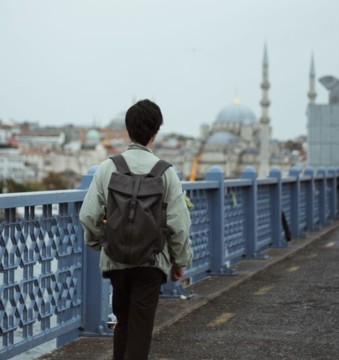
Photo by hicret at Pexels.
One Borrowed Sentence Across The StraitYoshitaka Morita © Copyright 2026 by Yoshitaka Morita |
Photo by hicret at Pexels. |
1. The Midnight Headset and a Ticket Above the Clouds
In the spring of 2015, I submitted a one-year leave of absence form to my university in Tokyo, bought a single backpack with the money I had saved working the graveyard shift at a call center, and left Japan. I was twenty-two years old. At the time, I did not smoke, nor was I taking antidepressants, yet somewhere deep inside me the gears connecting my mind and my body had slipped out of alignment. For months on end, I had been unable to get out of my futon until past noon, staring at the ceiling of my small room.
Looking back, the quiet fracture had begun four years earlier, at the end of March 2011, when I first left my hometown of Gonohe in Aomori Prefecture at the northern tip of Japan's main island. Just days after I graduated from high school and learned that I had been accepted into the Spanish Department at Tokyo University of Foreign Studies, the Great East Japan Earthquake struck the northeast coast. The tracks and overhead power poles of the Tohoku Shinkansen bullet train were bent and broken in dozens of places. With the railways severed, I boarded an emergency flight from Aomori and flew south to Tokyo, looking down through gaps in the heavy clouds at the scarred coastline of northern Japan.
In Gonohe, the small inland town where I grew up, people called the biting cold of winter tap water "shakkoyi," and when frozen fingers finally thawed in front of a stove, we called it "nugudamaru." It was a dialect known as Nanbu-ben, spoken without opening the mouth very wide, where vowels drifted close together in the back of the throat and the last third of a verb was softly swallowed before it reached the cold air. Having spent eighteen years inside the warm, abbreviated rhythm of that northern speech, I found the dry concrete air of Tokyo and the long daily commute on packed trains heavier than I had ever imagined. At the university, I enrolled not only in my major of Spanish, but also in French, Italian, classical Latin, ancient Greek, and even Yiddish. Sitting at a desk and piecing together unfamiliar alphabets and grammatical rules like a quiet puzzle was the one thing that still brought me genuine pleasure. Yet my body could not keep pace with the sudden change in environment. Little by little, my feet stopped carrying me to the daytime classrooms.
The only place I managed to attend with clockwork regularity was a part-time job I had started around 2013 on the night shift of an international English call center. Sitting on a windowless floor of an office building in central Tokyo, I wore a headset with black foam ear pads and spent the hours from midnight until dawn answering phone calls that arrived from across time zones. On the monitor in front of me sat rows of small rectangular boxes—categories designed to classify every human problem into a neat administrative code. No matter how anxious or exhausted the voice on the other end of the line sounded, my role as a clerk was to listen to their English, click the appropriate box on the screen, and file a concise record into the system before the next call chimed.
After processing dozens of faceless voices night after night, a strange habit settled into my ears. I became acutely sensitive to the slightest tremor or intake of breath in a stranger's voice, even as the texture of my own daily life grew thinner and more transparent. Meanwhile, the night-shift wages accumulated quietly in my bankbook. One morning, I decided to withdraw all of that money and step away from both my room and the glowing monitor. When I told my parents back in Aomori that I was taking a year off from school to travel around the world alone, neither my father nor my mother raised a single objection. They simply listened and sent me off.
2. Two Kilometers of Water
To be completely honest, the first several weeks of the journey felt less like an adventure and more like carrying the heavy air of my Tokyo room around the world inside my backpack. I flew from Japan to Thailand, and from there traveled through Dubai and Bahrain into Turkey. Even when I stood in front of famous mosques or ancient stone ruins, I could not shake the sensation that a thin pane of clear glass was wedged between my eyes and the landscape. Every morning, waking up on a hard mattress in a cheap hostel, I looked at the unfamiliar white ceiling and wondered why I had come all this way just to feel the same weight.
The first real crack in that pane of glass appeared when I boarded a small ferry on the western coast of Turkey and crossed over to the Greek island of Samos, at the eastern edge of the Aegean Sea. As anyone who opens a map of the region will immediately notice, although Samos is Greek territory, it lies far closer to the Turkish mainland than to Athens. At the narrowest point of the Mycale Strait, less than two kilometers of dark blue water separate the island from the Turkish hills across the channel. On a clear afternoon, you can stand on the shore of Samos and make out the shadows of buildings and the green slopes of trees on the other side with the naked eye.
The year 2015 was the year that this narrow ribbon of water became the center of global news reports. People fleeing the civil war in Syria and turmoil across the Middle East were pushing off from the Turkish coast in rubber dinghies and small wooden boats, risking their lives to reach the Greek islands—the first threshold of Europe. As I later learned from United Nations statistics, roughly eight hundred and fifty thousand people crossed the Aegean into Greece during that single year. At the time, of course, I had no clear grasp of the historical scale of the numbers surrounding me, nor do I have any memory of witnessing the sort of dramatic chaos at European train stations or border crossings that television broadcasts often emphasized. What I actually saw, both in the port town of Samos and later at the harbors on the Greek mainland, was much quieter: groups of Syrian people who had just finished crossing the sea, sitting along the stone quays with salt-stained bags at their feet, waiting in the sun for registration procedures or the next ferry.
3. Four Words Borrowed from a War Photographer
One afternoon, while walking near the harbor on Samos, my path took me right past a group of young Syrian men resting against a low wall. Some were sitting directly on the sun-baked cobblestones; others leaned against the stone, their eyes scanning the street with taut vigilance. As I approached—a twenty-two-year-old East Asian traveler carrying a backpack—several of the men looked toward me. Their expressions hardened into cold, unmistakable hostility, making it clear that strangers were not welcome.
To their eyes, I must have looked like an insensitive tourist who had come to gawk at other people's hardship, or perhaps a foreign journalist about to raise a camera lens without asking permission. A few sharp words in Arabic passed among them, and an invisible wall rose up between us in the middle of the street.
I could easily have lowered my gaze to my shoes and walked past. Under normal circumstances, that is almost certainly what I would have done. Yet in that moment, before my mind could calculate a response, a string of sounds slipped out of my mouth almost on its own.
"As-salamu alaykum, ana Yabani."
Peace be upon you; I am Japanese. It was not the Spanish I had studied in university classrooms, nor was it the English I had spoken into my headset every night in Tokyo. Months earlier, back in Japan, I had happened to watch an episode of an NHK educational television program on Arabic. A war photographer appearing as a guest on the show had explained that whenever he entered a tense street in the Middle East, he always spoke this single sentence first to state who he was and to show respect. Without my realizing it, my ears had stored away the exact cadence of his voice. I could not read the Arabic script, and I knew nothing of its verb conjugations. Relying solely on the rise and fall of the long vowels—just as I had imitated the adults around me speaking Nanbu dialect in Gonohe as a boy—I placed those four borrowed words into the dry sea breeze.
For a second, nobody moved. Then, with startling speed, the sharpness drained from the faces of the young men who had been glaring at me. What spread across their cheeks instead was a quiet, unforgettable smile—a smile in which the sudden relief of a taut string coming unknotted was blended inseparably with the bone-deep exhaustion of their long crossing.
"Japanese?" the young man closest to me asked, switching into English.
When I nodded, the same soft smile rippled across the faces of his companions. From that point on, both there on Samos and later when I met other Syrian arrivals on the Greek mainland, what followed was an ordinary conversation in English—so ordinary that it almost caught me off guard. We talked about where in Japan I had come from, where I was heading next, and how the journey had been so far. Simply speaking those four words of Arabic recognized them not as a spectacle, but as interlocutors, and the tension between strangers vanished. Unlike the English I had heard through the black foam pads of my headset in a windowless Tokyo building, the English we exchanged beside the Aegean carried the smell of salt water and the warmth of living voices.
4. Smartphone Screens and Moroccan Steam
What struck me more deeply than anything else as we stood talking was a simple, everyday detail: every single one of them reached into his pocket, pulled out a smartphone, and looked at the screen in the exact same way I did. Television news anchors and newspaper headlines tended to compress people who crossed the sea into a single vast column labeled "Refugees," portraying them as beings from another world who had lost every trace of ordinary life. Yet the young men laughing at my halting Arabic pronunciation, holding their smartphones in their hands, and speaking with me in casual English were no different from my friends or me looking at our phones on a street corner in Tokyo or Aomori.
After leaving Greece, my route wound northward by bus and train through Bulgaria, Romania, Hungary, the Czech Republic, and Poland, before turning south across the Mediterranean to Morocco and Spain, passing through Britain, and finally looping back through Thailand and Laos before returning to Japan—fifteen countries in all. Strange as it seemed, once I crossed into the second half of that long arc, the leaden heaviness that had dragged at my heels since Tokyo began to lift.
Above all, the overwhelming sense of another world that greeted me when I stepped into the streets of Morocco, together with the sheer deliciousness of the food there, remains vivid in my body more than a decade later. Walking through the labyrinthine alleys of the old medina, I was enveloped by waves of heat carrying the scent of cumin and coriander, the earthy smell of leather tanneries, and the toasted aroma of flat round loaves baking in communal ovens. One evening, I sat on a plastic chair at a tiny eatery as the cook lifted the conical clay lid off a simmering tagine. As I breathed in the fragrant steam, tore off a piece of hot bread, dipped it into the broth of slow-cooked meat and vegetables, and brought it to my mouth, a thought rose up from the bottom of my stomach for the first time in years: This is good.
Back in Tokyo before my leave of absence, everything I ate had tasted like dry paper, its contours blurred by exhaustion. Yet sitting in the corner of a noisy market in Morocco—and later, near the end of my journey, eating steaming dishes in the warm air of Laos—I could feel my throat and stomach working with unmistakable appetite. When I crossed the strait from Morocco into Spain, the Spanish words I had once treated as lifeless symbols on a classroom page leapt into my ears as the living voices of market vendors and bus drivers. Using words not to be graded or sorted into a box on a screen, but simply to order a hot meal and to greet the person standing in front of me, slowly thawed the frozen places inside me.
5. One Thousand Five Hundred and Fifty-Four Screenshots, and the Unphotographed Harbor
When my year on the road came to an end and I landed back in Japan, the photo folder on my smartphone held exactly one thousand five hundred and fifty-four screenshots. Because I was an anxious traveler worried about getting lost in unfamiliar cities, I had spent twelve months capturing screen after screen of offline street maps, long-distance bus timetables, hostel reservation numbers, and currency conversion tables—a digital bundle of records meant to keep me from losing my way across fifteen countries.
Yet among those one thousand five hundred and fifty-four images, there is not a single photograph of the young Syrian men I spoke with on Samos or the Greek mainland. I had my phone right there in my pocket, of course, and I could easily have taken a picture with them as proof of my journey. Still, my fingers never opened the camera app. Four borrowed words of Arabic had just erased the boundary between "the traveler who watches" and "the refugee who is watched," allowing us to stand on the cobblestones as ordinary human beings holding the same smartphones and speaking English. I knew instinctively that the moment I pointed a camera lens at their faces, I would push them right back into the rectangular box of a news report.
After returning to Japan, I went back to the university, graduated in 2017, and now live in Yokohama, where I work at an IT company. Every weekday, as I sit before a computer monitor and look at rows of data fields and input boxes, my thumb occasionally scrolls past the old folder containing those one thousand five hundred and fifty-four screenshots carried over from my old phone. All that remains in the files are blue route lines on maps and numbers on bus schedules. Whenever I close the screen, however, I can still smell the dry salt wind coming off the two-kilometer strait, and I can still see, more clearly than any photograph could ever preserve, the quiet outline of that smile—half relief, half exhaustion—that met my four borrowed words in the afternoon sun.
Yoshitaka Morita was born in 1992 in Aomori Prefecture, Japan, and currently lives in Yokohama, Kanagawa Prefecture, Japan. After graduating from the Spanish Department at Tokyo University of Foreign Studies, he began working at an IT company. He is a previously unpublished writer with no prior publishing credits, and he has never earned income from his writing.