Nyepi
Tiffany Lee

©
Copyright 2026 by Tiffany Lee
|
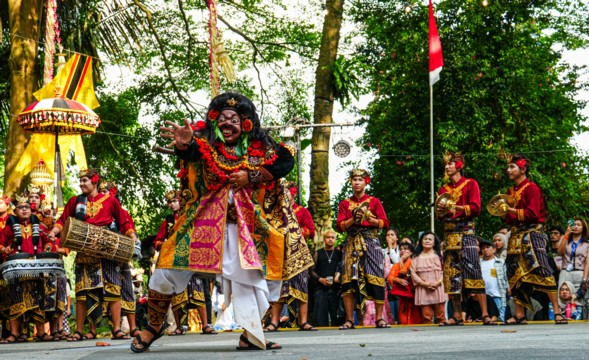
Photo by Andry Sasongko at Pexels. |
“Singapurrrr!”
Hearing
the surfers’ appellation for me, I turn reflexively toward the
greeting.
I’m
not Singaporean, but I always come to Bali from Singapore. A good
enough response to “where are you from” for this American.
I
wave back to the brown-skinned surfer, conspicuous with long,
blond-dyed hair, who had called out to me. I recognize him from a
neighboring surfing school. But I continue toward my destination. A
specific set of trees on the beach, a particular group of Indonesian
surfers. The blond has alerted them to my presence, so they also call
out: “Singapur!”
As
usual, the guys have some treats for themselves and for me –
rambutan or pineapple from a local vendor, a bit of bakso
(meatball soup), even a bottle of Bintang, the
local beer. I
plop down in the sand for an afternoon of lounging and laughing on
Kuta Beach, enjoying the shade of the trees, watching the picturesque
waves or else diving into them.
Our
conversations have an interesting rhythm due to the mix of languages
used. Some of the surfers speak basic English, and I speak some of
their language, Bahasa Indonesia. Ari and Imam speak Japanese better
than they do English, having learned it from Japanese tourists.
That’s my common language with them as I studied it in college.
Doni’s Mandarin is better than his English, so I use my limited
Mandarin with him – another language I studied a bit in college and
use (less than expected) in Singapore. And of course, the surfers
occasionally speak to each other in Bahasa too quickly for me to
follow. I catch a few phrases but at a certain point have to admit I
don’t understand. Ari eventually remembers to translate to Japanese
for me.
As
we chatter away, I also help beckon customers to their surf school,
inviting tourists to try surfing. I also give two thumbs up while
exclaiming “OK lah!”, Doni’s much overused catch phrase. It
essentially means “It’ll be great!” (The surfers laugh at my
adoption of their phrase and echo the exclamation.) At the very
least, I meet a bevy of interesting tourists – often from
Australia, Europe, or elsewhere in Asia. If luck is on our side, they
decide to try surfing, and one of the surfers in our group will teach
them.
This
is a typical day in Bali for me. A bit of tourist wrangling, taking
in the sight of rolling waves and clouds that assume the shapes of
beastly temple guardians, enjoying whatever jokes I can understand
from the surfers. Some days a tourist will take center stage – a
reporter from Japan, a snowboarder from China, a photographer from
Malaysia. They’ll stay with us for the whole afternoon. My English
is helpful at times, but in such cases, not more helpful than the
locals’ fluent Japanese, Mandarin, or Bahasa. With us, at least to
me, there is no hierarchy – only respect and curiosity. And when
the mood strikes, we jump in the water.
*****
One
day in March, 2017, I arrived to the airport in Denpasar, looking
forward to my usual routine in Bali. As I chatted with the taxi
driver, I learned that a holiday was approaching. He called it Nyepi.
I was curious to know more, but he proceeded to ask me a barrage of
questions about myself, as taxi drivers in Bali will do. Where am I
from, what do I do, how old am I, do I have a family. He was
delighted when I responded in my simple Bahasa, and we continued with
a mix of English and his language, the approaching holiday almost
forgotten.
I
met up with one of the surfers, Ari, at a restaurant near the beach,
and asked him about Nyepi. As usual, our
conversation was
entirely in Japanese, so I almost wondered if I was misunderstanding
him.
“Nyepi
is the Day of Silence. You stay indoors for 24 hours.”
“What
do you mean – indoors?” I hadn’t heard of an
indoors
part of the beach.
“In
the house, in the hotel, wherever you stay.”
He
was cheerful as always, his eyes dancing with a child-like innocence
as if he couldn’t comprehend why this might be a problem.
“Even
tourists?”
“Yes,
even tourists. They stay in the hotel. No internet –”
“No
internet?”
“And
the hotel will cover the windows so you can’t see out. They do the
same thing in all the houses.”
“Ok,
now I know you’re joking. You’re telling me people fly here from
Australia and Europe and all over to go sightseeing and enjoy the
beaches, and they can’t go outside or even look outside?”
He
nodded trustingly. Surely I would see how logical all of this was
eventually, his expression seemed to say.
“What
if I go outside anyway?”
“Religious
authorities will take you away,” he said matter-of-factly, holding
his wrists out as if being handcuffed. “And you’ll have to pay a
fine.”
Perhaps
literal handcuffs weren’t involved, but the fee was undoubtedly
real. As if outside my body, I could see myself getting miffed.
Anyone telling me I couldn’t go outside, restricting my movement
and liberty, was beyond the pale. As the thoughts ran through my
mind, I felt my mentality was embarrassingly American, but I couldn’t
control my anger and disappointment.
Admittedly,
a flight from Singapore to Bali wasn’t pricey, nor was my modest
hotel room in trendy Seminyak. Everything about my trip was usually
low hassle, low cost, low sacrifice. But still – the injustice of
it all! Until it actually unfolded, I wasn’t going to believe it.
Ari had to be pulling my leg.
He
continued to limn the festivities of the holiday. That night would
offer a parade through the streets of Ogoh-Ogoh –
some kind
of Balinese mythical creatures, it seemed. From 6 am on, each person
would be trapped in our respective homes or hotel rooms. What world
had I found myself in? One could only wonder what might befall a
homeless person.
Since
we still had a day of freedom, we headed to the beach as usual, and
the other surfers confirmed the situation. Even a few surfers from
the neighboring surf school chimed in. Surely they couldn’t all be
in on some elaborate joke. Could they?
I
looked for a twinkle in the eyes that might suggest they were just
being playful. To no avail – they always had that twinkle.
“So,
what is this holiday about?” I asked the group.
The
surfers took turns explaining, interjecting their pieces in the
various languages they used with me. Silent Day, or Nyepi,
involved shutting down the city and making it silent so that
wandering spirits would pass us by. Covering the windows wasn’t
about keeping us from looking out; it was to keep spirits from seeing
in. The airport would close down, not allowing flights in or out.
Internet and TV wouldn’t work. Lights would, thankfully.
It
was a Hindu holiday, and I later confirmed that nothing like this
happened in India, or even elsewhere in Indonesia other than the next
island over, Lombok. It was just a Bali and Lombok oddity.
“None
of you are even Hindu. How do you feel about this?” I asked, my
indignation finally giving way to plain bafflement. Surely Hindu
traditions being imposed on a captive Muslim populace was a recipe
for resentment at least.
“We
enjoy it!” Imam said in Japanese. “It’s time to spend with
family and friends – no internet, no distractions.” I mulled over
that, surprised.
“The
parades tonight are a lot of fun. My kids love it,” Sendi
commented. I didn’t doubt this, but his opinion had to be taken
with a grain of salt – he was the only one in the group who hailed
from Bali, so he would have grown up with this tradition.
“I
look forward to it, too,” Ari added. “We play board games and
card games, we relax, we smoke.”
They
all smoked cigarettes.
“Some
people meditate or read,” Doni, the Buddhist, noted.
“But
no internet,” I murmured.
Buang,
the boss, chuckled knowingly, and handed me a beer. “You’ll see,
it’s good that you’re here. This is Bali culture.”
Recalling
that almost all of these surfers were from Java, I couldn’t help
being impressed by how they had come to appreciate this local custom,
forced – as I saw it – upon them by a religion that wasn’t
theirs. Each of them must have experienced something of the
bewilderment I now felt; each had at one point been ambushed by their
first Nyepi.
I
suddenly recalled the time I had stayed out in the ocean too long,
playing games in the waves. As one wave approached, the surfers would
signal whether to stay up above the water or to swim down under it,
and we’d all go along with it. The game was endlessly fun despite
its simplicity, or because of it, and I had decided I’d never leave
the ocean. I was weightless, being lifted up and carried down
rhythmically in the water. The surfers had warned me I was getting
sunburned, laughing as they said it. I didn’t heed the warning. By
the time I started feeling the burn, it was too late.
Turned
out my brown skin was not at all immune to sunburn, despite never
having endured it growing up swimming in pools in Texas. My face was
burned and conspicuously patchy. I felt incredibly self-conscious,
especially as I imagined going back to office work in Singapore. But
the surfers had rallied around me, celebrating. “You’re like us
now!” I didn’t know what they meant. Their faces weren’t patchy
and burnt.
They
produced their smart phones and showed me one by one. In the photos,
their faces looked like mine, with patches many shades darker, and a
red undertone throughout, especially in the lighter patches. I
resisted wincing seeing those photos, but they were all smiling at
me. “You’re a surfer now!” they said. Never mind that I hadn’t
been surfing – I had just been playing around in the ocean. But my
heart warmed a little. I was one of them.
An
American woman with a job in Singapore would never really be one of
them. But the more I could experience of their world, the more
meaning I felt in these trips. A visitor to this island, I could
learn from their humility, their acceptance of local traditions. They
didn’t need everything to be perfect, and they didn’t need to be
in control. If there was one thing I had learned about Bali, it
always had something to teach me.
Bring
it on, Nyepi.
*****
Fortunately,
I wouldn’t spend the 24 hours alone. Ari, not having kids to go
home to, offered to stay with me, and I was happy for the company of
my best friend on the island. He had cards we could play games with,
and I knew from experience that the two of us could chit chat for
hours and the time would fly. So, that problem was solved.
That
night, we headed to the parade. From my hotel in Seminyak, Ari walked
me to the main street for the festivities. We stood along the
sidewalks in front of the shops, and emerging from the darkness,
vicious Ogoh-Ogoh were carried by. Enormous, they
loomed over
us menacingly. A wild-eyed orange beast with bat-like wings raised a
leg as if to squash us. A blue-skinned ogre reached out menacingly
while displaying a tongue of monstrous proportions. They reminded me
of fearsome gargoyles or temple guardians, maybe even more malicious
versions of Hindu deities, ostensibly on steroids and something
stronger. Children were everywhere, on their dads’ shoulders,
running around, holding onto their moms – all of them delighted by
even the most unnerving monsters.
I’d
never seen anything like it. If I had regretted the timing of my
visit, the parade changed my mind. The night was magic.
Except
for the bugs.
“Kechawa,
kechawa!” I remarked whenever I saw a little black body
scuttle
by on the ground, and I’d dart to the other side of Ari. I didn’t
know if I was speaking Bahasa or Japanese, but I knew it was the word
for my least favorite insect.
My
phobia was hilarious to Ari. Maybe he’d never met a bug-averse
person. Maybe he’d met many of us and we were all equally amusing.
Aside
from that, walking through the streets, which were full of other
people and families even after the parades finished, was enchanting.
Stores were closed, and everyone was just taking in the night. One
couldn’t help but be won over by the festive atmosphere.
Eventually
we headed back to my hotel. Throughout the next 24 hours, just as Ari
had predicted, coverings were put over the hotel windows so we
couldn’t see out – or rather, so the spirits couldn’t see in. I
declined to try the door; it would be too disturbing if it were
locked. As I understood it, people could move around within the
hotel, but I didn’t care to try.
I
imagined what the entire island must look like. Empty streets, no one
on the beaches, in the water, in the shops. Every house, hotel, and
shop shuttered. Even more odd perhaps, no noisy motorbikes or cars on
the road. I visualized the area called Denpasar, its streets always
so densely packed with motorbikes, now empty and silent. An entire
city ostensibly deserted. Nefarious spirits would wander through the
streets, searching, listening, moving on…
The
time passed quickly, even without that most basic of distractions,
the television. Ari called his family back in Java, and I enjoyed
hearing his native language; he even taught me a few Javanese words,
and insisted I speak to various family members. He showed me the
latest photos of himself in drag, and photos of a child in a hospital
bed in Java. I never understood all of the context for his photos.
His life seemed a mystery as deep as the ocean we loved. Mostly we
just talked and laughed, at times switching to playing card games. I
realized what a gift it is to have a good friend I could talk to
about every subject under the sun, even if I didn’t understand
every word. Maybe that was the point of the holiday: to really see
the people in one’s life, to be grateful for them.
Being
without the internet brought a sense of peace. This was how humans
had always lived. For thousands of years, we looked at one another in
the eye and talked, moving through our world without smart phones,
without computers. No devices distracted Ari and I from each other,
or from ourselves. Instead of trying to escape moments of silence, we
settled into them, heard our own thoughts.
By
the time the 24 hours had passed, I was genuinely grateful. For the
ghoulish whimsy of the previous night, for the peace that the holiday
had brought, and for friendship.
*****
In
quiet moments, I thought back to how I got started helping out at
Buang’s surf school. It was only my second trip to Bali, and I had
never really watched people surf. I had seen surfers in wet suits
walking with their boards on the beaches of Los Angeles, San Diego,
and even San Francisco, but I had never watched them in the water.
Here in Bali, taking in the beauty of the ocean meant noticing the
people standing up on the waves, balancing on them, moving along on
them. I was mesmerized.
Sendi,
one of those who had been surfing, had seen me sitting alone watching
him and the other surfers. He approached me, smiling. “Try
surfing?” I smiled but shook my head. No way, surfing wasn’t for
me. I had lived in California but was raised in North Texas. Surfing
couldn’t be further from my wheelhouse.
He
went back out to catch a few more waves, and after a while, revisited
me. “Try surfing! Just try!”
I
reconsidered. Who said surfing couldn’t be for me? Where was it
written in stone? I had never even considered it before, but now…
“I
don’t have a wetsuit,” I said hesitantly.
He
waved that off. “We can give you.”
He
produced not a wet suit but rather a sporty long sleeve shirt and
surfing shorts. Sendi explained the board positioning, foot
placement, and pop up technique. Whenever a good wave was coming, he
yelled, “Now!” and I tried to get up on the board. He was an
effective teacher, and I stood up after the first few tries. Riding a
wave, even briefly, gave me a beautiful sense of freedom. Eventually
a few others from the surf school were watching and taking pictures,
and I started meeting the surfers one by one.
After
that, I started coming back regularly, not just for surfing – I
loved it, and I loved that I had learned a new skill after age 30,
but surfing was hard work. I preferred to watch other (more
proficient) people surfing, swim leisurely in the waves, and talk to
people. Conversing with others – surfers from around Indonesia who
had found opportunity in Bali’s tourism industry, tourists from
Australia, China, Europe, and India, sometimes even the US – was a
great way to spend my vacation.
Over
time, I got to know what the surfers’ days were like. They each
found themselves on the beach at 6 in the morning. There were long
stretches of time with no customers, especially during the off season
or if it had rained. Time was spent sitting together on the beach,
enjoying single-mindedly whatever food they had, making jokes,
sometimes just enjoying the view of the ocean. Even if no customers
came, they could look forward to a day of hanging out together.
Forget
the paradisical setting, which for them was a workplace after all.
The value in their day-to-day world, outside of their families and
home life, boiled down to each other. Observing their way of life
from an outsider’s perspective, I could see what I couldn’t in my
own high-pressure, office-based routine. All they had on that beach
was each other.
It
was a lesson I would take back to Singapore. We had a million things
to do once in the office, but the essence of it was the co-workers I
would see every day. Whatever else was going on, there would be some
slower moments. I could count on our casual chats at the front desk,
at the water cooler, during smoke breaks (even we non-smokers stepped
out), during shared lunches. There would be laughs.
Nyepi
also humbled me. As I always learned while traveling, the assumptions
I had were not universal. Reasons to limit basic rights, like
freedom, varied. There’s always another perspective.
Freedom
of movement was not any less important to me after my Nyepi
experience. But I chose to open my mind to a different way of
thinking, and at least see the benefits of this cultural tradition.
It reminded me of what I love about travel. The most fascinating
moments are usually not the perfect ones, where everything goes as
expected.
*****
I
never again travelled to Bali in March, but the lessons of Nyepi
have continued to reverberate. This was especially true when Covid-19
struck. At the beginning in Singapore, we couldn’t step outside
without wearing a mask. We couldn’t go to the office, or sit down
in a restaurant. We couldn’t go grocery shopping with another
person, or meet up with each other – outside or in our own homes.
We couldn’t enter malls, which in Singapore are tantamount to
neighborhood downtowns (often housing a grocery store, post office,
library, movie theatre, hair salon, medical clinic, and more), unless
we were on Trace Together, an app that allowed the government to
track our movements and know where we were in real time. And even
when the vaccine came out, we couldn’t enter the malls without
proof we’d been vaccinated.
At
times, the restrictions seemed absurd. For example, the rules
eventually loosened to allow for up to 5 people to go out together;
families of more than 5 faced an awkward situation when going out to
restaurants. Which kid was getting left behind? Or would it be a
grandparent or a parent this time? When I was first told I had to
wear a mask outdoors, it struck me as over the top. Unable to meet up
with others even outdoors, my knee-jerk reaction was irritation. As
an American, I wonder if my indignation was stronger because of my
specific understanding of freedom and what that should look like.
But
with each restriction, I forced myself to revisit the lessons of
Nyepi, to see those Javanese surfers’ faces in my
mind.
Humility and open-mindedness became my mantra. I connected with
myself. And I found ways to enjoy each day.
Faced
with challenges to my freedom or values, I now remind myself to stay
open – to other perspectives, to surprises, to learning. I revisit
the enchantment of Nyepi.
I am an education consultant, and while I
now live in Plano, Texas, the events in this story took place when I
was living in Singapore. I have been working at Prep Zone Academy for
the past 11 years. Prior to that, I worked in the legal field. I went
to law school at UC Berkeley and did my undergrad and Masters in
Asian Studies at Harvard. Although I published articles in academic
journals (Texas Review of Entertainment and Sports Law as well
as Arizona State University Sports and Entertainment
Law
Journal), I am otherwise unpublished.
(Unless
you
type
the
author's name
in
the subject
line
of the message
we
won't know where to send it.)
*****
If the
link to the letter doesn't work you can copy
and paste in this address: preserve@storyhouse.org
Book
Case
Home
Page
The
Preservation Foundation, Inc., A Nonprofit Book Publisher