Tamila Bahshieva
© Copyright 2026 Tamila Bahshieva
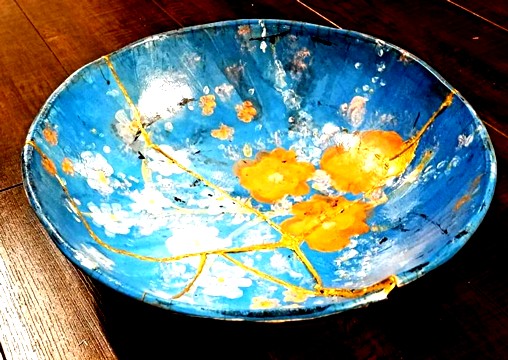
Photo by Ruthann Hurwitz at Wikimedia Commons.
| Kintsugi Tamila Bahshieva © Copyright 2026 Tamila Bahshieva |
Photo by Ruthann Hurwitz at Wikimedia Commons. |
It is the Japanese art of restoring broken pottery with lacquer mixed with gold or platinum powder.
What fascinated me was that kintsugi is not simply about mending something that has been broken. It is also a philosophy — one that embraces imperfection, seeing it as an inseparable part of an object’s history.
Gold is used most often, drawing attention to the lines of fracture and creating a new kind of beauty — one born from imperfection, not concealed, but illuminated.
Japan was my first journey “abroad.”
It was love at first sight — and, somehow, the feeling was mutual.
An entirely different planet, with its own philosophy, language, cuisine, traditions, and culture.
Six months of living in Hiroshima, travelling through Osaka, Kobe and Kyoto, left me with unforgettable memories and a new understanding of myself and of life.
Taiheiyō — that is what they call the ocean. It became my favourite word. There is so much mystery in it, like the mountains veiled in a dreamlike blue-grey haze.
A cradle of humanity, slowly rocking to the sounds of the pentatonic scale, intoxicating you with its sweet air.
Irasshaimase! — the Japanese call out wherever you go. It is how they welcome their guests, with smiles and bows.
The Japanese are generous, kind-hearted, and mysterious.
One of the places I loved most was Miyajima, an island not far from Hiroshima, reached by ferry.
Hundreds of deer await you there, ready to be fed rice crackers. They are gentle and extraordinarily beautiful.
The island is home to many temples and shrines. For centuries it was considered sacred ground, a place where no commoner was allowed to set foot. Today anyone may visit — but no one may remain there forever: neither people nor animals are buried on the island.
A Japanese man once told me that the island is guarded by a jealous goddess, and so lovers should never come here together. It is considered bad luck.
Once, the head of the local yakuza introduced me to the last geisha, a woman who had personally known the Emperor.
This mysterious woman was something of a local legend, yet she did not grant conversation to everyone. She chose her company carefully. I no longer remember the intricacies of what she told me, but throughout our conversation she kept one hand covered with a handkerchief.
When we said goodbye and exchanged bows, she finally removed it — and an enormous diamond flashed on her finger, scattering light from its magical facets.
A gift from the Emperor.
In Japan, quite unexpectedly, I discovered that my appearance embodied what the Japanese considered an ideal — a blend of Asian and European features.
Both women and men showered me generously with compliments, lifting my spirits and, I must admit, my self-esteem.
I desperately did not want to leave.
My friends and I promised one another that someday we would return.
Farewell, yakitori, takoyaki, wasabi and senbei — the most delicious cuisine in the world.
Far Eastern crabs waved their red claws goodbye, Japanese men in love shed a restrained tear, and maneki-neko promised us luck and happiness.
Twenty years have passed.
And now I see my reflection in a Japanese ceramic vase, its surface traced with golden veins of imperfection.
Those shimmering lines resemble my own — every fracture carrying its own story, and its own beauty.
Aishiteru — this is how they say “I love you” in Japanese.
Aishiteru, I say to myself.
Learning, at last, to love and accept who I am.
“Changes aren’t permanent. But change is.”
Tamila Bahshieva was born in Pavlohrad, Ukraine. She began writing as a child, and her early poems appeared in magazines before music became the central focus of her life. A professionally trained musician, she has worked as a singer for more than twenty-five years and also teaches voice.
An avid traveler, Bahshieva has visited more than sixty countries, including the Arctic and Antarctica. At forty-three, she returned to writing, this time through short fiction, drawing on years of impressions, memories, encounters, and observations.
A self-taught writer, she names Ivan Bunin, Konstantin Paustovsky, and Yuri Nagibin among her most important literary influences, particularly for their attention to language, atmosphere, and the inner life of the individual. Her work explores memory, love, loss, and the subtle moments that shape human lives. She is currently working on a collection of short fiction. Her growing collection includes thirty-seven completed stories.