Sylvia Eze
© Copyright 2025 Sylvia Eze
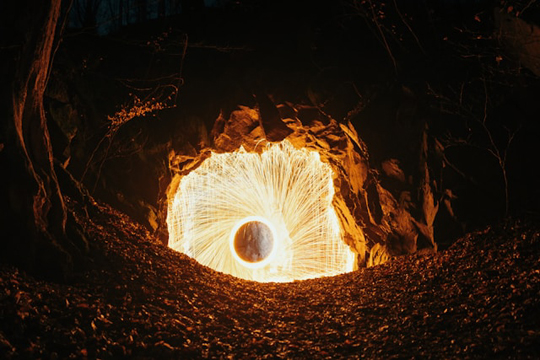
Photo by Oliver Guhr on Unsplash
| Ready Sylvia Eze © Copyright 2025 Sylvia Eze |
Photo by Oliver Guhr on Unsplash |
It began fifteen minutes before the meeting.
That was always when she felt it — the shift, the quiet invasion.
There was no one in the room, yet she knew she wasn’t alone. The air felt charged, alive with something unseen. Her breath hitched. She fought — clawing, kicking, striking at nothing but air — but the force slipped through her defiance like smoke.
And then it had her.
Her body stilled, her heartbeat slowed. The world dimmed into a distant hum. She became another — a stranger living inside her skin.
When it was over, she always cleaned up the mess: papers scattered, broken glass, overturned chairs. No one else knew. No one could. It wasn’t possession in the way people imagined. It was worse. It was her, but darker — colder.
She hated it.
She hated that the thing inside her felt confident, powerful — everything she wasn’t.
And when it left, guilt came flooding back, heavy as wet sand.
Sometimes she wished she couldn’t remember what it did when it took control. The others — the ones like her — claimed they blacked out. But not her. She watched it all, trapped behind her own eyes. She could never claim innocence, because she saw everything.
Now, walking to the Trade House for her hearing, she wondered if she was ready. The patrol guards flanked her on both sides. Her grandmother, who once understood her better than anyone, could no longer save her.
She kept her eyes on the ground until the judge called her name.
The first witness stood and pointed.
“You cannot hand her over to that man,” the woman said.
And just like that, the memory fractured—
—light, color, sound—
—and
she was back in the past.
The Mission
When she first entered Lacan, the academy that loomed like a castle at the edge of the village, she’d felt nothing but pride. It was the dream of her childhood — to study among the chosen few. Within two years, she became one of the top five students. People admired her discipline, her precision, the quiet brilliance that set her apart.
So when the headmistress selected her for the Magnum Mission — to recover the stolen staff of Magnum — she felt chosen by destiny itself.
Two weeks later, in the dense forest beyond the school, she and her two teammates, Samuel and Peter, cornered the thieves near a cave. The staff — dark green, flecked with red and black — slipped from their hands and flew into the cave as if pulled by unseen will.
They argued at the entrance, a mist swirling thick and silver. Peter read the ancient warning carved into the stone:
Only the childlike may enter.
“I’ll go first,” Peter said, stepping forward. But the mist threw him back.
Samuel tried and failed too.
When she stepped forward, the mist parted like a sigh.
Inside, vines clung to the walls like veins. The air smelled of damp earth and forgotten lullabies. Sand pits covered the ground — places for children to play. The staff lay just ahead, pulsing faintly with light.
She lifted it, feeling warmth hum through her palms.
For a moment, she thought she heard laughter — soft, echoing, childlike.
She turned and saw, across the room, what looked like a mirror. But when she looked closer, it shimmered as if it were breathing. She reached toward it — and for a moment, saw her reflection smile before she did.
Then
she blinked, and it was gone.
They returned to Lacan as heroes. The staff was restored to the academy, the ceremony bright with music and speeches.
But soon after, the nightmares began.
At first, it was small things — the feeling of being watched, shadows that lingered too long, whispers she couldn’t trace. Then her teammates began complaining too — of voices, of sleepless nights, of mirrors that fogged when no one breathed.
The headmistress summoned them.
“Ever since you brought the staff back,” she said, “something has followed you. Mrs. Miya saw a vision — a man calling you back to the cave. You must go, before it consumes you.”
Samuel protested, Peter laughed nervously, but in the end, they went.
The
forest felt different this time — heavier, as if it knew they
were coming. The mist parted for all three of them now, swallowing
them whole.
The Voice in the Cave
Inside, the cave was immaculate. No dust, no cobwebs. The air pulsed faintly, alive.
She was drawn again to the mirror at the far wall.
It shimmered like liquid glass.
Without warning, it rippled open — and she stepped through.
Darkness.
Then a voice.
“Nice to see you again.”
She froze.
The room was dim, only thin rays of light cutting through holes in the ceiling.
“I’m impressed,” the voice said, echoing from everywhere and nowhere. “Do you know why you’re back?”
“No,” she whispered.
“Because I called you. I needed to know how you entered when no adult could. This place has rules. It accepts only the pure, the unbroken. But you—”
The voice paused, as if smiling. “You are fractured.”
“Who are you?”
“Once, I was a guardian. Now, I am what remains of belief. But when you took the staff, you broke the balance. The childlike cannot be both innocent and divided.”
“I don’t understand.”
“You will,” the voice said. “Take the stone beside you. Drop it where the first light touches the ground.”
She obeyed.
And suddenly — images unfurled before her eyes like smoke.
A little girl.
An old woman beside her.
The girl screamed, kicked at the air.
Then darkness.
“Now the second light.”
She dropped another stone.
This time, she saw herself older — fighting something invisible, clawing at it, crying out.
“The third.”
The image changed — a man holding her head, murmuring words that made her collapse.
Her breath came fast. “What is this?”
“Memory,” the voice said. “Yours.”
The images blurred, melting into one another until only one thing remained clear — the Trade House.
And then — a flicker of recognition.
Fifteen minutes before the meeting.
The thing that took over her.
“Nothing stays hidden forever,” the voice thundered. “Everything in darkness will be brought to light.”
(Part Two – The Awakening)
The cave trembled with the sound of the voice.
The air thickened, pressing down on her chest.
“I still don’t understand,” she said, her voice trembling. “What do those memories mean?”
“You will,” the voice replied. “But first, you must see what came after.”
The last beam of light shifted, striking the ground before her feet. The stone rolled from her hand, clicking softly as it landed — and then the vision opened.
She saw herself — younger, smaller — standing in front of a council at the Trade House. The same walls. The same judgmental eyes. Her grandmother sitting silently in the corner, hands folded, eyes heavy with sorrow.
Then the man appeared — tall, dark, face unreadable. He spoke in a language she didn’t understand. The girl screamed, kicked, cried out. Her grandmother reached for her, but the men held her back.
Light erupted — a burst of white — and then the child went still.
The
vision dissolved into smoke.
“Who was he?” she whispered.
The voice sighed, deep and old.
“The one who bound you,” it said. “He took what he couldn’t control — your fear, your anger, your innocence — and locked them inside you. The childlike part of you stayed here, safe in this cave. But the rest of you grew up without it.”
Her heart pounded. “You mean… part of me has been trapped here all this time?”
“Yes,” the voice said softly. “And the thing that haunts you — the one you call it — is what’s left of that lost part. You and it are two halves of the same soul.”
She staggered backward, shaking her head. “No. That can’t be true.”
“Everything you saw — the rage, the confusion, the guilt — they aren’t curses. They’re memories. The cave doesn’t imprison. It remembers. And so do you.”
The
light in the room began to shift — from cold white to a warm,
golden hue. She felt something stir inside her, like a pulse that had
been silent for years.
Then, footsteps.
Her teammates — Samuel and Peter — burst into the chamber, torches raised.
“Where were you?” Samuel called. “We’ve been searching for you!”
She turned, but the voice spoke again, low and urgent.
“They can’t see me. But they can destroy me — and everything here. They’ve read the writing on the wall.”
“What writing?” she asked.
“The one that tells them to burn the cave,” the voice said sadly. “They think it’s the only way to stop me. But they’re wrong. If they destroy this place, they destroy you too — the part that still remembers what you were.”
She turned to Samuel. “Don’t light it!” she cried.
He frowned. “We have to. It’s the only way to break the curse.”
“No,” she said, stepping forward, her voice rising with desperation. “It’s not a curse. It’s memory. It’s me.”
But
the torches were already falling.
The flames caught quickly, racing along the vines that crawled across the walls. Smoke filled the air. She coughed, stumbling toward the mirror.
“Go,” the voice urged. “You must leave before the passage closes.”
“But you—”
“I am you,” it said gently. “You cannot save me, because I was never lost. You only needed to remember.”
The room flared with light — a searing, brilliant gold — and in that instant, she saw it: the child version of herself standing in the glow, smiling softly, holding the staff of Magnum.
Then,
silence.
She woke on the forest floor, gasping. Smoke curled up from the burning cave. Samuel knelt beside her, shaking her shoulders.
“You okay?” he asked, eyes wide.
She nodded faintly. “I was there,” she murmured, glancing toward the flames.
“Where?” Peter asked.
She looked back. The cave’s entrance was gone. Nothing but scorched stone remained.
“Nowhere,”
she said quietly. “Everywhere.”
The Return
Two weeks later, she returned home for summer break. The train ride was long, the window reflecting her face against the fading landscape. She couldn’t shake the feeling that something still lingered — not darkness, but a quiet hum beneath her skin, as if the cave still whispered her name.
Her parents ran to meet her at the door, her mother pulling her into a tight embrace.
“It’s good to have you home,” her mother said. “You’ve grown thinner.”
“I’ve just been... busy,” she said.
As they sat down, her mother glanced at her, hesitant. “Is something wrong?”
She hesitated, then asked, “What happened to me when I was a child?”
The question hung heavy in the room.
Her parents exchanged a look — the kind that carried history, guilt, and secrets. Then her mother spoke.
“When you were three, your father... your real father... wasn’t well. He thought he could fix you through strange means. He let a man perform something — something ancient. We don’t know what it was. After that, you changed. Violent outbursts. Voices. Things we couldn’t explain. Your grandmother tried to protect you, but—”
She stopped, tears pooling in her eyes.
Her father continued softly, “One night, a stranger came to our door. He said he could help. He placed his hands on you, said a prayer, and you fell unconscious. When you woke, you were calm. You didn’t remember anything — not him, not your past. He said you were free. We didn’t question it.”
The woman sat still, her mind racing. “Free,” she repeated. “But maybe not whole.”
Her mother frowned. “What do you mean?”
“I think... part of me was left behind.”
Her
parents said nothing.
That night, she dreamed of the cave again — but it wasn’t burning anymore.
The vines had regrown, the air shimmering with light.
The child stood there again, holding the staff.
“Are you ready?” the child asked.
“For what?”
“To live as one.”
The staff glowed, and the light poured into her chest. She felt warmth — no longer fear, but peace.
When
she woke, the morning sun streamed through her window. For the first
time, she didn’t feel haunted. The air felt new. Her reflection
in the mirror didn’t flinch, didn’t mimic her — it
smiled with her.
Epilogue
Weeks later, she returned to Lacan.
The staff of Magnum still stood in its glass case, gleaming faintly under the hall lights. She stared at it for a long time, and for a moment, thought she saw her reflection split — the faint outline of a child standing beside her.
But this time, it didn’t frighten her.
Because she understood.
The cave hadn’t cursed her. It had protected her — kept her innocence safe until she was strong enough to claim it.
She turned, feeling the hum of the staff behind her fade into silence.
As she stepped out into the courtyard, the wind carried the faintest whisper — a child’s laughter, echoing through the trees.
She smiled.
She was no longer haunted.
She was whole.
She
was ready.