The Warmest Place In The Village
Syed Peerzada Shoib Nazir
© Copyright 2026 by Syed Peerzada Shoib Nazir

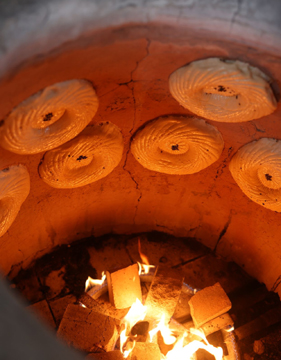
Photo by Valeria Boltneva at Pexels.
The Warmest Place In The VillageSyed Peerzada Shoib Nazir © Copyright 2026 by Syed Peerzada Shoib Nazir |
Photo by Valeria Boltneva at Pexels. |
On winter mornings, I would leave the house carrying a cloth bag, already knowing there would be a queue waiting outside. Everyone seemed to arrive at nearly the same time. Some stood quietly with empty bags folded beneath their arms, while others greeted neighbours they had known for years. No one seemed impatient. Waiting was simply part of the morning.
Inside, the warmth reached you before anything else. The smell of fresh bread mixed with wood smoke, and the sound of people calling out their orders blended with quiet conversations that seemed to begin long before anyone arrived.
In one corner stood the clay oven, glowing with steady heat that felt especially comforting after walking through the winter cold. Beside it sat a man whose hands never seemed to stop moving. The baker placed soft rounds of dough against the walls of the oven, while the man sitting beside him pulled out freshly baked girda and lavasa one after another with remarkable speed. They hardly needed to speak. Their hands moved with the confidence of people who had repeated the same work thousands of times before.
When our turn finally came, we would call out how many girdas and lavasas we needed. The warm bread disappeared into our cloth bag almost as quickly as it left the oven, and for a moment it became impossible to hold the bag too tightly because of the heat. By the time I stepped outside, the smell of freshly baked bread seemed to follow me all the way home.
Growing up in a joint family meant the journey to the bakery belonged to everyone. We took turns. Sometimes my father went, sometimes one of my older cousins, and sometimes it was my turn. We always brought girda for the family and lavasa for my grandparents, whose breakfast never felt complete without it. At the time, it seemed like nothing more than another household chore. In hindsight, I realise it was one of the rituals that quietly held our mornings together.
What I remember most is not the bread. It is the conversations.
One man worried that this year's apples had ripened too early. Another insisted the harvest would still be good if the weather held. Someone else shared news that a neighbour's son had been selected for a new job. Another conversation drifted towards weddings, visitors, or events from the previous evening. Stories moved from one person to another as naturally as the bread itself.
During winter, people often lingered after collecting their bread, stretching their hands towards the heat of the clay oven while conversations continued without any urgency to end. Someone always had another story to tell. Someone else remembered an older one. As a child, I rarely joined those conversations, but I listened carefully. Without realising it, I was learning that stories travelled through a village in much the same way as the smell of fresh bread: quietly, generously, and from one person to the next.
The bakery belonged to everyone, but it always seemed to belong most of all to one man.
No one called him by his name. Looking back, I realise I never knew what his real name was.
To every child, every parent, and every grandparent, he was simply Kaka.
I never thought that was unusual. As children, we assumed he had always been Kaka and always would be. He greeted everyone with the same warmth, whether they were buying a single girda or enough bread for an entire family. There was never any hurry in his voice, even on the busiest mornings. Somehow, he always found time to ask how we were, smile at the younger children, or exchange a few words with the elderly who had been coming to his bakery for years.
When it was my turn, I rarely left empty-handed.
If the queue was long, he would sometimes hand me a warm girda and say, "Eat this while you wait."
On other mornings, after placing our order into the cloth bag, he would quietly slip in an extra girda or a kulcha. He never announced it. He simply smiled and said,
"Yi govuy che."
"This one is for you."
By the time I reached home, that extra piece of bread had almost always disappeared. I told myself I was helping by making the bag lighter before I arrived, though I suspect nobody believed that explanation.
My grandparents certainly did not.
They had a habit of pressing the bread gently with their hands before breakfast.
"If it isn't hot," they would complain, "you must have taken too long."
My cousins and I always defended ourselves with complete confidence.
"Kaka took it straight out of the oven."
Whether they believed us or not never really mattered. It became one of those small family conversations repeated so often that it quietly became part of everyday life.
Above the clay oven was a small opening in the roof where smoke escaped into the morning air. Every now and then, the smoke refused to cooperate. Instead of finding its way outside, it lingered inside the bakery, filling the room until our eyes watered. We rubbed away the tears, laughed at one another, and stayed anyway.
At the time, it felt like an inconvenience.
Today, strangely enough, it feels like one of the memories I cherish most.
I did not imagine that one day I would stop going there. Years passed, and life carried our family into a new home. The walk to the bakery grew longer, and mornings became busier. One day, after a long time, I found myself standing outside the same bakery again.
Everything looked familiar. The clay oven was still there. The shelves were still filled with freshly baked girda and lavasa. People still arrived carrying cloth bags, just as they always had.
Only Kaka was missing.
Someone told me he had left the village and settled somewhere else.
The bakery was still open, but it no longer felt like the place I had known as a child.
I collected the bread and went home without waiting.
No one handed a child a warm girda while the queue moved slowly forward. No one quietly slipped an extra kulcha into a cloth bag with a smile that needed no explanation. The conversations were shorter, and I no longer found myself lingering beside the clay oven simply to listen. The bakery still sold bread. It simply no longer felt like ours.
It was only then that I understood what had really changed.
It had never been only about the bread.
Today, I wonder whether Kaka ever knew he was becoming part of so many childhoods. To him, he was simply baking bread, morning after morning, just as he always had.
He gave us a place where we felt we belonged.
Whenever I think of those winter mornings, the warmth of the clay oven, the smoke that sometimes filled the room until our eyes watered, the stories that travelled more quickly than the bread itself, and the familiar smile that greeted every customer, I understand I was never only waiting for my turn.
I was witnessing an ordinary part of village life that quietly became extraordinary.
Sometimes, when I pass a bakery and catch the smell of freshly baked bread, I find myself looking towards the oven before I realise I am no longer a child.
I am not searching for the bread.
I
am searching for Kaka.