Four Voices, One Song
Simran Kaur
© Copyright 2025 by Simran Kaur

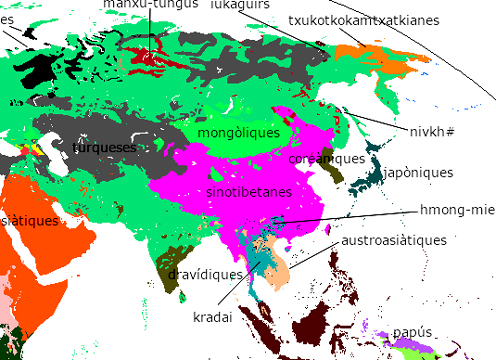
Chart showing language families in Simran's part of the world at Wikimedia Commons
Four Voices, One Song
|
Chart showing language families in Simran's part of the world at Wikimedia Commons |
What I did not realise then was how unusual it was to live in that space between languages. Most of my friends had one tongue that fit like a glove, something they could lean on without hesitation. Mine felt slippery, like trying to hold water in my hands. I was worried that if I gripped too tightly, I would lose every drop. For years, I saw this restlessness as a weakness—as evidence that I did not truly belong to any single world. But later I would learn that it was also the seed of something else: an ability to cross boundaries, to listen differently, to find meaning in the in-between. What felt like fragmentation was, in fact, the foundation of a whole.
Learning Malay was its own uphill climb. My dad knew it but was buried in work, and my mum, who was new to Malaysia, struggled with Malay and English herself. Still, she tried to help, picking up scraps of Malay and Mandarin from my kindergarten books so she could teach me what little she knew. I still remember one night at the kitchen table; my kindergarten workbook spread between us. My mum would point at a picture of a cat and say, “Kucing” hesitantly, waiting for me to nod. Then she would grin, repeating it a couple more times, as though the word itself were a small victory we had won together. Her accent was heavy, her confidence uncertain, but I saw her determination shining brighter than her mistakes. Those evenings were less about grammar and more about watching my mother build a bridge for me, stone by stone, even as she was learning to walk on it herself. It helped me get through kindergarten, and even being the top student every year, but primary school was more of a challenge.
At school, my accent made Mandarin stumble out of my mouth like a foreign visitor. Everyone else was Chinese, and I often felt like the outsider in my own classroom. Yet there was one moment that still burns in memory: the day I scored highest in the class for Mandarin. The classmates who once underestimated me looked stunned, as if I had suddenly broken some unspoken rule about who could belong. But even then, belonging was slippery. Malay remained difficult, tripping me with grammar and pronunciation that never felt natural. In college and in public spaces, I learned to quietly understand Mandarin when people spoke around me, yet I rarely spoke back. Even Punjabi, the language that should have been home, betrayed me. When I visited my mother’s hometown in Punjab, my cousins laughed at how “Malaysian” my Punjabi sounded, as if the words themselves carried an accent of displacement. One afternoon, sitting cross-legged on the rooftop in Punjab, I tried to tell a joke in Punjabi. My cousins burst into laughter—not at the joke, but at the way I stretched the words, my tongue tripping over sounds that came so easily to them. I forced a smile, but inside I felt the sting of being measured and found lacking in the very language that should have been my inheritance. Every language I spoke came with both proof of effort and a reminder of difference, like doors I could open but never quite step fully inside.
By the time I reached adolescence, the weight of juggling languages began to shift. What once felt like a burden started to reveal itself as an advantage. I noticed it first in the small moments: helping a classmate understand an English passage, or translating a Malay phrase for someone who was struggling. My awkwardness in each language, instead of holding me back, became the bridge that let me step into someone else’s world. Code-switching, which used to happen out of panic, became something I could do with purpose. In one conversation I could slip between English, Malay, and Punjabi, without thinking, and instead of embarrassment, I felt in control. It was as though the very thing that had once marked me as different was now giving me a kind of quiet power.
There were times when this advantage revealed itself in unexpected ways. I could catch fragments of Mandarin conversations in public, surprising friends by explaining what had been said. At home, speaking Punjabi with my parents and grandparents felt less like a chore and more like a way of holding on to something that might otherwise slip away. My grandmother would sometimes pause mid-conversation, tilt her head, and correct the way I pronounce a word. Then she would chuckle softly, not unkindly, and repeat it again until I got closer. Those corrections, once a source of embarrassment, slowly began to feel like gifts—tiny threads tying me back to a family history that might otherwise slip out of reach. Even my “Malaysian” accent in Punjabi became less of a flaw and more of a reminder of where my story stretched—across borders, classrooms, and family ties. The laughter, the missteps, the corrections—all of it shaped a perspective that was no longer only about survival. It was about connection. For the first time, I began to see languages not as walls keeping me out, but as keys, each one unlocking a new way of belonging.
As I grew older, the patchwork of languages in my life began to feel like a patchwork of selves. Speaking Punjabi with my father came with a certain seriousness, almost as though I was borrowing his tone of authority. Malay, when I used it in class, carried a kind of politeness that softened my voice. English was sharper, quicker—the language of exams, arguments, and self-expression. Mandarin, though less fluent, gave me an odd sense of secrecy: I could slip into understanding without needing to seen speaking. Each switch felt like putting on a new coat, not disguising who I am, but shifting which side of myself showed most clearly. It was then that I began to wonder: do languages shape us, or do we simply bend ourselves to fit them? This question haunted me into my teenage years.
At the same time, my empathy seemed to grow sharper because of these shifts. I learned to notice not only words but pauses, tones, and gestures. I understood the hesitation of someone struggling to translate their thoughts, because I had lived it. I could sense the pride in a classmate’s voice when they finally nailed a phrase, because I remembered my own small victories. What once had made me feel like an outsider was turning me into a better listener, a more patient observer of people’s inner lives.
This curiosity, about how words shaped thought and thought shaped identity—is what eventually pulled me toward psychology. Languages were no longer just tools of survival; they were clues about how the mind works, about how people see themselves and each other. To me, multilingualism stopped being only a skill. It became a worldview, one that taught me that identity is never fixed in a single language, but layered, flexible, and alive.
When I think back to those noisy dinners, I see them differently now. What once felt like chaos—Punjabi clashing with English, Malay competing with Mandarin—was not a storm to endure but a foundation being laid. Each voice at the table was not pulling me apart, but stitching something together.
The confusion I once felt has become clarity: my family gave me more than words. They gave me the ability to shift, to listen, to connect. They gave me a way of seeing the world that is not limited to one voice or one perspective. Now, when I hear my sister talking to me in Mandarin, my mother’s Punjabi, or my father’s Malay, I do not hear division. I hear harmony. The languages overlap like threads in a single cloth, messy up close but beautiful when you step back.
I may not have grown up with the kind of wealth others measure in numbers, but I have inherited something far rarer. Each language is a jewel from a different world, Punjabi carrying the weight of ancestry, Malay tying me to the soil I walk on, Mandarin sharpening my ear to hidden meanings, and English giving me the confidence to speak my mind. Woven together, they are more than words; they are a legacy. I am not rich in money, but I am rich in culture, and that richness is one no border, no accent, and no laughter can take away. I once thought I was divided by four voices. Now I know they speak as one.
Simran Kaur is an 18-year-old student from Malaysia. Growing up in a multilingual family, she developed a deep appreciation for how language shapes identity and belonging. She hopes to continue exploring psychology and storytelling as ways of understanding human connection.