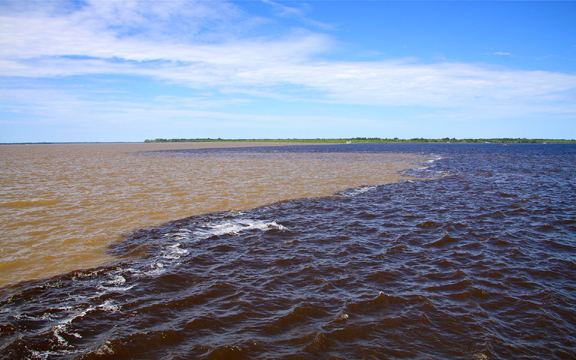
Meeting of the waters. Photo by Gabriel Castaldini at
Wikimedia Commons.
Dreamy-eyed,
I put down my copy of Richard Halliburton’s Book of Marvels
and decided then and there that I wanted to be an explorer
just
like him. I was ten years old at the time and could already picture
myself sailing down the mighty Amazon, sleeping in a tent in the
jungle and grappling with wild animals. Forty-five years later, I dug
deep down into my soul and found the guts and determination to travel
to the rain forest of Brazil and turn my dream into a reality.
Years
before, when I had visited Egypt, the Nile was exactly as I had
expected it to be: a long, thin blue line snaking through an
impenetrable desert. For a few short miles on either side, paradise
oozed out from the river’s edge and then … then, there
was nothing … nothing but desert, sand, nomads, and
desolation. The Amazon, on the other hand, was nothing at all
like
I had pictured it to be. Years before, while flying 20,000
feet
over its delta, I watched its Herculean power as it spewed millions
of tons of black Amazonian loam hundreds of miles into the crystal
clear Atlantic. Now, however, I stood on the Manaus side of the
Amazon and even though I was nearly a thousand miles from that delta,
I had to strain my eyes to see the opposite shore.
After
a wild 30-minute trip from my hotel through town, I boarded a
powerboat to begin my journey and even though the boat tore across
the river at break-neck speed, it still took 45 minutes to reach the
opposite shore. Erase all the pictures you have ever had of the
Amazon. Now substitute any scene from the movie Water World
and you have a truer picture of what the Amazon is really like! Water
was everywhere. There were streams, lakes, rivers, and even puddles
the size of the District of Columbia -- and all were moving at their
own rates -- rapidly or slowly, the mighty rivers and oozing streams
flowed eastward toward the Atlantic. Some were crystal clear, some
were tawdry, and others were black with silt, but they were all
mixing and merging as they meandered, roared, billowed, or flowed
toward the delta. And I stood in awe at the sight, wishing I had come
a thousand years before, wishing I had the power, the time, the money
to stay forever!
Halfway
across the river, we stopped at the Meeting of the Waters
where the black soil in the Rio Negro merged with the crystal clear
water of the . I had waited forty-five years to see this
sight and now my heart skipped several beats as I sat in a tiny boat
in the middle of the Amazon watching two of its mightiest tributaries
converge. I had already sailed on the Nile, the Danube, the Yellow,
the Yangtze, the Mississippi, the Yukon, the Volga, the Themes, the
Seine, the Rhine and the Zambezi, but now I was on the magnificent
AMAZON and it was almost as if all of the other experiences had been
nothing but preludes to this event.
When
we embarked, I literally crawled up an extremely steep concrete ramp
to reach Careiro, a small shantytown, where our Jeep waited for us.
We bought Cokes and a snack and then started down a dirt road to the
Araca River. This leg of the trip was about 40 miles, but it seemed
longer because the road had so many potholes and ruts that it took
over an hour and a half to reach the next river. Along the way I had
to rethink everything I had ever learned about
Brazil. I had
been taught that the Amazon was a mighty river, but what I discovered
was that it was actually a gridlock of massive rivers and gigantic
streams. Picture downtown DC - grid locked with streets, avenues,
circles and squares interconnecting and crisscrossing each other.
Then superimpose that view as you sail down the Amazon. Picture
Washington's streets as rivers, streams, tributaries, ponds, shallows
and swamps and you have a picture of the real Amazon.
The
road finally dead-ended at the Araca River where our guide, Jose and
Tico the boat pilot, waited for us in a small powerboat. We spent
about an hour and a half sailing up the Araca before we crossed
Piranha Lake (its name was a lot more ominous than it appeared). Then
we sailed up the Mamori River to Lake Juma and the Amazon lodge.
Altogether, it took a total of four and a half hours to get from the
door of my hotel to the lodge -- a journey of 62 miles. Along the
way, the views were extraordinary! Each bend, each twist in the
river, was better than the one before. (The only time I can say the
same was during my trip to Transylvania when we crossed mountain
range after mountain range. There, too, each vista was more beautiful
than the one before.)
To
say that the lodge was unique is an understatement! It sat on a raft
built of four-foot thick balsa trees. Facing the lake, there was a
large two-story hut-like structure. The upper room was a screened-in
dining room. The lower portion was an open greeting area, bar, lounge
and embarkation point for our jungle trips. The owner, designer,
manager had planned and built everything perfectly in order to fit
into the ecological surroundings. The rest of the raft consisted of a
kitchen, 17 bedroom, 3 lavatories and 3 showers (also with sinks) and
the owner’s quarters. Each bedroom door opened unto a two-foot
wide outer deck, giving the impression of living on a houseboat.
There was no hot water and the electric generator was only turned on
during the dining, conversation hours from sundown to about 11 PM.
Dinner
the first evening consisted of chicken and fish -- both excellently
prepared. I shied away from the raw fresh vegetables to avoid tourist
disease, but ate them later in Salvador Bahia and Rio with no ill
effect. After dinner I went alligator spotting with my fellow
tourists, an Argentine with his two children. We boarded our small
powerboat and sailed along Piranha Lake shining our flashlights up
and down the shore trying to spot the pairs of red glowing eyes
staring back at us. Alligators, our guide Jose, told us, are blinded
when you shine a light in their eyes. To prove his point, he had us
shine our lights on a baby alligator while he stuck his hand into the
water and grabbed it. Feel yourself sitting next to me … a
non-swimmer without a life jacket -- in a powerboat narrowing
avoiding trees that grow from the depth of the river, cruising across
Piranha Lake in the middle of a starless, moonless night, shining
flashlights along the distant shore, seeing dozens of pairs of tiny
red eyes staring motionlessly back at you. That's the glory of the
jungle!
After
another rousing evening of conversing in a half dozen languages, I
called it a night and headed to my room. My eight-by-six -foot
bedroom contained a single bed, a sink, a small shelf for clothing
and a fan. There were no closets and the room was barely big enough
to turn around in, but considering the amount of time I needed to
spend in it, it was more than sufficient. At night, however, when I
needed to use the bathroom, I had to get out my flashlight, stumble
out my door, turn right onto the narrow and wobbling deck, walk
through the bar/lounge area, continue to the right, walk down another
bobbing two-foot wide deck and then turn right past the kitchen. How
can I describe the experience? The jungle skies were overcast. There
was no light except a feeble ray shining from my flashlight. I walked
tenuously, praying I wouldn’t be thrown into the lake as the
raft bobbed back and forth. Sleepily, I nearly crashed into a support
beam in the common area. My tired eyes tried to focus on the heaving
raft below me. The monkeys chattered in the trees. When I ultimately
found the toilet, I didn't dare think about my journey back to my
room.
A
FRIGHTFUL JUNGLE
WALK
I
slept fitfully. All night long, I heard the monkeys scampering across
the rooftops. After breakfast, I went for my jungle walk, which was
one of the most nerve-wrecking moments of the trip. As I watched Tico
and Jose hacked their way through the forest and I thought about the
men, women and children who had been hacked to death in countless
civil wars. Then, just as I got used to the sights and sounds of the
jungle and started to lose my fear of the machetes, the ten-year old
Argentine boy was stung by wasps and became hysterical. By the time
his dad calmed him down, I was more than edgy and faced my next
obstacle -- how to drag my 56 year old body up a thirty-foot high
embankment into an almost impenetrable jungle. Forget Walt Disney and
all the things you've ever read about the rain forest. This was the
real thing: A jungle so thick that our guides had to hack a path for
every step we took. Then, just as I started to relax and enjoy the
scenery, something happened that totally freaked me out. Jose grew
very quite and almost whispered, “watch out for snakes,
especially black or brown snakes -- because they are poisonous. If I
say run," he continued, “run and don't ask why because if
you get bitten by a snake, you will have to be transported to Manaus,
otherwise you will die." I knew that the trip to Manus would
take hours. And I could imagine dying an agonizing death on the way
back. I've visited 60 countries and want to visit more, but as much
as I love Brazil, I wasn’t ready to die -- not just yet!
Luckily
I didn't hear, see, feel or smell any snakes, but I
did see
several animal blinds where the natives hid in the evening as they
hunted. I’m sure the blinds were built by poachers, but I
didn’t say anything. As we continued through the jungle, Jose
pointed out various trees, including the beautiful rosewood tree. He
even cut off a piece of the bark. (I have an antique umbrella stand
made of rosewood, so it was amazing to see what the tree looked like
in its native habitat). As he stood there, Jose told us about how
endangered many of the trees were, but he kept jabbing at the trees
with his machete -- hack, hack, hack. I guess he didn't think it
would hurt the tree. Perhaps it would, perhaps it wouldn't;
nevertheless, I felt very sorry for the trees. Jose also showed us
the Brazil nut tree, which grows to be 120 feet tall. The trees
produce huge coconut-sized shells and each husk produces 14 or 15
Brazil nuts. Jose cracked open several and we all tried them. They
were more like coconut -- sweet and white, so unlike the yellow,
bitter ones we get at home. Jose told us that the agouni, a rodent,
was the only animal with strong enough teeth to cut through the outer
shell of the Brazil nut husk. Then he showed us an example of the
hole the agouni had made. Later, Jose who grew up in the jungle and
was quite a woodsman, cut down a bamboo fern and made a crown, a fan,
and a toy snake for the Argentinean children. He then made several
ashtrays from the Brazil nuts for the adults.
The
jungle terrain was rugged and Jose had to hack through the overgrowth
so we’d be able to take our tiny mincing steps into the vast
wilderness. We sidestepped a mound of termites, examined the various
fauna and tried to avoid the insects. I once read that 60% of all the
world’s insects are in the Amazon rain forest and now I believe
it! I also noticed the water marks on the trees. The Amazon ebbed and
flowed 40 feet or more from the dry to the wet season, which explains
why we had to climb up a 30-foot embankment from the dry season “low”
river to reach the rain forest. I learned that there were two types
of forest in the Amazon. One forest grew only on terra firma -- the
Brazil nut tree, for example. But, there was another forest that grew
only in the river. Often when we canoed or power boated along the
rivers and tributaries, we’d skirt around the trees growing out
of the river. The scene was straight out of a Stephen King novel.
Imagine being on a boat -- with the river 10, 20, 30, 40 feet deep as
you glide through their branches. It was eerie and unworldly.
After
lunch, I took a 3-hour siesta. It was unbearably hot. I wouldn’t
want to guess the temperature, although I've read that it reaches 120
degrees. And, of course, even though there was electricity, the owner
only turned it on in the evenings. So we slept each day from about
noon to three. And I mean -- I slept soundly.
In
the late afternoon, we boarded th
A
TRIP DOWN THE
AMAZON
Written
in 2001 by
Scot Walker
Dreamy-eyed,
I put down my copy of Richard Halliburton’s Book of Marvels
and decided then and there that I wanted to be an explorer
just
like him. I was ten years old at the time and could already picture
myself sailing down the mighty Amazon, sleeping in a tent in the
jungle and grappling with wild animals. Forty-five years later, I dug
deep down into my soul and found the guts and determination to travel
to the rain forest of Brazil and turn my dream into a reality.
Years
before, when I had visited Egypt, the Nile was exactly as I had
expected it to be: a long, thin blue line snaking through an
impenetrable desert. For a few short miles on either side, paradise
oozed out from the river’s edge and then … then, there
was nothing … nothing but desert, sand, nomads, and
desolation. The Amazon, on the other hand, was nothing at all
like
I had pictured it to be. Years before, while flying 20,000
feet
over its delta, I watched its Herculean power as it spewed millions
of tons of black Amazonian loam hundreds of miles into the crystal
clear Atlantic. Now, however, I stood on the Manaus side of the
Amazon and even though I was nearly a thousand miles from that delta,
I had to strain my eyes to see the opposite shore.
After
a wild 30-minute trip from my hotel through town, I boarded a
powerboat to begin my journey and even though the boat tore across
the river at break-neck speed, it still took 45 minutes to reach the
opposite shore. Erase all the pictures you have ever had of the
Amazon. Now substitute any scene from the movie Water World
and you have a truer picture of what the Amazon is really like! Water
was everywhere. There were streams, lakes, rivers, and even puddles
the size of the District of Columbia -- and all were moving at their
own rates -- rapidly or slowly, the mighty rivers and oozing streams
flowed eastward toward the Atlantic. Some were crystal clear, some
were tawdry, and others were black with silt, but they were all
mixing and merging as they meandered, roared, billowed, or flowed
toward the delta. And I stood in awe at the sight, wishing I had come
a thousand years before, wishing I had the power, the time, the money
to stay forever!
Halfway
across the river, we stopped at the Meeting of the Waters
where the black soil in the Rio Negro merged with the crystal clear
water of the Rio Solimoes. I had waited forty-five years to see this
sight and now my heart skipped several beats as I sat in a tiny boat
in the middle of the Amazon watching two of its mightiest tributaries
converge. I had already sailed on the Nile, the Danube, the Yellow,
the Yangtze, the Mississippi, the Yukon, the Volga, the Themes, the
Seine, the Rhine and the Zambezi, but now I was on the magnificent
AMAZON and it was almost as if all of the other experiences had been
nothing but preludes to this event.
When
we embarked, I literally crawled up an extremely steep concrete ramp
to reach Careiro, a small shantytown, where our Jeep waited for us.
We bought Cokes and a snack and then started down a dirt road to the
Araca River. This leg of the trip was about 40 miles, but it seemed
longer because the road had so many potholes and ruts that it took
over an hour and a half to reach the next river. Along the way I had
to rethink everything I had ever learned about
Brazil. I had
been taught that the Amazon was a mighty river, but what I discovered
was that it was actually a gridlock of massive rivers and gigantic
streams. Picture downtown DC - grid locked with streets, avenues,
circles and squares interconnecting and crisscrossing each other.
Then superimpose that view as you sail down the Amazon. Picture
Washington's streets as rivers, streams, tributaries, ponds, shallows
and swamps and you have a picture of the real Amazon.
The
road finally dead-ended at the Araca River where our guide, Jose and
Tico the boat pilot, waited for us in a small powerboat. We spent
about an hour and a half sailing up the Araca before we crossed
Piranha Lake (its name was a lot more ominous than it appeared). Then
we sailed up the Mamori River to Lake Juma and the Amazon lodge.
Altogether, it took a total of four and a half hours to get from the
door of my hotel to the lodge -- a journey of 62 miles. Along the
way, the views were extraordinary! Each bend, each twist in the
river, was better than the one before. (The only time I can say the
same was during my trip to Transylvania when we crossed mountain
range after mountain range. There, too, each vista was more beautiful
than the one before.)
To
say that the lodge was unique is an understatement! It sat on a raft
built of four-foot thick balsa trees. Facing the lake, there was a
large two-story hut-like structure. The upper room was a screened-in
dining room. The lower portion was an open greeting area, bar, lounge
and embarkation point for our jungle trips. The owner, designer,
manager had planned and built everything perfectly in order to fit
into the ecological surroundings.
A
TRIP DOWN THE
AMAZON
Written
in 2001 by
Scot Walker
Dreamy-eyed,
I put down my copy of Richard Halliburton’s Book of Marvels
and decided then and there that I wanted to be an explorer
just
like him. I was ten years old at the time and could already picture
myself sailing down the mighty Amazon, sleeping in a tent in the
jungle and grappling with wild animals. Forty-five years later, I dug
deep down into my soul and found the guts and determination to travel
to the rain forest of Brazil and turn my dream into a reality.
Years
before, when I had visited Egypt, the Nile was exactly as I had
expected it to be: a long, thin blue line snaking through an
impenetrable desert. For a few short miles on either side, paradise
oozed out from the river’s edge and then … then, there
was nothing … nothing but desert, sand, nomads, and
desolation. The Amazon, on the other hand, was nothing at all
like
I had pictured it to be. Years before, while flying 20,000
feet
over its delta, I watched its Herculean power as it spewed millions
of tons of black Amazonian loam hundreds of miles into the crystal
clear Atlantic. Now, however, I stood on the Manaus side of the
Amazon and even though I was nearly a thousand miles from that delta,
I had to strain my eyes to see the opposite shore.
After
a wild 30-minute trip from my hotel through town, I boarded a
powerboat to begin my journey and even though the boat tore across
the river at break-neck speed, it still took 45 minutes to reach the
opposite shore. Erase all the pictures you have ever had of the
Amazon. Now substitute any scene from the movie Water World
and you have a truer picture of what the Amazon is really like! Water
was everywhere. There were streams, lakes, rivers, and even puddles
the size of the District of Columbia -- and all were moving at their
own rates -- rapidly or slowly, the mighty rivers and oozing streams
flowed eastward toward the Atlantic. Some were crystal clear, some
were tawdry, and others were black with silt, but they were all
mixing and merging as they meandered, roared, billowed, or flowed
toward the delta. And I stood in awe at the sight, wishing I had come
a thousand years before, wishing I had the power, the time, the money
to stay forever!
Halfway
across the river, we stopped at the Meeting of the Waters
where the black soil in the Rio Negro merged with the crystal clear
water of the Rio Solimoes. I had waited forty-five years to see this
sight and now my heart skipped several beats as I sat in a tiny boat
in the middle of the Amazon watching two of its mightiest tributaries
converge. I had already sailed on the Nile, the Danube, the Yellow,
the Yangtze, the Mississippi, the Yukon, the Volga, the Themes, the
Seine, the Rhine and the Zambezi, but now I was on the magnificent
AMAZON and it was almost as if all of the other experiences had been
nothing but preludes to this event.
When
we embarked, I literally crawled up an extremely steep concrete ramp
to reach Careiro, a small shantytown, where our Jeep waited for us.
We bought Cokes and a snack and then started down a dirt road to the
Araca River. This leg of the trip was about 40 miles, but it seemed
longer because the road had so many potholes and ruts that it took
over an hour and a half to reach the next river. Along the way I had
to rethink everything I had ever learned about
Brazil. I had
been taught that the Amazon was a mighty river, but what I discovered
was that it was actually a gridlock of massive rivers and gigantic
streams. Picture downtown DC - grid locked with streets, avenues,
circles and squares interconnecting and crisscrossing each other.
Then superimpose that view as you sail down the Amazon. Picture
Washington's streets as rivers, streams, tributaries, ponds, shallows
and swamps and you have a picture of the real Amazon.
The
road finally dead-ended at the Araca River where our guide, Jose and
Tico the boat pilot, waited for us in a small powerboat. We spent
about an hour and a half sailing up the Araca before we crossed
Piranha Lake (its name was a lot more ominous than it appeared). Then
we sailed up the Mamori River to Lake Juma and the Amazon lodge.
Altogether, it took a total of four and a half hours to get from the
door of my hotel to the lodge -- a journey of 62 miles. Along the
way, the views were extraordinary! Each bend, each twist in the
river, was better than the one before. (The only time I can say the
same was during my trip to Transylvania when we crossed mountain
range after mountain range. There, too, each vista was more beautiful
than the one before.)
To
say that the lodge was unique is an understatement! It sat on a raft
built of four-foot thick balsa trees. Facing the lake, there was a
large two-story hut-like structure. The upper room was a screened-in
dining room. The lower portion was an open greeting area, bar, lounge
and embarkation point for our jungle trips. The owner, designer,
manager had planned and built everything perfectly in order to fit
into the ecological surroundings. The rest of the raft consisted of a
kitchen, 17 bedroom, 3 lavatories and 3 showers (also with sinks) and
the owner’s quarters. Each bedroom door opened unto a two-foot
wide outer deck, giving the impression of living on a houseboat.
There was no hot water and the electric generator was only turned on
during the dining, conversation hours from sundown to about 11 PM.
Dinner
the first evening consisted of chicken and fish -- both excellently
prepared. I shied away from the raw fresh vegetables to avoid tourist
disease, but ate them later in Salvador Bahia and Rio with no ill
effect. After dinner I went alligator spotting with my fellow
tourists, an Argentine with his two children. We boarded our small
powerboat and sailed along Piranha Lake shining our flashlights up
and down the shore trying to spot the pairs of red glowing eyes
staring back at us. Alligators, our guide Jose, told us, are blinded
when you shine a light in their eyes. To prove his point, he had us
shine our lights on a baby alligator while he stuck his hand into the
water and grabbed it. Feel yourself sitting next to me … a
non-swimmer without a life jacket -- in a powerboat narrowing
avoiding trees that grow from the depth of the river, cruising across
Piranha Lake in the middle of a starless, moonless night, shining
flashlights along the distant shore, seeing dozens of pairs of tiny
red eyes staring motionlessly back at you. That's the glory of the
jungle!
After
another rousing evening of conversing in a half dozen languages, I
called it a night and headed to my room. My eight-by-six -foot
bedroom contained a single bed, a sink, a small shelf for clothing
and a fan. There were no closets and the room was barely big enough
to turn around in, but considering the amount of time I needed to
spend in it, it was more than sufficient. At night, however, when I
needed to use the bathroom, I had to get out my flashlight, stumble
out my door, turn right onto the narrow and wobbling deck, walk
through the bar/lounge area, continue to the right, walk down another
bobbing two-foot wide deck and then turn right past the kitchen. How
can I describe the experience? The jungle skies were overcast. There
was no light except a feeble ray shining from my flashlight. I walked
tenuously, praying I wouldn’t be thrown into the lake as the
raft bobbed back and forth. Sleepily, I nearly crashed into a support
beam in the common area. My tired eyes tried to focus on the heaving
raft below me. The monkeys chattered in the trees. When I ultimately
found the toilet, I didn't dare think about my journey back to my
room.
A
FRIGHTFUL JUNGLE
WALK
I
slept fitfully. All night long, I heard the monkeys scampering across
the rooftops. After breakfast, I went for my jungle walk, which was
one of the most nerve-wrecking moments of the trip. As I watched Tico
and Jose hacked their way through the forest and I thought about the
men, women and children who had been hacked to death in countless
civil wars. Then, just as I got used to the sights and sounds of the
jungle and started to lose my fear of the machetes, the ten-year old
Argentine boy was stung by wasps and became hysterical. By the time
his dad calmed him down, I was more than edgy and faced my next
obstacle -- how to drag my 56 year old body up a thirty-foot high
embankment into an almost impenetrable jungle. Forget Walt Disney and
all the things you've ever read about the rain forest. This was the
real thing: A jungle so thick that our guides had to hack a path for
every step we took. Then, just as I started to relax and enjoy the
scenery, something happened that totally freaked me out. Jose grew
very quite and almost whispered, “watch out for snakes,
especially black or brown snakes -- because they are poisonous. If I
say run," he continued, “run and don't ask why because if
you get bitten by a snake, you will have to be transported to Manaus,
otherwise you will die." I knew that the trip to Manus would
take hours. And I could imagine dying an agonizing death on the way
back. I've visited 60 countries and want to visit more, but as much
as I love Brazil, I wasn’t ready to die -- not just yet!
Luckily
I didn't hear, see, feel or smell any snakes, but I
did see
several animal blinds where the natives hid in the evening as they
hunted. I’m sure the blinds were built by poachers, but I
didn’t say anything. As we continued through the jungle, Jose
pointed out various trees, including the beautiful rosewood tree. He
even cut off a piece of the bark. (I have an antique umbrella stand
made of rosewood, so it was amazing to see what the tree looked like
in its native habitat). As he stood there, Jose told us about how
endangered many of the trees were, but he kept jabbing at the trees
with his machete -- hack, hack, hack. I guess he didn't think it
would hurt the tree. Perhaps it would, perhaps it wouldn't;
nevertheless, I felt very sorry for the trees. Jose also showed us
the Brazil nut tree, which grows to be 120 feet tall. The trees
produce huge coconut-sized shells and each husk produces 14 or 15
Brazil nuts. Jose cracked open several and we all tried them. They
were more like coconut -- sweet and white, so unlike the yellow,
bitter ones we get at home. Jose told us that the agouni, a rodent,
was the only animal with strong enough teeth to cut through the outer
shell of the Brazil nut husk. Then he showed us an example of the
hole the agouni had made. Later, Jose who grew up in the jungle and
was quite a woodsman, cut down a bamboo fern and made a crown, a fan,
and a toy snake for the Argentinean children. He then made several
ashtrays from the Brazil nuts for the adults.
The
jungle terrain was rugged and Jose had to hack through the overgrowth
so we’d be able to take our tiny mincing steps into the vast
wilderness. We sidestepped a mound of termites, examined the various
fauna and tried to avoid the insects. I once read that 60% of all the
world’s insects are in the Amazon rain forest and now I believe
it! I also noticed the water marks on the trees. The Amazon ebbed and
flowed 40 feet or more from the dry to the wet season, which explains
why we had to climb up a 30-foot embankment from the dry season “low”
river to reach the rain forest. I learned that there were two types
of forest in the Amazon. One forest grew only on terra firma -- the
Brazil nut tree, for example. But, there was another forest that grew
only in the river. Often when we canoed or power boated along the
rivers and tributaries, we’d skirt around the trees growing out
of the river. The scene was straight out of a Stephen King novel.
Imagine being on a boat -- with the river 10, 20, 30, 40 feet deep as
you glide through their branches. It was eerie and unworldly.
After
lunch, I took a 3-hour siesta. It was unbearably hot. I wouldn’t
want to guess the temperature, although I've read that it reaches 120
degrees. And, of course, even though there was electricity, the owner
only turned it on in the evenings. So we slept each day from about
noon to three. And I mean -- I slept soundly.
In
the late afternoon, we boarded the speedboat and went on a
reconnaissance cruise to look for wildlife. Our first stop was the
island directly across from the lodge. There we hand-fed a pet
monkey. An alligator had eaten one of his legs and when the staff
heard the monkey screaming, they rescued him from the jaws of the
alligator. They then nursed the little monkey back to health and set
him up in his own private sanctuary.
That
evening we went piranha fishing and caught eight fish that we took
back to the lodge and ate for dinner. And yes, of course,
they
tasted just like chicken!
Just
before dinner, three new groups of travelers arrived. The first was a
Swiss family of four. The second was a single man from Austria and
the third consisted of a group of two Brazilians. Within a few
minutes, we determined that German would be the language of the
evening. It's my second language and one of the Swiss boys spoke both
Low German (Swiss) and High German. The Austrian, of course, spoke
German as his native language. The English and Portuguese guests
spoke no German, but I volunteered to translate. WHAT A NIGHT! Mario,
the young man from Switzerland, translated his parents’ and
brother's Low German into High German and I passed on the information
in my self-taught Portuguese. Then, of course, I had the difficult
job of translating Portuguese into High German. My understanding of
German is good, but speaking it is another matter. Believe me, we had
a lot of laughs that evening. [I don't think I've had as much fun
since I sat with a dozen students in Marrakech in 1989. On that
occasion, too, we used German as our common language -- even though
the group was French, Spanish, American, and Italian.]
At
10:30, we called it a night -- knowing we’d have early
adventures awaiting us in the morning. I slept well this time,
knowing that the sounds on my rooftop were merely scampering,
monkeys, foraging for food and having fun!
MORE
AMAZING
ADVENTURES
Today
was a very special day. The three Argentines went off in a canoe and
Tico, the Austrian and I went in another. The canoe looked as if it
would sink at any moment and I had seen several of the other tourists
floundering in them. The bow was barely three inches out of the water
and I shook so much when I got in that I forgot to take my camera.
The canoe sank another two inches when I boarded, leaving a lip of
about an inch or so above the water line. Believe it or not, I, the
intrepid adventurer, was terrified! Actually, my fear went beyond
terror. I had nearly drowned when I was a boy and I had barely passed
swimming class in college. I was respectful of the water
as
they say. I knew when to pray to Neptune, magnus deus Neptunus noster
defenderus (Great god Neptune defend us).
I
asked Tico how long we'd be gone and when he said two hours, I agreed
to go for fifteen minutes. If I couldn’t handle it, I said,
he’d have to bring me back. We immediately set out across the
lake. Again, I was scared senseless. We had no life jackets and I
couldn’t swim more than a few yards. Should I tell him or just
fake it? I honestly couldn’t decide. Within a few moments,
however, we reached a small stream, which looked low enough to wade
in case of emergency. We listened to the Argentines singing and
chatting in front of us, but when we came to a fork, we took a
different channel, and paddled quietly into the forest. Within a few
minutes, we saw cream color woodpeckers, parrots and two cappuccino
monkeys. Later we saw a red-tailed squirrel. We also saw a scarlet
macaw and many banded aracaris (toucans). Then we saw an agouni --
the animal that cracks the Brazil nut shell and eats the nuts. The
Austrian spotted him on the ground and we pulled very close and
watched him eat for about 20 minutes. It was amazing! I very seldom
observe animals in their natural habitat. I have a small steam in my
backyard and once watched a beaver swim upstream -- that was
beautiful -- but sitting in a canoe, in the middle of the Amazon
jungle, watching an animal crack a Brazil nut husk with its teeth and
then devour the nuts inside … that was as close to heaven as I
have ever come!
Later,
we saw an anteater high up in a tree. We paddled to the shore and
literally jumped out of our canoe as we shook the tree to watch the
anteater race upwards. Tico said it was one of the few times he’d
ever seen an anteater. When we got back to the lodge, I realized that
I’d spent over four hours in the canoe -- and wished it had
gone on forever. My real joy, however, was that I sailed with the
Austrian naturalist instead of the singing Argentines, who later
admitted that they didn't spot any animals at all. For once in my
life I was kind and didn’t tell them that their singing scared
away half the animals in the rain forest.
In
the afternoon, we boarded a small powerboat that quickly became a
water taxi as we picked up several natives and took them to their
homes. There are no roads in the Amazon rain forest, so the only
means of transportation is the river. If you don’t own a boat,
it’s imperative that you have a friend who has access to one.
So, we ferried several strangers here and there. Then we went to
Jose’s home. His mother has a wonderful house, called a
caboclo, which was built entirely from jungle materials, including
its new straw roof. She didn’t pay for the land. She doesn’t
pay taxes. She had a maniac field, coffee bushes, orchards, cows,
goats, chickens, vegetables – and even orchards! The house,
which was built on stilts, was high up from the river. There were no
windows -- just openings. I didn’t ask about monkeys or snakes
or insects. There were several pet dogs and cats, however and I
imagined them jumping in and out of the windows all day and night.
The family even owned a small houseboat, which was docked at their
own private pier. What a life! And people want to leave Brazil. I
wonder why!
After
a short visit, we picked up Jose’s wife and sister-in-law and
went to an Indian village to watch a soccer game. Tico, our boat
pilot, joined in the game while I sat in the grandstands drinking a
Coke and flicking my eyes from the gorgeous rainbow in front of me to
the players on the soccer field. Fo
A
TRIP DOWN THE
AMAZON
Written
in 2001 by
Scot Walker
Dreamy-eyed,
I put down my copy of Richard Halliburton’s Book of Marvels
and decided then and there that I wanted to be an explorer
just
like him. I was ten years old at the time and could already picture
myself sailing down the mighty Amazon, sleeping in a tent in the
jungle and grappling with wild animals. Forty-five years later, I dug
deep down into my soul and found the guts and determination to travel
to the rain forest of Brazil and turn my dream into a reality.
Years
before, when I had visited Egypt, the Nile was exactly as I had
expected it to be: a long, thin blue line snaking through an
impenetrable desert. For a few short miles on either side, paradise
oozed out from the river’s edge and then … then, there
was nothing … nothing but desert, sand, nomads, and
desolation. The Amazon, on the other hand, was nothing at all
like
I had pictured it to be. Years before, while flying 20,000
feet
over its delta, I watched its Herculean power as it spewed millions
of tons of black Amazonian loam hundreds of miles into the crystal
clear Atlantic. Now, however, I stood on the Manaus side of the
Amazon and even though I was nearly a thousand miles from that delta,
I had to strain my eyes to see the opposite shore.
After
a wild 30-minute trip from my hotel through town, I boarded a
powerboat to begin my journey and even though the boat tore across
the river at break-neck speed, it still took 45 minutes to reach the
opposite shore. Erase all the pictures you have ever had of the
Amazon. Now substitute any scene from the movie Water World
and you have a truer picture of what the Amazon is really like! Water
was everywhere. There were streams, lakes, rivers, and even puddles
the size of the District of Columbia -- and all were moving at their
own rates -- rapidly or slowly, the mighty rivers and oozing streams
flowed eastward toward the Atlantic. Some were crystal clear, some
were tawdry, and others were black with silt, but they were all
mixing and merging as they meandered, roared, billowed, or flowed
toward the delta. And I stood in awe at the sight, wishing I had come
a thousand years before, wishing I had the power, the time, the money
to stay forever!
Halfway
across the river, we stopped at the Meeting of the Waters
where the black soil in the Rio Negro merged with the crystal clear
water of the Rio Solimoes. I had waited forty-five years to see this
sight and now my heart skipped several beats as I sat in a tiny boat
in the middle of the Amazon watching two of its mightiest tributaries
converge. I had already sailed on the Nile, the Danube, the Yellow,
the Yangtze, the Mississippi, the Yukon, the Volga, the Themes, the
Seine, the Rhine and the Zambezi, but now I was on the magnificent
AMAZON and it was almost as if all of the other experiences had been
nothing but preludes to this event.
When
we embarked, I literally crawled up an extremely steep concrete ramp
to reach Careiro, a small shantytown, where our Jeep waited for us.
We bought Cokes and a snack and then started down a dirt road to the
Araca River. This leg of the trip was about 40 miles, but it seemed
longer because the road had so many potholes and ruts that it took
over an hour and a half to reach the next river. Along the way I had
to rethink everything I had ever learned about
Brazil. I had
been taught that the Amazon was a mighty river, but what I discovered
was that it was actually a gridlock of massive rivers and gigantic
streams. Picture downtown DC - grid locked with streets, avenues,
circles and squares interconnecting and crisscrossing each other.
Then superimpose that view as you sail down the Amazon. Picture
Washington's streets as rivers, streams, tributaries, ponds, shallows
and swamps and you have a picture of the real Amazon.
The
road finally dead-ended at the
A
TRIP DOWN THE
AMAZON
Written
in 2001 by
Scot Walker
Dreamy-eyed,
I put down my copy of Richard Halliburton’s Book of Marvels
and decided then and there that I wanted to be an explorer
just
like him. I was ten years old at the time and could already picture
myself sailing down the mighty Amazon, sleeping in a tent in the
jungle and grappling with wild animals. Forty-five years later, I dug
deep down into my soul and found the guts and determination to travel
to the rain forest of Brazil and turn my dream into a reality.
Years
before, when I had visited Egypt, the Nile was exactly as I had
expected it to be: a long, thin blue line snaking through an
impenetrable desert. For a few short miles on either side, paradise
oozed out from the river’s edge and then … then, there
was nothing … nothing but desert, sand, nomads, and
desolation. The Amazon, on the other hand, was nothing at all
like
I had pictured it to be. Years before, while flying 20,000
feet
over its delta, I watched its Herculean power as it spewed millions
of tons of black Amazonian loam hundreds of miles into the crystal
clear Atlantic. Now, however, I stood on the Manaus side of the
Amazon and even though I was nearly a thousand miles from that delta,
I had to strain my eyes to see the opposite shore.
After
a wild 30-minute trip from my hotel through town, I boarded a
powerboat to begin my journey and even though the boat tore across
the river at break-neck speed, it still took 45 minutes to reach the
opposite shore. Erase all the pictures you have ever had of the
Amazon. Now substitute any scene from the movie Water World
and you have a truer picture of what the Amazon is really like! Water
was everywhere. There were streams, lakes, rivers, and even puddles
the size of the District of Columbia -- and all were moving at their
own rates -- rapidly or slowly, the mighty rivers and oozing streams
flowed eastward toward the Atlantic. Some were crystal clear, some
were tawdry, and others were black with silt, but they were all
mixing and merging as they meandered, roared, billowed, or flowed
toward the delta. And I stood in awe at the sight, wishing I had come
a thousand years before, wishing I had the power, the time, the money
to stay forever!
Halfway
across the river, we stopped at the Meeting of the Waters
where the black soil in the Rio Negro merged with the crystal clear
water of the Rio Solimoes. I had waited forty-five years to see this
sight and now my heart skipped several beats as I sat in a tiny boat
in the middle of the Amazon watching two of its mightiest tributaries
converge. I had already sailed on the Nile, the Danube, the Yellow,
the Yangtze, the Mississippi, the Yukon, the Volga, the Themes, the
Seine, the Rhine and the Zambezi, but now I was on the magnificent
AMAZON and it was almost as if all of the other experiences had been
nothing but preludes to this event.
When
we embarked, I literally crawled up an extremely steep concrete ramp
to reach Careiro, a small shantytown, where our Jeep waited for us.
We bought Cokes and a snack and then started down a dirt road to the
Araca River. This leg of the trip was about 40 miles, but it seemed
longer because the road had so many potholes and ruts that it took
over an hour and a half to reach the next river. Along the way I had
to rethink everything I had ever learned about
Brazil. I had
been taught that the Amazon was a mighty river, but what I discovered
was that it was actually a gridlock of massive rivers and gigantic
streams. Picture downtown DC - grid locked with streets, avenues,
circles and squares interconnecting and crisscrossing each other.
Then superimpose that view as you sail down the Amazon. Picture
Washington's streets as rivers, streams, tributaries, ponds, shallows
and swamps and you have a picture of the real Amazon.
The
road finally dead-ended at the Araca River where our guide, Jose and
Tico the boat pilot, waited for us in a small powerboat. We spent
about an hour and a half sailing up the Araca before we crossed
Piranha Lake (its name was a lot more ominous than it appeared). Then
we sailed up the Mamori River to Lake Juma and the Amazon lodge.
Altogether, it took a total of four and a half hours to get from the
door of my hotel to the lodge -- a journey of 62 miles. Along the
way, the views were extraordinary! Each bend, each twist in the
river, was better than the one before. (The only time I can say the
same was during my trip to Transylvania when we crossed mountain
range after mountain range. There, too, each vista was more beautiful
than the one before.)
To
say that the lodge was unique is an understatement! It sat on a raft
built of four-foot thick balsa trees. Facing the lake, there was a
large two-story hut-like structure. The upper room was a screened-in
dining room. The lower portion was an open greeting area, bar, lounge
and embarkation point for our jungle trips. The owner, designer,
manager had planned and built everything perfectly in order to fit
into the ecological surroundings. The rest of the raft consisted of a
kitchen, 17 bedroom, 3 lavatories and 3 showers (also with sinks) and
the owner’s quarters. Each bedroom door opened unto a two-foot
wide outer deck, giving the impression of living on a houseboat.
There was no hot water and the electric generator was only turned on
during the dining, conversation hours from sundown to about 11 PM.
Dinner
the first evening consisted of chicken and fish -- both excellently
prepared. I shied away from the raw fresh vegetables to avoid tourist
disease, but ate them later in Salvador Bahia and Rio with no ill
effect. After dinner I went alligator spotting with my fellow
tourists, an Argentine with his two children. We boarded our small
powerboat and sailed along Piranha Lake shining our flashlights up
and down the shore trying to spot the pairs of red glowing eyes
staring back at us. Alligators, our guide Jose, told us, are blinded
when you shine a light in their eyes. To prove his point, he had us
shine our lights on a baby alligator while he stuck his hand into the
water and grabbed it. Feel yourself sitting next to me … a
non-swimmer without a life jacket -- in a powerboat narrowing
avoiding trees that grow from the depth of the river, cruising across
Piranha Lake in the middle of a starless, moonless night, shining
flashlights along the distant shore, seeing dozens of pairs of tiny
red eyes staring motionlessly back at you. That's the glory of the
jungle!
After
another rousing evening of conversing in a half dozen languages, I
called it a night and headed to my room. My eight-by-six -foot
bedroom contained a single bed, a sink, a small shelf for clothing
and a fan. There were no closets and the room was barely big enough
to turn around in, but considering the amount of time I needed to
spend in it, it was more than sufficient. At night, however, when I
needed to use the bathroom, I had to get out my flashlight, stumble
out my door, turn right onto the narrow and wobbling deck, walk
through the bar/lounge area, continue to the right, walk down another
bobbing two-foot wide deck and then turn right past the kitchen. How
can I describe the experience? The jungle skies were overcast. There
was no light except a feeble ray shining from my flashlight. I walked
tenuously, praying I wouldn’t be thrown into the lake as the
raft bobbed back and forth. Sleepily, I nearly crashed into a support
beam in the common area. My tired eyes tried to focus on the heaving
raft below me. The monkeys chattered in the trees. When I ultimately
found the toilet, I didn't dare think about my journey back to my
room.
A
FRIGHTFUL JUNGLE
WALK
I
slept fitfully. All night long, I heard the monkeys scampering across
the rooftops. After breakfast, I went for my jungle walk, which was
one of the most nerve-wrecking moments of the trip. As I watched Tico
and Jose hacked their way through the forest and I thought about the
men, women and children who had been hacked to death in countless
civil wars. Then, just as I got used to the sights and sounds of the
jungle and started to lose my fear of the machetes, the ten-year old
Argentine boy was stung by wasps and became hysterical. By the time
his dad calmed him down, I was more than edgy and faced my next
obstacle -- how to drag my 56 year old body up a thirty-foot high
embankment into an almost impenetrable jungle. Forget Walt Disney and
all the things you've ever read about the rain forest. This was the
real thing: A jungle so thick that our guides had to hack a path for
every step we took. Then, just as I started to relax and enjoy the
scenery, something happened that totally freaked me out. Jose grew
very quite and almost whispered, “watch out for snakes,
especially black or brown snakes -- because they are poisonous. If I
say run," he continued, “run and don't ask why because if
you get bitten by a snake, you will have to be transported to Manaus,
otherwise you will die." I knew that the trip to Manus would
take hours. And I could imagine dying an agonizing death on the way
back. I've visited 60 countries and want to visit more, but as much
as I love Brazil, I wasn’t ready to die -- not just yet!
Luckily
I didn't hear, see, feel or smell any snakes, but I
did see
several animal blinds where the natives hid in the evening as they
hunted. I’m sure the blinds were built by poachers, but I
didn’t say anything. As we continued through the jungle, Jose
pointed out various trees, including the beautiful rosewood tree. He
even cut off a piece of the bark. (I have an antique umbrella stand
made of rosewood, so it was amazing to see what the tree looked like
in its native habitat). As he stood there, Jose told us about how
endangered many of the trees were, but he kept jabbing at the trees
with his machete -- hack, hack, hack. I guess he didn't think it
would hurt the tree. Perhaps it would, perhaps it wouldn't;
nevertheless, I felt very sorry for the trees. Jose also showed us
the Brazil nut tree, which grows to be 120 feet tall. The trees
produce huge coconut-sized shells and each husk produces 14 or 15
Brazil nuts. Jose cracked open several and we all tried them. They
were more like coconut -- sweet and white, so unlike the yellow,
bitter ones we get at home. Jose told us that the agouni, a rodent,
was the only animal with strong enough teeth to cut through the outer
shell of the Brazil nut husk. Then he showed us an example of the
hole the agouni had made. Later, Jose who grew up in the jungle and
was quite a woodsman, cut down a bamboo fern and made a crown, a fan,
and a toy snake for the Argentinean children. He then made several
ashtrays from the Brazil nuts for the adults.
The
jungle terrain was rugged and Jose had to hack through the overgrowth
so we’d be able to take our tiny mincing steps into the vast
wilderness. We sidestepped a mound of termites, examined the various
fauna and tried to avoid the insects. I once read that 60% of all the
world’s insects are in the Amazon rain forest and now I believe
it! I also noticed the water marks on the trees. The Amazon ebbed and
flowed 40 feet or more from the dry to the wet season, which explains
why we had to climb up a 30-foot embankment from the dry season “low”
river to reach the rain forest. I learned that there were two types
of forest in the Amazon. One forest grew only on terra firma -- the
Brazil nut tree, for example. But, there was another forest that grew
only in the river. Often when we canoed or power boated along the
rivers and tributaries, we’d skirt around the trees growing out
of the river. The scene was straight out of a Stephen King novel.
Imagine being on a boat -- with the river 10, 20, 30, 40 feet deep as
you glide through their branches. It was eerie and unworldly.
A
TRIP DOWN THE
AMAZON
Written
in 2001 by
Scot Walker
Dreamy-eyed,
I put down my copy of Richard Halliburton’s Book of Marvels
and decided then and there that I wanted to be an explorer
just
like him. I was ten years old at the time and could already picture
myself sailing down the mighty Amazon, sleeping in a tent in the
jungle and grappling with wild animals. Forty-five years later, I dug
deep down into my soul and found the guts and determination to travel
to the rain forest of Brazil and turn my dream into a reality.
Years
before, when I had visited Egypt, the Nile was exactly as I had
expected it to be: a long, thin blue line snaking through an
impenetrable desert. For a few short miles on either side, paradise
oozed out from the river’s edge and then … then, there
was nothing … nothing but desert, sand, nomads, and
desolation. The Amazon, on the other hand, was nothing at all
like
I had pictured it to be. Years before, while flying 20,000
feet
over its delta, I watched its Herculean power as it spewed millions
of tons of black Amazonian loam hundreds of miles into the crystal
clear Atlantic. Now, however, I stood on the Manaus side of the
Amazon and even though I was nearly a thousand miles from that delta,
I had to strain my eyes to see the opposite shore.
After
a wild 30-minute trip from my hotel through town, I boarded a
powerboat to begin my journey and even though the boat tore across
the river at break-neck speed, it still took 45 minutes to reach the
opposite shore. Erase all the pictures you have ever had of the
Amazon. Now substitute any scene from the movie Water World
and you have a truer picture of what the Amazon is really like! Water
was everywhere. There were streams, lakes, rivers, and even puddles
the size of the District of Columbia -- and all were moving at their
own rates -- rapidly or slowly, the mighty rivers and oozing streams
flowed eastward toward the Atlantic. Some were crystal clear, some
were tawdry, and others were black with silt, but they were all
mixing and merging as they meandered, roared, billowed, or flowed
toward the delta. And I stood in awe at the sight, wishing I had come
a thousand years before, wishing I had the power, the time, the money
to stay forever!
Halfway
across the river, we stopped at the Meeting of the Waters
where the black soil in the Rio Negro merged with the crystal clear
water of the Rio Solimoes. I had waited forty-five years to see this
sight and now my heart skipped several beats as I sat in a tiny boat
in the middle of the Amazon watching two of its mightiest tributaries
converge. I had already sailed on the Nile, the Danube, the Yellow,
the Yangtze, the Mississippi, the Yukon, the Volga, the Themes, the
Seine, the Rhine and the Zambezi, but now I was on the magnificent
AMAZON and it was almost as if all of the other experiences had been
nothing but preludes to this event.
When
we embarked, I literally crawled up an extremely steep concrete ramp
to reach Careiro, a small shantytown, where our Jeep waited for us.
We bought Cokes and a snack and then started down a dirt road to the
Araca River. This leg of the trip was about 40 miles, but it seemed
longer because the road had so many potholes and ruts that it took
over an hour and a half to reach the next river. Along the way I had
to rethink everything I had ever learned about
Brazil. I had
been taught that the Amazon was a mighty river, but what I discovered
was that it was actually a gridlock of massive rivers and gigantic
streams. Picture downtown DC - grid locked with streets, avenues,
circles and squares interconnecting and crisscrossing each other.
Then superimpose that view as you sail down the Amazon. Picture
Washington's streets as rivers, streams, tributaries, ponds, shallows
and swamps and you have a picture of the real Amazon.
The
road finally dead-ended at the Araca River where our guide, Jose and
Tico the boat pilot, waited for us in a small powerboat. We spent
about an hour and a half sailing up the Araca before we crossed
Piranha Lake (its name was a lot more ominous than it appeared). Then
we sailed up the Mamori River to Lake Juma and the Amazon lodge.
Altogether, it took a total of four and a half hours to get from the
door of my hotel to the lodge -- a journey of 62 miles. Along the
way, the views were extraordinary! Each bend, each twist in the
river, was better than the one before. (The only time I can say the
same was during my trip to Transylvania when we crossed mountain
range after mountain range. There, too, each vista was more beautiful
than the one before.)
To
say that the lodge was unique is an understatement! It sat on a raft
built of four-foot thick balsa trees. Facing the lake, there was a
large two-story hut-like structure. The upper room was a screened-in
dining room. The lower portion was an open greeting area, bar, lounge
and embarkation point for our jungle trips. The owner, designer,
manager had planned and built everything perfectly in order to fit
into the ecological surroundings. The rest of the raft consisted of a
kitchen, 17 bedroom, 3 lavatories and 3 showers (also with sinks) and
the owner’s quarters. Each bedroom door opened unto a two-foot
wide outer deck, giving the impression of living on a houseboat.
There was no hot water and the electric generator was only turned on
during the dining, conversation hours from sundown to about 11 PM.
Dinner
the first evening consisted of chicken and fish -- both excellently
prepared. I shied away from the raw fresh vegetables to avoid tourist
disease, but ate them later in Salvador Bahia and Rio with no ill
effect. After dinner I went alligator spotting with my fellow
tourists, an Argentine with his two children. We boarded our small
powerboat and sailed along Piranha Lake shining our flashlights up
and down the shore trying to spot the pairs of red glowing eyes
staring back at us. Alligators, our guide Jose, told us, are blinded
when you shine a light in their eyes. To prove his point, he had us
shine our lights on a baby alligator while he stuck his hand into the
water and grabbed it. Feel yourself sitting next to me … a
non-swimmer without a life jacket -- in a powerboat narrowing
avoiding trees that grow from the depth of the river, cruising across
Piranha Lake in the middle of a starless, moonless night, shining
flashlights along the distant shore, seeing dozens of pairs of tiny
red eyes staring motionlessly back at you. That's the glory of the
jungle!
After
another rousing evening of conversing in a half dozen languages, I
called it a night and headed to my room. My eight-by-six -foot
bedroom contained a single bed, a sink, a small shelf for clothing
and a fan. There were no closets and the room was barely big enough
to turn around in, but considering the amount of time I needed to
spend in it, it was more than sufficient. At night, however, when I
needed to use the bathroom, I had to get out my flashlight, stumble
out my door, turn right onto the narrow and wobbling deck, walk
through the bar/lounge area, continue to the right, walk down another
bobbing two-foot wide deck and then turn right past the kitchen. How
can I describe the experience? The jungle skies were overcast. There
was no light except a feeble ray shining from my flashlight. I walked
tenuously, praying I wouldn’t be thrown into the lake as the
raft bobbed back and forth. Sleepily, I nearly crashed into a support
beam in the common area. My tired eyes tried to focus on the heaving
raft below me. The monkeys chattered in the trees. When I ultimately
found the toilet, I didn't dare think about my journey back to my
room.
A
FRIGHTFUL JUNGLE
WALK
I
slept fitfully. All night long, I heard the monkeys scampering across
the rooftops. After breakfast, I went for my jungle walk, which was
one of the most nerve-wrecking moments of the trip. As I watched Tico
and Jose hacked their way through the forest and I thought about the
men, women and children who had been hacked to death in countless
civil wars. Then, just as I got used to the sights and sounds of the
jungle and started to lose my fear of the machetes, the ten-year old
Argentine boy was stung by wasps and became hysterical. By the time
his dad calmed him down, I was more than edgy and faced my next
obstacle -- how to drag my 56 year old body up a thirty-foot high
embankment into an almost impenetrable jungle. Forget Walt Disney and
all the things you've ever read about the rain forest. This was the
real thing: A jungle so thick that our guides had to hack a path for
every step we took. Then, just as I started to relax and enjoy the
scenery, something happened that totally freaked me out. Jose grew
very quite and almost whispered, “watch out for snakes,
especially black or brown snakes -- because they are poisonous. If I
say run," he continued, “run and don't ask why because if
you get bitten by a snake, you will have to be transported to Manaus,
otherwise you will die." I knew that the trip to Manus would
take hours. And I could imagine dying an agonizing death on the way
back. I've visited 60 countries and want to visit more, but as much
as I love Brazil, I wasn’t ready to die -- not just yet!
Luckily
I didn't hear, see, feel or smell any snakes, but I
did see
several animal blinds where the natives hid in the evening as they
hunted. I’m sure the blinds were built by poachers, but I
didn’t say anything. As we continued through the jungle, Jose
pointed out various trees, including the beautiful rosewood tree. He
even cut off a piece of the bark. (I have an antique umbrella stand
made of rosewood, so it was amazing to see what the tree looked like
in its native habitat). As he stood there, Jose told us about how
endangered many of the trees were, but he kept jabbing at the trees
with his machete -- hack, hack, hack. I guess he didn't think it
would hurt the tree. Perhaps it would, perhaps it wouldn't;
nevertheless, I felt very sorry for the trees. Jose also showed us
the Brazil nut tree, which grows to be 120 feet tall. The trees
produce huge coconut-sized shells and each husk produces 14 or 15
Brazil nuts. Jose cracked open several and we all tried them. They
were more like coconut -- sweet and white, so unlike the yellow,
bitter ones we get at home. Jose told us that the agouni, a rodent,
was the only animal with strong enough teeth to cut through the outer
shell of the Brazil nut husk. Then he showed us an example of the
hole the agouni had made. Later, Jose who grew up in the jungle and
was quite a woodsman, cut down a bamboo fern and made a crown, a fan,
and a toy snake for the Argentinean children. He then made several
ashtrays from the Brazil nuts for the adults.
The
jungle terrain was rugged and Jose had to hack through the overgrowth
so we’d be able to take our tiny mincing steps into the vast
wilderness. We sidestepped a mound of termites, examined the various
fauna and tried to avoid the insects. I once read that 60% of all the
world’s insects are in the Amazon rain forest and now I believe
it! I also noticed the water marks on the trees. The Amazon ebbed and
flowed 40 feet or more from the dry to the wet season, which explains
why we had to climb up a 30-foot embankment from the dry season “low”
river to reach the rain forest. I learned that there were two types
of forest in the Amazon. One forest grew only on terra firma -- the
Brazil nut tree, for example. But, there was another forest that grew
only in the river. Often when we canoed or power boated along the
rivers and tributaries, we’d skirt around the trees growing out
of the river. The scene was straight out of a Stephen King novel.
Imagine being on a boat -- with the river 10, 20, 30, 40 feet deep as
you glide through their branches. It was eerie and unworldly.
After
lunch, I took a 3-hour siesta. It was unbearably hot. I wouldn’t
want to guess the temperature, although I've read that it reaches 120
degrees. And, of course, even though there was electricity, the owner
only turned it on in the evenings. So we slept each day from about
noon to three. And I mean -- I slept soundly.
In
the late afternoon, we boarded the speedboat and went on a
reconnaissance cruise to look for wildlife. Our first stop was the
island directly across from the lodge. There we hand-fed a pet
monkey. An alligator had eaten one of his legs and when the staff
heard the monkey screaming, they rescued him from the jaws of the
alligator. They then nursed the little monkey back to health and set
him up in his own private sanctuary.
That
evening we went piranha fishing and caught eight fish that we took
back to the lodge and ate for dinner. And yes, of course,
they
tasted just like chicken!
Just
before dinner, three new groups of travelers arrived. The first was a
Swiss family of four. The second was a single man from Austria and
the third consisted of a group of two Brazilians. Within a few
minutes, we determined that German would be the language of the
evening. It's my second language and one of the Swiss boys spoke both
Low German (Swiss) and High German. The Austrian, of course, spoke
German as his native language. The English and Portuguese guests
spoke no German, but I volunteered to translate. WHAT A NIGHT! Mario,
the young man from Switzerland, translated his parents’ and
brother's Low German into High German and I passed on the information
in my self-taught Portuguese. Then, of course, I had the difficult
job of translating Portuguese into High German. My understanding of
German is good, but speaking it is another matter. Believe me, we had
a lot of laughs that evening. [I don't think I've had as much fun
since I sat with a dozen students in Marrakech in 1989. On that
occasion, too, we used German as our common language -- even though
the group was French, Spanish, American, and Italian.]
At
10:30, we called it a night -- knowing we’d have early
adventures awaiting us in the morning. I slept well this time,
knowing that the sounds on my rooftop were merely scampering,
monkeys, foraging for food and having fun!
MORE
AMAZING
ADVENTURES
Today
was a very special day. The three Argentines went off in a canoe and
Tico, the Austrian and I went in another. The canoe looked as if it
would sink at any moment and I had seen several of the other tourists
floundering in them. The bow was barely three inches out of the water
and I shook so much when I got in that I forgot to take my camera.
The canoe sank another two inches when I boarded, leaving a lip of
about an inch or so above the water line. Believe it or not, I, the
intrepid adventurer, was terrified! Actually, my fear went beyond
terror. I had nearly drowned when I was a boy and I had barely passed
swimming class in college. I was respectful of the water
as
they say. I knew when to pray to Neptune, magnus deus Neptunus noster
defenderus (Great god Neptune defend us).
I
asked Tico how long we'd be gone and when he said two hours, I agreed
to go for fifteen minutes. If I couldn’t handle it, I said,
he’d have to bring me back. We immediately set out across the
lake. Again, I was scared senseless. We had no life jackets and I
couldn’t swim more than a few yards. Should I tell him or just
fake it? I honestly couldn’t decide. Within a few moments,
however, we reached a small stream, which looked low enough to wade
in case of emergency. We listened to the Argentines singing and
chatting in front of us, but when we came to a fork, we took a
different channel, and paddled quietly into the forest. Within a few
minutes, we saw cream color woodpeckers, parrots and two cappuccino
monkeys. Later we saw a red-tailed squirrel. We also saw a scarlet
macaw and many banded aracaris (toucans). Then we saw an agouni --
the animal that cracks the Brazil nut shell and eats the nuts. The
Austrian spotted him on the ground and we pulled very close and
watched him eat for about 20 minutes. It was amazing! I very seldom
observe animals in their natural habitat. I have a small steam in my
backyard and once watched a beaver swim upstream -- that was
beautiful -- but sitting in a canoe, in the middle of the Amazon
jungle, watching an animal crack a Brazil nut husk with its teeth and
then devour the nuts inside … that was as close to heaven as I
have ever come!
Later,
we saw an anteater high up in a tree. We paddled to the shore and
literally jumped out of our canoe as we shook the tree to watch the
anteater race upwards. Tico said it was one of the few times he’d
ever seen an anteater. When we got back to the lodge, I realized that
I’d spent over four hours in the canoe -- and wished it had
gone on forever. My real joy, however, was that I sailed with the
Austrian naturalist instead of the singing Argentines, who later
admitted that they didn't spot any animals at all. For once in my
life I was kind and didn’t tell them that their singing scared
away half the animals in the rain forest.
In
the afternoon, we boarded a small powerboat that quickly became a
water taxi as we picked up several natives and took them to their
homes. There are no roads in the Amazon rain forest, so the only
means of transportation is the river. If you don’t own a boat,
it’s imperative that you have a friend who has access to one.
So, we ferried several strangers here and there. Then we went to
Jose’s home. His mother has a wonderful house, called a
caboclo, which was built entirely from jungle materials, including
its new straw roof. She didn’t pay for the land. She doesn’t
pay taxes. She had a maniac field, coffee bushes, orchards, cows,
goats, chickens, vegetables – and even orchards! The house,
which was built on stilts, was high up from the river. There were no
windows -- just openings. I didn’t ask about monkeys or snakes
or insects. There were several pet dogs and cats, however and I
imagined them jumping in and out of the windows all day and night.
The family even owned a small houseboat, which was docked at their
own private pier. What a life! And people want to leave Brazil. I
wonder why!
After
a short visit, we picked up Jose’s wife and sister-in-law and
went to an Indian village to watch a soccer game. Tico, our boat
pilot, joined in the game while I sat in the grandstands drinking a
Coke and flicking my eyes from the gorgeous rainbow in front of me to
the players on the soccer field. For the first time in many years, I
felt worthy to be a human being.
THE
TREK BACK TO
MANAUS
I
left for Manaus at 6 AM the next morning. At first, everything went
well as we sailed across Lake Juma to the Mamori River to Piranha
Lake to the Araca River. The skies were bright and sunny even though
we had had a torrential downpour the night before. Our pilot slowed
down as he neared each house, and I thought he was a taxi driver
looking for fares. Then I realized he was driving cautiously and
politely. The straits were narrow and our boat had a large wake. He
wanted to make sure the wake didn’t disturb his neighbors by
upsetting their boats or disrupting their bathing and washing.
The
boat ride was, in short, wonderful, but when we got to the road, our
problems began. A soaking rain had washed out the road the night
before we got three. We were ferried across the river, but a truck
took off just before we did and, of course, it got stuck in the mud.
It was stuck for over twenty minutes and our driver became more and
more frustrated. He knew we still needed to cross the Amazon, drive
through town and reach the airport for our late morning flight to
Salvador Bahia. So, we backed part way down the hill and waited. When
several dozen men finally pushed the truck out of the mud, we tried
to get to the top, but we had already gone up part of the hill and
had lost our momentum, so we, too, got stuck. It was at that moment
that I was most thankful that I had worn my jungle boots since we all
had to get out and push. Several strangers volunteered to help and
within five minutes, we were back on our way - on a slightly drier
road. As a reward, however, the car-pushers were
allowed to
climb aboard and ride with us to Manaus. We got stuck a second time
and again, we all had to get out of the truck and push. This time, I
slipped and my boots and jeans were covered with mud. We picked up
our next group of car-pushers-who-wanted-to-go-to-Manaus and I
counted four men, two women and three children riding along with us
as our guests. It took us nearly six hours to get to Manaus and then
we had to drop off the Argentines to their downtown hotel before we
could head off to the airport. The Austrian was visibly agitated, but
he didn’t say anything as we raced to the airport for our
boarding passes. We reached the tiny airport at Manaus with just a
few minutes to spare before I headed off to Salvador Bahia (where I
saw Paul Simon) and Rio de Janeiro (but I’ll save those stories
for another time).
After
lunch, I took a 3-hour siesta. It was unbearably hot. I wouldn’t
want to guess the temperature, although I've read that it reaches 120
degrees. And, of course, even though there was electricity, the owner
only turned it on in the evenings. So we slept each day from about
noon to three. And I mean -- I slept soundly.
In
the late afternoon, we boarded the speedboat and went on a
reconnaissance cruise to look for wildlife. Our first stop was the
island directly across from the lodge. There we hand-fed a pet
monkey. An alligator had eaten one of his legs and when the staff
heard the monkey screaming, they rescued him from the jaws of the
alligator. They then nursed the little monkey back to health and set
him up in his own private sanctuary.
That
evening we went piranha fishing and caught eight fish that we took
back to the lodge and ate for dinner. And yes, of course,
they
tasted just like chicken!
Just
before dinner, three new groups of travelers arrived. The first was a
Swiss family of four. The second was a single man from Austria and
the third consisted of a group of two Brazilians. Within a few
minutes, we determined that German would be the language of the
evening. It's my second language and one of the Swiss boys spoke both
Low German (Swiss) and High German. The Austrian, of course, spoke
German as his native language. The English and Portuguese guests
spoke no German, but I volunteered to translate. WHAT A NIGHT! Mario,
the young man from Switzerland, translated his parents’ and
brother's Low German into High German and I passed on the information
in my self-taught Portuguese. Then, of course, I had the difficult
job of translating Portuguese into High German. My understanding of
German is good, but speaking it is another matter. Believe me, we had
a lot of laughs that evening. [I don't think I've had as much fun
since I sat with a dozen students in Marrakech in 1989. On that
occasion, too, we used German as our common language -- even though
the group was French, Spanish, American, and Italian.]
At
10:30, we called it a night -- knowing we’d have early
adventures awaiting us in the morning. I slept well this time,
knowing that the sounds on my rooftop were merely scampering,
monkeys, foraging for food and having fun!
MORE
AMAZING
ADVENTURES
Today
was a very special day. The three Argentines went off in a canoe and
Tico, the Austrian and I went in another. The canoe looked as if it
would sink at any moment and I had seen several of the other tourists
floundering in them. The bow was barely three inches out of the water
and I shook so much when I got in that I forgot to take my camera.
The canoe sank another two inches when I boarded, leaving a lip of
about an inch or so above the water line. Believe it or not, I, the
intrepid adventurer, was terrified! Actually, my fear went beyond
terror. I had nearly drowned when I was a boy and I had barely passed
swimming class in college. I was respectful of the water
as
they say. I knew when to pray to Neptune, magnus deus Neptunus noster
defenderus (Great god Neptune defend us).
I
asked Tico how long we'd be gone and when he said two hours, I agreed
to go for fifteen minutes. If I couldn’t handle it, I said,
he’d have to bring me back. We immediately set out across the
lake. Again, I was scared senseless. We had no life jackets and I
couldn’t swim more than a few yards. Should I tell him or just
fake it? I honestly couldn’t decide. Within a few moments,
however, we reached a small stream, which looked low enough to wade
in case of emergency. We listened to the Argentines singing and
chatting in front of us, but when we came to a fork, we took a
different channel, and paddled quietly into the forest. Within a few
minutes, we saw cream color woodpeckers, parrots and two cappuccino
monkeys. Later we saw a red-tailed squirrel. We also saw a scarlet
macaw and many banded aracaris (toucans). Then we saw an agouni --
the animal that cracks the Brazil nut shell and eats the nuts. The
Austrian spotted him on the ground and we pulled very close and
watched him eat for about 20 minutes. It was amazing! I very seldom
observe animals in their natural habitat. I have a small steam in my
backyard and once watched a beaver swim upstream -- that was
beautiful -- but sitting in a canoe, in the middle of the Amazon
jungle, watching an animal crack a Brazil nut husk with its teeth and
then devour the nuts inside … that was as close to heaven as I
have ever come!
Later,
we saw an anteater high up in a tree. We paddled to the shore and
literally jumped out of our canoe as we shook the tree to watch the
anteater race upwards. Tico said it was one of the few times he’d
ever seen an anteater. When we got back to the lodge, I realized that
I’d spent over four hours in the canoe -- and wished it had
gone on forever. My real joy, however, was that I sailed with the
Austrian naturalist instead of the singing Argentines, who later
admitted that they didn't spot any animals at all. For once in my
life I was kind and didn’t tell them that their singing scared
away half the animals in the rain forest.
In
the afternoon, we boarded a small powerboat that quickly became a
water taxi as we picked up several natives and took them to their
homes. There are no roads in the Amazon rain forest, so the only
means of transportation is the river. If you don’t own a boat,
it’s imperative that you have a friend who has access to one.
So, we ferried several strangers here and there. Then we went to
Jose’s home. His mother has a wonderful house, called a
caboclo, which was built entirely from jungle materials, including
its new straw roof. She didn’t pay for the land. She doesn’t
pay taxes. She had a maniac field, coffee bushes, orchards, cows,
goats, chickens, vegetables – and even orchards! The house,
which was built on stilts, was high up from the river. There were no
windows -- just openings. I didn’t ask about monkeys or snakes
or insects. There were several pet dogs and cats, however and I
imagined them jumping in and out of the windows all day and night.
The family even owned a small houseboat, which was docked at their
own private pier. What a life! And people want to leave Brazil. I
wonder why!
After
a short visit, we picked up Jose’s wife and sister-in-law and
went to an Indian village to watch a soccer game. Tico, our boat
pilot, joined in the game while I sat in the grandstands drinking a
Coke and flicking my eyes from the gorgeous rainbow in front of me to
the players on the soccer field. For the first time in many years, I
felt worthy to be a human being.
THE
TREK BACK TO
MANAUS
I
left for Manaus at 6 AM the next morning. At first, everything went
well as we sailed across Lake Juma to the Mamori River to Piranha
Lake to the Araca River. The skies were bright and sunny even though
we had had a torrential downpour the night before. Our pilot slowed
down as he neared each house, and I thought he was a taxi driver
looking for fares. Then I realized he was driving cautiously and
politely. The straits were narrow and our boat had a large wake. He
wanted to make sure the wake didn’t disturb his neighbors by
upsetting their boats or disrupting their bathing and washing.
The
boat ride was, in short, wonderful, but when we got to the road, our
problems began. A soaking rain had washed out the road the night
before we got three. We were ferried across the river, but a truck
took off just before we did and, of course, it got stuck in the mud.
It was stuck for over twenty minutes and our driver became more and
more frustrated. He knew we still needed to cross the Amazon, drive
through town and reach the airport for our late morning flight to
Salvador Bahia. So, we backed part way down the hill and waited. When
several dozen men finally pushed the truck out of the mud, we tried
to get to the top, but we had already gone up part of the hill and
had lost our momentum, so we, too, got stuck. It was at that moment
that I was most thankful that I had worn my jungle boots since we all
had to get out and push. Several strangers volunteered to help and
within five minutes, we were back on our way - on a slightly drier
road. As a reward, however, the car-pushers were
allowed to
climb aboard and ride with us to Manaus. We got stuck a second time
and again, we all had to get out of the truck and push. This time, I
slipped and my boots and jeans were covered with mud. We picked up
our next group of car-pushers-who-wanted-to-go-to-Manaus and I
counted four men, two women and three children riding along with us
as our guests. It took us nearly six hours to get to Manaus and then
we had to drop off the Argentines to their downtown hotel before we
could head off to the airport. The Austrian was visibly agitated, but
he didn’t say anything as we raced to the airport for our
boarding passes. We reached the tiny airport at Manaus with just a
few minutes to spare before I headed off to Salvador Bahia (where I
saw Paul Simon) and Rio de Janeiro (but I’ll save those stories
for another time).
Araca
River where our guide, Jose and
Tico the boat pilot, waited for us in a small powerboat. We spent
about an hour and a half sailing up the Araca before we crossed
Piranha Lake (its name was a lot more ominous than it appeared). Then
we sailed up the Mamori River to Lake Juma and the Amazon lodge.
Altogether, it took a total of four and a half hours to get from the
door of my hotel to the lodge -- a journey of 62 miles. Along the
way, the views were extraordinary! Each bend, each twist in the
river, was better than the one before. (The only time I can say the
same was during my trip to Transylvania when we crossed mountain
range after mountain range. There, too, each vista was more beautiful
than the one before.)
To
say that the lodge was unique is an understatement! It sat on a raft
built of four-foot thick balsa trees. Facing the lake, there was a
large two-story hut-like structure. The upper room was a screened-in
dining room. The lower portion was an open greeting area, bar, lounge
and embarkation point for our jungle trips. The owner, designer,
manager had planned and built everything perfectly in order to fit
into the ecological surroundings. The rest of the raft consisted of a
kitchen, 17 bedroom, 3 lavatories and 3 showers (also with sinks) and
the owner’s quarters. Each bedroom door opened unto a two-foot
wide outer deck, giving the impression of living on a houseboat.
There was no hot water and the electric generator was only turned on
during the dining, conversation hours from sundown to about 11 PM.
Dinner
the first evening consisted of chicken and fish -- both excellently
prepared. I shied away from the raw fresh vegetables to avoid tourist
disease, but ate them later in Salvador Bahia and Rio with no ill
effect. After dinner I went alligator spotting with my fellow
tourists, an Argentine with his two children. We boarded our small
powerboat and sailed along Piranha Lake shining our flashlights up
and down the shore trying to spot the pairs of red glowing eyes
staring back at us. Alligators, our guide Jose, told us, are blinded
when you shine a light in their eyes. To prove his point, he had us
shine our lights on a baby alligator while he stuck his hand into the
water and grabbed it. Feel yourself sitting next to me … a
non-swimmer without a life jacket -- in a powerboat narrowing
avoiding trees that grow from the depth of the river, cruising across
Piranha Lake in the middle of a starless, moonless night, shining
flashlights along the distant shore, seeing dozens of pairs of tiny
red eyes staring motionlessly back at you. That's the glory of the
jungle!
After
another rousing evening of conversing in a half dozen languages, I
called it a night and headed to my room. My eight-by-six -foot
bedroom contained a single bed, a sink, a small shelf for clothing
and a fan. There were no closets and the room was barely big enough
to turn around in, but considering the amount of time I needed to
spend in it, it was more than sufficient. At night, however, when I
needed to use the bathroom, I had to get out my flashlight, stumble
out my door, turn right onto the narrow and wobbling deck, walk
through the bar/lounge area, continue to the right, walk down another
bobbing two-foot wide deck and then turn right past the kitchen. How
can I describe the experience? The jungle skies were overcast. There
was no light except a feeble ray shining from my flashlight. I walked
tenuously, praying I wouldn’t be thrown into the lake as the
raft bobbed back and forth. Sleepily, I nearly crashed into a support
beam in the common area. My tired eyes tried to focus on the heaving
raft below me. The monkeys chattered in the trees. When I ultimately
found the toilet, I didn't dare think about my journey back to my
room.
A
FRIGHTFUL JUNGLE
WALK
I
slept fitfully. All night long, I heard the monkeys scampering across
the rooftops. After breakfast, I went for my jungle walk, which was
one of the most nerve-wrecking moments of the trip. As I watched Tico
and Jose hacked their way through the forest and I thought about the
men, women and children who had been hacked to death in countless
civil wars. Then, just as I got used to the sights and sounds of the
jungle and started to lose my fear of the machetes, the ten-year old
Argentine boy was stung by wasps and became hysterical. By the time
his dad calmed him down, I was more than edgy and faced my next
obstacle -- how to drag my 56 year old body up a thirty-foot high
embankment into an almost impenetrable jungle. Forget Walt Disney and
all the things you've ever read about the rain forest. This was the
real thing: A jungle so thick that our guides had to hack a path for
every step we took. Then, just as I started to relax and enjoy the
scenery, something happened that totally freaked me out. Jose grew
very quite and almost whispered, “watch out for snakes,
especially black or brown snakes -- because they are poisonous. If I
say run," he continued, “run and don't ask why because if
you get bitten by a snake, you will have to be transported to Manaus,
otherwise you will die." I knew that the trip to Manus would
take hours. And I could imagine dying an agonizing death on the way
back. I've visited 60 countries and want to visit more, but as much
as I love Brazil, I wasn’t ready to die -- not just yet!
Luckily
I didn't hear, see, feel or smell any snakes, but I
did see
several animal blinds where the natives hid in the evening as they
hunted. I’m sure the blinds were built by poachers, but I
didn’t say anything. As we continued through the jungle, Jose
pointed out various trees, including the beautiful rosewood tree. He
even cut off a piece of the bark. (I have an antique umbrella stand
made of rosewood, so it was amazing to see what the tree looked like
in its native habitat). As he stood there, Jose told us about how
endangered many of the trees were, but he kept jabbing at the trees
with his machete -- hack, hack, hack. I guess he didn't think it
would hurt the tree. Perhaps it would, perhaps it wouldn't;
nevertheless, I felt very sorry for the trees. Jose also showed us
the Brazil nut tree, which grows to be 120 feet tall. The trees
produce huge coconut-sized shells and each husk produces 14 or 15
Brazil nuts. Jose cracked open several and we all tried them. They
were more like coconut -- sweet and white, so unlike the yellow,
bitter ones we get at home. Jose told us that the agouni, a rodent,
was the only animal with strong enough teeth to cut through the outer
shell of the Brazil nut husk. Then he showed us an example of the
hole the agouni had made. Later, Jose who grew up in the jungle and
was quite a woodsman, cut down a bamboo fern and made a crown, a fan,
and a toy snake for the Argentinean children. He then made several
ashtrays from the Brazil nuts for the adults.
The
jungle terrain was rugged and Jose had to hack through the overgrowth
so we’d be able to take our tiny mincing steps into the vast
wilderness. We sidestepped a mound of termites, examined the various
fauna and tried to avoid the insects. I once read that 60% of all the
world’s insects are in the Amazon rain forest and now I believe
it! I also noticed the water marks on the trees. The Amazon ebbed and
flowed 40 feet or more from the dry to the wet season, which explains
why we had to climb up a 30-foot embankment from the dry season “low”
river to reach the rain forest. I learned that there were two types
of forest in the Amazon. One forest grew only on terra firma -- the
Brazil nut tree, for example. But, there was another forest that grew
only in the river. Often when we canoed or power boated along the
rivers and tributaries, we’d skirt around the trees growing out
of the river. The scene was straight out of a Stephen King novel.
Imagine being on a boat -- with the river 10, 20, 30, 40 feet deep as
you glide through their branches. It was eerie and unworldly.
After
lunch, I took a 3-hour siesta. It was unbearably hot. I wouldn’t
want to guess the temperature, although I've read that it reaches 120
degrees. And, of course, even though there was electricity, the owner
only turned it on in the evenings. So we slept each day from about
noon to three. And I mean -- I slept soundly.
In
the late afternoon, we boarded the speedboat and went on a
reconnaissance cruise to look for wildlife. Our first stop was the
island directly across from the lodge. There we hand-fed a pet
monkey. An alligator had eaten one of his legs and when the staff
heard the monkey screaming, they rescued him from the jaws of the
alligator. They then nursed the little monkey back to health and set
him up in his own private sanctuary.
That
evening we went piranha fishing and caught eight fish that we took
back to the lodge and ate for dinner. And yes, of course,
they
tasted just like chicken!
Just
before dinner, three new groups of travelers arrived. The first was a
Swiss family of four. The second was a single man from Austria and
the third consisted of a group of two Brazilians. Within a few
minutes, we determined that German would be the language of the
evening. It's my second language and one of the Swiss boys spoke both
Low German (Swiss) and High German. The Austrian, of course, spoke
German as his native language. The English and Portuguese guests
spoke no German, but I volunteered to translate. WHAT A NIGHT! Mario,
the young man from Switzerland, translated his parents’ and
brother's Low German into High German and I passed on the information
in my self-taught Portuguese. Then, of course, I had the difficult
job of translating Portuguese into High German. My understanding of
German is good, but speaking it is another matter. Believe me, we had
a lot of laughs that evening. [I don't think I've had as much fun
since I sat with a dozen students in Marrakech in 1989. On that
occasion, too, we used German as our common language -- even though
the group was French, Spanish, American, and Italian.]
At
10:30, we called it a night -- knowing we’d have early
adventures awaiting us in the morning. I slept well this time,
knowing that the sounds on my rooftop were merely scampering,
monkeys, foraging for food and having fun!
MORE
AMAZING
ADVENTURES
Today
was a very special day. The three Argentines went off in a canoe and
Tico, the Austrian and I went in another. The canoe looked as if it
would sink at any moment and I had seen several of the other tourists
floundering in them. The bow was barely three inches out of the water
and I shook so much when I got in that I forgot to take my camera.
The canoe sank another two inches when I boarded, leaving a lip of
about an inch or so above the water line. Believe it or not, I, the
intrepid adventurer, was terrified! Actually, my fear went beyond
terror. I had nearly drowned when I was a boy and I had barely passed
swimming class in college. I was respectful of the water
as
they say. I knew when to pray to Neptune, magnus deus Neptunus noster
defenderus (Great god Neptune defend us).
I
asked Tico how long we'd be gone and when he said two hours, I agreed
to go for fifteen minutes. If I couldn’t handle it, I said,
he’d have to bring me back. We immediately set out across the
lake. Again, I was scared senseless. We had no life jackets and I
couldn’t swim more than a few yards. Should I tell him or just
fake it? I honestly couldn’t decide. Within a few moments,
however, we reached a small stream, which looked low enough to wade
in case of emergency. We listened to the Argentines singing and
chatting in front of us, but when we came to a fork, we took a
different channel, and paddled quietly into the forest. Within a few
minutes, we saw cream color woodpeckers, parrots and two cappuccino
monkeys. Later we saw a red-tailed squirrel. We also saw a scarlet
macaw and many banded aracaris (toucans). Then we saw an agouni --
the animal that cracks the Brazil nut shell and eats the nuts. The
Austrian spotted him on the ground and we pulled very close and
watched him eat for about 20 minutes. It was amazing! I very seldom
observe animals in their natural habitat. I have a small steam in my
backyard and once watched a beaver swim upstream -- that was
beautiful -- but sitting in a canoe, in the middle of the Amazon
jungle, watching an animal crack a Brazil nut husk with its teeth and
then devour the nuts inside … that was as close to heaven as I
have ever come!
Later,
we saw an anteater high up in a tree. We paddled to the shore and
literally jumped out of our canoe as we shook the tree to watch the
anteater race upwards. Tico said it was one of the few times he’d
ever seen an anteater. When we got back to the lodge, I realized that
I’d spent over four hours in the canoe -- and wished it had
gone on forever. My real joy, however, was that I sailed with the
Austrian naturalist instead of the singing Argentines, who later
admitted that they didn't spot any animals at all. For once in my
life I was kind and didn’t tell them that their singing scared
away half the animals in the rain forest.
In
the afternoon, we boarded a small powerboat that quickly became a
water taxi as we picked up several natives and took them to their
homes. There are no roads in the Amazon rain forest, so the only
means of transportation is the river. If you don’t own a boat,
it’s imperative that you have a friend who has access to one.
So, we ferried several strangers here and there. Then we went to
Jose’s home. His mother has a wonderful house, called a
caboclo, which was built entirely from jungle materials, including
its new straw roof. She didn’t pay for the land. She doesn’t
pay taxes. She had a maniac field, coffee bushes, orchards, cows,
goats, chickens, vegetables – and even orchards! The house,
which was built on stilts, was high up from the river. There were no
windows -- just openings. I didn’t ask about monkeys or snakes
or insects. There were several pet dogs and cats, however and I
imagined them jumping in and out of the windows all day and night.
The family even owned a small houseboat, which was docked at their
own private pier. What a life! And people want to leave Brazil. I
wonder why!
After
a short visit, we picked up Jose’s wife and sister-in-law and
went to an Indian village to watch a soccer game. Tico, our boat
pilot, joined in the game while I sat in the grandstands drinking a
Coke and flicking my eyes from the gorgeous rainbow in front of me to
the players on the soccer field. For the first time in many years, I
felt worthy to be a human being.
THE
TREK BACK TO
MANAUS
I
left for Manaus at 6 AM the next morning. At first, everything went
well as we sailed across Lake Juma to the Mamori River to Piranha
Lake to the Araca River. The skies were bright and sunny even though
we had had a torrential downpour the night before. Our pilot slowed
down as he neared each house, and I thought he was a taxi driver
looking for fares. Then I realized he was driving cautiously and
politely. The straits were narrow and our boat had a large wake. He
wanted to make sure the wake didn’t disturb his neighbors by
upsetting their boats or disrupting their bathing and washing.
The
boat ride was, in short, wonderful, but when we got to the road, our
problems began. A soaking rain had washed out the road the night
before we got three. We were ferried across the river, but a truck
took off just before we did and, of course, it got stuck in the mud.
It was stuck for over twenty minutes and our driver became more and
more frustrated. He knew we still needed to cross the Amazon, drive
through town and reach the airport for our late morning flight to
Salvador Bahia. So, we backed part way down the hill and waited. When
several dozen men finally pushed the truck out of the mud, we tried
to get to the top, but we had already gone up part of the hill and
had lost our momentum, so we, too, got stuck. It was at that moment
that I was most thankful that I had worn my jungle boots since we all
had to get out and push. Several strangers volunteered to help and
within five minutes, we were back on our way - on a slightly drier
road. As a reward, however, the car-pushers were
allowed to
climb aboard and ride with us to Manaus. We got stuck a second time
and again, we all had to get out of the truck and push. This time, I
slipped and my boots and jeans were covered with mud. We picked up
our next group of car-pushers-who-wanted-to-go-to-Manaus and I
counted four men, two women and three children riding along with us
as our guests. It took us nearly six hours to get to Manaus and then
we had to drop off the Argentines to their downtown hotel before we
could head off to the airport. The Austrian was visibly agitated, but
he didn’t say anything as we raced to the airport for our
boarding passes. We reached the tiny airport at Manaus with just a
few minutes to spare before I headed off to Salvador Bahia (where I
saw Paul Simon) and Rio de Janeiro (but I’ll save those stories
for another time).
r
the first time in many years, I
felt worthy to be a human being.
THE
TREK BACK TO
MANAUS
I
left for Manaus at 6 AM the next morning. At first, everything went
well as we sailed across Lake Juma to the Mamori River to Piranha
Lake to the Araca River. The skies were bright and sunny even though
we had had a torrential downpour the night before. Our pilot slowed
down as he neared each house, and I thought he was a taxi driver
looking for fares. Then I realized he was driving cautiously and
politely. The straits were narrow and our boat had a large wake. He
wanted to make sure the wake didn’t disturb his neighbors by
upsetting their boats or disrupting their bathing and washing.
The
boat ride was, in short, wonderful, but when we got to the road, our
problems began. A soaking rain had washed out the road the night
before we got three. We were ferried across the river, but a truck
took off just before we did and, of course, it got stuck in the mud.
It was stuck for over twenty minutes and our driver became more and
more frustrated. He knew we still needed to cross the Amazon, drive
through town and reach the airport for our late morning flight to
Salvador Bahia. So, we backed part way down the hill and waited. When
several dozen men finally pushed the truck out of the mud, we tried
to get to the top, but we had already gone up part of the hill and
had lost our momentum, so we, too, got stuck. It was at that moment
that I was most thankful that I had worn my jungle boots since we all
had to get out and push. Several strangers volunteered to help and
within five minutes, we were back on our way - on a slightly drier
road. As a reward, however, the car-pushers were
allowed to
climb aboard and ride with us to Manaus. We got stuck a second time
and again, we all had to get out of the truck and push. This time, I
slipped and my boots and jeans were covered with mud. We picked up
our next group of car-pushers-who-wanted-to-go-to-Manaus and I
counted four men, two women and three children riding along with us
as our guests. It took us nearly six hours to get to Manaus and then
we had to drop off the Argentines to their downtown hotel before we
could head off to the airport. The Austrian was visibly agitated, but
he didn’t say anything as we raced to the airport for our
boarding passes. We reached the tiny airport at Manaus with just a
few minutes to spare before I headed off to Salvador Bahia (where I
saw Paul Simon) and Rio de Janeiro (but I’ll save those stories
for another time).
The
rest of the raft consisted of a
kitchen, 17 bedroom, 3 lavatories and 3 showers (also with sinks) and
the owner’s quarters. Each bedroom door opened unto a two-foot
wide outer deck, giving the impression of living on a houseboat.
There was no hot water and the electric generator was only turned on
during the dining, conversation hours from sundown to about 11 PM.
Dinner
the first evening consisted of chicken and fish -- both excellently
prepared. I shied away from the raw fresh vegetables to avoid tourist
disease, but ate them later in Salvador Bahia and Rio with no ill
effect. After dinner I went alligator spotting with my fellow
tourists, an Argentine with his two children. We boarded our small
powerboat and sailed along Piranha Lake shining our flashlights up
and down the shore trying to spot the pairs of red glowing eyes
staring back at us. Alligators, our guide Jose, told us, are blinded
when you shine a light in their eyes. To prove his point, he had us
shine our lights on a baby alligator while he stuck his hand into the
water and grabbed it. Feel yourself sitting next to me … a
non-swimmer without a life jacket -- in a powerboat narrowing
avoiding trees that grow from the depth of the river, cruising across
Piranha Lake in the middle of a starless, moonless night, shining
flashlights along the distant shore, seeing dozens of pairs of tiny
red eyes staring motionlessly back at you. That's the glory of the
jungle!
After
another rousing evening of conversing in a half dozen languages, I
called it a night and headed to my room. My eight-by-six -foot
bedroom contained a single bed, a sink, a small shelf for clothing
and a fan. There were no closets and the room was barely big enough
to turn around in, but considering the amount of time I needed to
spend in it, it was more than sufficient. At night, however, when I
needed to use the bathroom, I had to get out my flashlight, stumble
out my door, turn right onto the narrow and wobbling deck, walk
through the bar/lounge area, continue to the right, walk down another
bobbing two-foot wide deck and then turn right past the kitchen. How
can I describe the experience? The jungle skies were overcast. There
was no light except a feeble ray shining from my flashlight. I walked
tenuously, praying I wouldn’t be thrown into the lake as the
raft bobbed back and forth. Sleepily, I nearly crashed into a support
beam in the common area. My tired eyes tried to focus on the heaving
raft below me. The monkeys chattered in the trees. When I ultimately
found the toilet, I didn't dare think about my journey back to my
room.
A
FRIGHTFUL JUNGLE
WALK
I
slept fitfully. All night long, I heard the monkeys scampering across
the rooftops. After breakfast, I went for my jungle walk, which was
one of the most nerve-wrecking moments of the trip. As I watched Tico
and Jose hacked their way through the forest and I thought about the
men, women and children who had been hacked to death in countless
civil wars. Then, just as I got used to the sights and sounds of the
jungle and started to lose my fear of the machetes, the ten-year old
Argentine boy was stung by wasps and became hysterical. By the time
his dad calmed him down, I was more than edgy and faced my next
obstacle -- how to drag my 56 year old body up a thirty-foot high
embankment into an almost impenetrable jungle. Forget Walt Disney and
all the things you've ever read about the rain forest. This was the
real thing: A jungle so thick that our guides had to hack a path for
every step we took. Then, just as I started to relax and enjoy the
scenery, something happened that totally freaked me out. Jose grew
very quite and almost whispered, “watch out for snakes,
especially black or brown snakes -- because they are poisonous. If I
say run," he continued, “run and don't ask why because if
you get bitten by a snake, you will have to be transported to Manaus,
otherwise you will die." I knew that the trip to Manus would
take hours. And I could imagine dying an agonizing death on the way
back. I've visited 60 countries and want to visit more, but as much
as I love Brazil, I wasn’t ready to die -- not just yet!
Luckily
I didn't hear, see, feel or smell any snakes, but I
did see
several animal blinds where the natives hid in the evening as they
hunted. I’m sure the blinds were built by poachers, but I
didn’t say anything. As we continued through the jungle, Jose
pointed out various trees, including the beautiful rosewood tree. He
even cut off a piece of the bark. (I have an antique umbrella stand
made of rosewood, so it was amazing to see what the tree looked like
in its native habitat). As he stood there, Jose told us about how
endangered many of the trees were, but he kept jabbing at the trees
with his machete -- hack, hack, hack. I guess he didn't think it
would hurt the tree. Perhaps it would, perhaps it wouldn't;
nevertheless, I felt very sorry for the trees. Jose also showed us
the Brazil nut tree, which grows to be 120 feet tall. The trees
produce huge coconut-sized shells and each husk produces 14 or 15
Brazil nuts. Jose cracked open several and we all tried them. They
were more like coconut -- sweet and white, so unlike the yellow,
bitter ones we get at home. Jose told us that the agouni, a rodent,
was the only animal with strong enough teeth to cut through the outer
shell of the Brazil nut husk. Then he showed us an example of the
hole the agouni had made. Later, Jose who grew up in the jungle and
was quite a woodsman, cut down a bamboo fern and made a crown, a fan,
and a toy snake for the Argentinean children. He then made several
ashtrays from the Brazil nuts for the adults.
The
jungle terrain was rugged and Jose had to hack through the overgrowth
so we’d be able to take our tiny mincing steps into the vast
wilderness. We sidestepped a mound of termites, examined the various
fauna and tried to avoid the insects. I once read that 60% of all the
world’s insects are in the Amazon rain forest and now I believe
it! I also noticed the water marks on the trees. The Amazon ebbed and
flowed 40 feet or more from the dry to the wet season, which explains
why we had to climb up a 30-foot embankment from the dry season “low”
river to reach the rain forest. I learned that there were two types
of forest in the Amazon. One forest grew only on terra firma -- the
Brazil nut tree, for example. But, there was another forest that grew
only in the river. Often when we canoed or power boated along the
rivers and tributaries, we’d skirt around the trees growing out
of the river. The scene was straight out of a Stephen King novel.
Imagine being on a boat -- with the river 10, 20, 30, 40 feet deep as
you glide through their branches. It was eerie and unworldly.
After
lunch, I took a 3-hour siesta. It was unbearably hot. I wouldn’t
want to guess the temperature, although I've read that it reaches 120
degrees. And, of course, even though there was electricity, the owner
only turned it on in the evenings. So we slept each day from about
noon to three. And I mean -- I slept soundly.
In
the late afternoon, we boarded the speedboat and went on a
reconnaissance cruise to look for wildlife. Our first stop was the
island directly across from the lodge. There we hand-fed a pet
monkey. An alligator had eaten one of his legs and when the staff
heard the monkey screaming, they rescued him from the jaws of the
alligator. They then nursed the little monkey back to health and set
him up in his own private sanctuary.
That
evening we went piranha fishing and caught eight fish that we took
back to the lodge and ate for dinner. And yes, of course,
they
tasted just like chicken!
Just
before dinner, three new groups of travelers arrived. The first was a
Swiss family of four. The second was a single man from Austria and
the third consisted of a group of two Brazilians. Within a few
minutes, we determined that German would be the language of the
evening. It's my second language and one of the Swiss boys spoke both
Low German (Swiss) and High German. The Austrian, of course, spoke
German as his native language. The English and Portuguese guests
spoke no German, but I volunteered to translate. WHAT A NIGHT! Mario,
the young man from Switzerland, translated his parents’ and
brother's Low German into High German and I passed on the information
in my self-taught Portuguese. Then, of course, I had the difficult
job of translating Portuguese into High German. My understanding of
German is good, but speaking it is another matter. Believe me, we had
a lot of laughs that evening. [I don't think I've had as much fun
since I sat with a dozen students in Marrakech in 1989. On that
occasion, too, we used German as our common language -- even though
the group was French, Spanish, American, and Italian.]
At
10:30, we called it a night -- knowing we’d have early
adventures awaiting us in the morning. I slept well this time,
knowing that the sounds on my rooftop were merely scampering,
monkeys, foraging for food and having fun!
MORE
AMAZING
ADVENTURES
Today
was a very special day. The three Argentines went off in a canoe and
Tico, the Austrian and I went in another. The canoe looked as if it
would sink at any moment and I had seen several of the other tourists
floundering in them. The bow was barely three inches out of the water
and I shook so much when I got in that I forgot to take my camera.
The canoe sank another two inches when I boarded, leaving a lip of
about an inch or so above the water line. Believe it or not, I, the
intrepid adventurer, was terrified! Actually, my fear went beyond
terror. I had nearly drowned when I was a boy and I had barely passed
swimming class in college. I was respectful of the water
as
they say. I knew when to pray to Neptune, magnus deus Neptunus noster
defenderus (Great god Neptune defend us).
I
asked Tico how long we'd be gone and when he said two hours, I agreed
to go for fifteen minutes. If I couldn’t handle it, I said,
he’d have to bring me back. We immediately set out across the
lake. Again, I was scared senseless. We had no life jackets and I
couldn’t swim more than a few yards. Should I tell him or just
fake it? I honestly couldn’t decide. Within a few moments,
however, we reached a small stream, which looked low enough to wade
in case of emergency. We listened to the Argentines singing and
chatting in front of us, but when we came to a fork, we took a
different channel, and paddled quietly into the forest. Within a few
minutes, we saw cream color woodpeckers, parrots and two cappuccino
monkeys. Later we saw a red-tailed squirrel. We also saw a scarlet
macaw and many banded aracaris (toucans). Then we saw an agouni --
the animal that cracks the Brazil nut shell and eats the nuts. The
Austrian spotted him on the ground and we pulled very close and
watched him eat for about 20 minutes. It was amazing! I very seldom
observe animals in their natural habitat. I have a small steam in my
backyard and once watched a beaver swim upstream -- that was
beautiful -- but sitting in a canoe, in the middle of the Amazon
jungle, watching an animal crack a Brazil nut husk with its teeth and
then devour the nuts inside … that was as close to heaven as I
have ever come!
Later,
we saw an anteater high up in a tree. We paddled to the shore and
literally jumped out of our canoe as we shook the tree to watch the
anteater race upwards. Tico said it was one of the few times he’d
ever seen an anteater. When we got back to the lodge, I realized that
I’d spent over four hours in the canoe -- and wished it had
gone on forever. My real joy, however, was that I sailed with the
Austrian naturalist instead of the singing Argentines, who later
admitted that they didn't spot any animals at all. For once in my
life I was kind and didn’t tell them that their singing scared
away half the animals in the rain forest.
In
the afternoon, we boarded a small powerboat that quickly became a
water taxi as we picked up several natives and took them to their
homes. There are no roads in the Amazon rain forest, so the only
means of transportation is the river. If you don’t own a boat,
it’s imperative that you have a friend who has access to one.
So, we ferried several strangers here and there. Then we went to
Jose’s home. His mother has a wonderful house, called a
caboclo, which was built entirely from jungle materials, including
its new straw roof. She didn’t pay for the land. She doesn’t
pay taxes. She had a maniac field, coffee bushes, orchards, cows,
goats, chickens, vegetables – and even orchards! The house,
which was built on stilts, was high up from the river. There were no
windows -- just openings. I didn’t ask about monkeys or snakes
or insects. There were several pet dogs and cats, however and I
imagined them jumping in and out of the windows all day and night.
The family even owned a small houseboat, which was docked at their
own private pier. What a life! And people want to leave Brazil. I
wonder why!
After
a short visit, we picked up Jose’s wife and sister-in-law and
went to an Indian village to watch a soccer game. Tico, our boat
pilot, joined in the game while I sat in the grandstands drinking a
Coke and flicking my eyes from the gorgeous rainbow in front of me to
the players on the soccer field. For the first time in many years, I
felt worthy to be a human being.
THE
TREK BACK TO
MANAUS
I
left for Manaus at 6 AM the next morning. At first, everything went
well as we sailed across Lake Juma to the Mamori River to Piranha
Lake to the Araca River. The skies were bright and sunny even though
we had had a torrential downpour the night before. Our pilot slowed
down as he neared each house, and I thought he was a taxi driver
looking for fares. Then I realized he was driving cautiously and
politely. The straits were narrow and our boat had a large wake. He
wanted to make sure the wake didn’t disturb his neighbors by
upsetting their boats or disrupting their bathing and washing.
The
boat ride was, in short, wonderful, but when we got to the road, our
problems began. A soaking rain had washed out the road the night
before we got three. We were ferried across the river, but a truck
took off just before we did and, of course, it got stuck in the mud.
It was stuck for over twenty minutes and our driver became more and
more frustrated. He knew we still needed to cross the Amazon, drive
through town and reach the airport for our late morning flight to
Salvador Bahia. So, we backed part way down the hill and waited. When
several dozen men finally pushed the truck out of the mud, we tried
to get to the top, but we had already gone up part of the hill and
had lost our momentum, so we, too, got stuck. It was at that moment
that I was most thankful that I had worn my jungle boots since we all
had to get out and push. Several strangers volunteered to help and
within five minutes, we were back on our way - on a slightly drier
road. As a reward, however, the car-pushers were
allowed to
climb aboard and ride with us to Manaus. We got stuck a second time
and again, we all had to get out of the truck and push. This time, I
slipped and my boots and jeans were covered with mud. We picked up
our next group of car-pushers-who-wanted-to-go-to-Manaus and I
counted four men, two women and three children riding along with us
as our guests. It took us nearly six hours to get to Manaus and then
we had to drop off the Argentines to their downtown hotel before we
could head off to the airport. The Austrian was visibly agitated, but
he didn’t say anything as we raced to the airport for our
boarding passes. We reached the tiny airport at Manaus with just a
few minutes to spare before I headed off to Salvador Bahia (where I
saw Paul Simon) and Rio de Janeiro (but I’ll save those stories
for another time).
e
speedboat and went on a
reconnaissance cruise to look for wildlife. Our first stop was the
island directly across from the lodge. There we hand-fed a pet
monkey. An alligator had eaten one of his legs and when the staff
heard the monkey screaming, they rescued him from the jaws of the
alligator. They then nursed the little monkey back to health and set
him up in his own private sanctuary.
That
evening we went piranha fishing and caught eight fish that we took
back to the lodge and ate for dinner. And yes, of course,
they
tasted just like chicken!
Just
before dinner, three new groups of travelers arrived. The first was a
Swiss family of four. The second was a single man from Austria and
the third consisted of a group of two Brazilians. Within a few
minutes, we determined that German would be the language of the
evening. It's my second language and one of the Swiss boys spoke both
Low German (Swiss) and High German. The Austrian, of course, spoke
German as his native language. The English and Portuguese guests
spoke no German, but I volunteered to translate. WHAT A NIGHT! Mario,
the young man from Switzerland, translated his parents’ and
brother's Low German into High German and I passed on the information
in my self-taught Portuguese. Then, of course, I had the difficult
job of translating Portuguese into High German. My understanding of
German is good, but speaking it is another matter. Believe me, we had
a lot of laughs that evening. [I don't think I've had as much fun
since I sat with a dozen students in Marrakech in 1989. On that
occasion, too, we used German as our common language -- even though
the group was French, Spanish, American, and Italian.]
At
10:30, we called it a night -- knowing we’d have early
adventures awaiting us in the morning. I slept well this time,
knowing that the sounds on my rooftop were merely scampering,
monkeys, foraging for food and having fun!
MORE
AMAZING
ADVENTURES
Today
was a very special day. The three Argentines went off in a canoe and
Tico, the Austrian and I went in another. The canoe looked as if it
would sink at any moment and I had seen several of the other tourists
floundering in them. The bow was barely three inches out of the water
and I shook so much when I got in that I forgot to take my camera.
The canoe sank another two inches when I boarded, leaving a lip of
about an inch or so above the water line. Believe it or not, I, the
intrepid adventurer, was terrified! Actually, my fear went beyond
terror. I had nearly drowned when I was a boy and I had barely passed
swimming class in college. I was respectful of the water
as
they say. I knew when to pray to Neptune, magnus deus Neptunus noster
defenderus (Great god Neptune defend us).
I
asked Tico how long we'd be gone and when he said two hours, I agreed
to go for fifteen minutes. If I couldn’t handle it, I said,
he’d have to bring me back. We immediately set out across the
lake. Again, I was scared senseless. We had no life jackets and I
couldn’t swim more than a few yards. Should I tell him or just
fake it? I honestly couldn’t decide. Within a few moments,
however, we reached a small stream, which looked low enough to wade
in case of emergency. We listened to the Argentines singing and
chatting in front of us, but when we came to a fork, we took a
different channel, and paddled quietly into the forest. Within a few
minutes, we saw cream color woodpeckers, parrots and two cappuccino
monkeys. Later we saw a red-tailed squirrel. We also saw a scarlet
macaw and many banded aracaris (toucans). Then we saw an agouni --
the animal that cracks the Brazil nut shell and eats the nuts. The
Austrian spotted him on the ground and we pulled very close and
watched him eat for about 20 minutes. It was amazing! I very seldom
observe animals in their natural habitat. I have a small steam in my
backyard and once watched a beaver swim upstream -- that was
beautiful -- but sitting in a canoe, in the middle of the Amazon
jungle, watching an animal crack a Brazil nut husk with its teeth and
then devour the nuts inside … that was as close to heaven as I
have ever come!
Later,
we saw an anteater high up in a tree. We paddled to the shore and
literally jumped out of our canoe as we shook the tree to watch the
anteater race upwards. Tico said it was one of the few times he’d
ever seen an anteater. When we got back to the lodge, I realized that
I’d spent over four hours in the canoe -- and wished it had
gone on forever. My real joy, however, was that I sailed with the
Austrian naturalist instead of the singing Argentines, who later
admitted that they didn't spot any animals at all. For once in my
life I was kind and didn’t tell them that their singing scared
away half the animals in the rain forest.
In
the afternoon, we boarded a small powerboat that quickly became a
water taxi as we picked up several natives and took them to their
homes. There are no roads in the Amazon rain forest, so the only
means of transportation is the river. If you don’t own a boat,
it’s imperative that you have a friend who has access to one.
So, we ferried several strangers here and there. Then we went to
Jose’s home. His mother has a wonderful house, called a
caboclo, which was built entirely from jungle materials, including
its new straw roof. She didn’t pay for the land. She doesn’t
pay taxes. She had a maniac field, coffee bushes, orchards, cows,
goats, chickens, vegetables – and even orchards! The house,
which was built on stilts, was high up from the river. There were no
windows -- just openings. I didn’t ask about monkeys or snakes
or insects. There were several pet dogs and cats, however and I
imagined them jumping in and out of the windows all day and night.
The family even owned a small houseboat, which was docked at their
own private pier. What a life! And people want to leave Brazil. I
wonder why!
After
a short visit, we picked up Jose’s wife and sister-in-law and
went to an Indian village to watch a soccer game. Tico, our boat
pilot, joined in the game while I sat in the grandstands drinking a
Coke and flicking my eyes from the gorgeous rainbow in front of me to
the players on the soccer field. For the first time in many years, I
felt worthy to be a human being.
THE
TREK BACK TO
MANAUS
I
left for Manaus at 6 AM the next morning. At first, everything went
well as we sailed across Lake Juma to the Mamori River to Piranha
Lake to the Araca River. The skies were bright and sunny even though
we had had a torrential downpour the night before. Our pilot slowed
down as he neared each house, and I thought he was a taxi driver
looking for fares. Then I realized he was driving cautiously and
politely. The straits were narrow and our boat had a large wake. He
wanted to make sure the wake didn’t disturb his neighbors by
upsetting their boats or disrupting their bathing and washing.
The
boat ride was, in short, wonderful, but when we got to the road, our
problems began. A soaking rain had washed out the road the night
before we got three. We were ferried across the river, but a truck
took off just before we did and, of course, it got stuck in the mud.
It was stuck for over twenty minutes and our driver became more and
more frustrated. He knew we still needed to cross the Amazon, drive
through town and reach the airport for our late morning flight to
Salvador Bahia. So, we backed part way down the hill and waited. When
several dozen men finally pushed the truck out of the mud, we tried
to get to the top, but we had already gone up part of the hill and
had lost our momentum, so we, too, got stuck. It was at that moment
that I was most thankful that I had worn my jungle boots since we all
had to get out and push. Several strangers volunteered to help and
within five minutes, we were back on our way - on a slightly drier
road. As a reward, however, the car-pushers were
allowed to
climb aboard and ride with us to Manaus. We got stuck a second time
and again, we all had to get out of the truck and push. This time, I
slipped and my boots and jeans were covered with mud. We picked up
our next group of car-pushers-who-wanted-to-go-to-Manaus and I
counted four men, two women and three children riding along with us
as our guests. It took us nearly six hours to get to Manaus and then
we had to drop off the Argentines to their downtown hotel before we
could head off to the airport. The Austrian was visibly agitated, but
he didn’t say anything as we raced to the airport for our
boarding passes. We reached the tiny airport at Manaus with just a
few minutes to spare before I headed off to Salvador Bahia (where I
saw Paul Simon) and Rio de Janeiro (but I’ll save those stories
for another time).