A Journey Through Time
Scot Walker

© Copyright 2026 by Scot Walker
| A
Memory Of Machu Picchu A Journey Through Time Scot Walker © Copyright 2026 by Scot Walker |
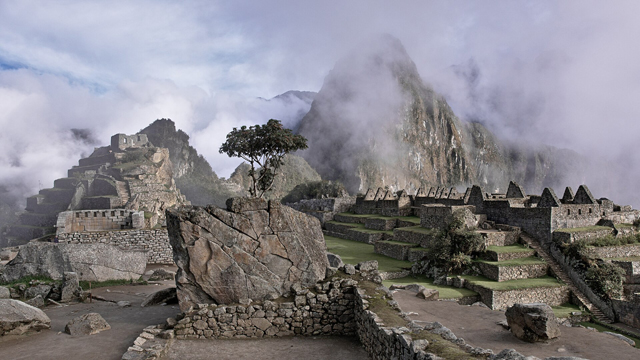
Photo by Tomas Sobek at Wikimedia Commons. |
December 22, 1977:
Cuzco is freezing me to the marrow of my bones. My soul, however is on fire. Tomorrow I will visit Machu Picchu, the “lost city of the Incas”.
My journey began thirty-three years earlier when as a ten-year old I discovered Richard Halliburton’s New Worlds to Conquer. Halliburton was an explorer, adventurer and reporter who chronicled his daily adventures in newspapers and books, and from the moment I discovered him, he owned me! I lived through each of his illustrated easy-to-read publications, devouring Halliburton’s knowledge of history and his adventures as I imbued my soul with his passion and ultimately planned to walk in his very footsteps! Now, with that as background and the fact that I’m a junior high school history teacher, I have begun this marvelous journey, deciding to spend my entire 1977 Christmas vacation in the land of the Incas.
December 23, 1977.
I had booked a stay in Cuzco at a small hotel for $1.65 a night and was surprised when the owner’s two sons, Paulo and Alejandro, met me at the airport. I told them my bag didn’t come through and they told me it was probably in Lima and would come up on the next flight, and not to worry. I still couldn’t grasp why my bag had gone from DC to Atlanta to Lima so easily—I saw it at the airport in Lima before I boarded my plane to Cuzco and assumed it would be picked up and sent on. My travel agent assured me it was checked straight through but I realized things were going to be a lot slower here south of the equator, so I unpacked my small carry-on bag, familiarized myself with the hotel and walked downtown slowly, because I had read about and knew the effects of Sirocco: mountain sickness.
As a boy who grew up with chronic bronchitis and suffered from asthma, I know that breathing on sea level is hard enough but here 11,100 feet high up the Andes, it might be deadly. The advice was for me to nap right away, walk slowly and never carry anything, so I walked very slowly toward the outdoor market a few blocks from my hotel and bought three wool sweaters for two dollars.
DECEMBER 24, 1977
Today, I visited the Cathedral and then walked over to one of Cuzco’s two restaurants: the Roma. The only word I recognized on the menu was “pollo”. . . chicken, I thought that’s always a safe bet! So I ordered mollejas de pollo, figuring it would be as good as any of the other chicken dinners. Well, it wasn’t. It turned out to be chicken gizzards, which were something my grandmother would have loved but unfortunately, she was no longer alive. So I devoured the rice, potatoes, and beans as dusk fell, I headed back to my hotel, where, sadly, I discovered there was no heat—no radiator—and nothing that was warm. It was so cold I could feel my teeth rattling so I put on the wool sweaters I’d purchased at the market, on top of my long sleeve shirt, on top of my undershirt, and then put on my heavy winter coat. . . yet I still shivered all night long.
Tomorrow will be Christmas Day, the first Christmas I’ll spend south of the equator, the only one I’ll spend this high. The day I met the owner, I asked how I could get a train ticket to Machu Picchu and he said he’d take care of it.
December 25, Christmas Day
The owner’s son came through and handed me my ticket and after paying him, I grabbed a cab to the small train depot and boarded the most marvelous train I’d ever been on.
My ticket was for second class…with the peasants and children and chickens and a little Peruvian boy who kept running back and forth as the train switched back and forth, saying “aqui, ali,” which meant here, there. We watched the smoking engine together, as the train snaked up and down the switchback struggling to get over the Andes. First aqui then ali. I had read about the term switchback and had no idea what it meant until I was aboard this train. Cuzco is in a bowl of the Andes—at the bottom of steep mountainsides and in order to get to the ruins of Machu Picchu it first had to climb up from Cuzco’s 11,152 foot elevation to the 13,000 foot tall mountain that loomed over us. The only way to do that was by traversing the mountain and in order to go up, we had do it in angles, first in one direction, then an engineer would hop off the train and literally switch the track, so we’d head backwards at a higher angle. And so it went, switch after switch until finally we reached the top of the mountain that surrounded this tiny Inca town known as Cuzco.
Cuzco was founded by Manco Capac in the 12th century and was the most glorious South American capital until ravaged by Francisco Pizarro in 1533 when he destroyed most of the beauty, elegance and power of the Inca Empire.
I looked back and thanked the boy for teaching me a few basic Spanish words as he hugged a chicken and sat next to his mom, kicking his feet back and forth under the straw mats that formed our seats as I settled back in this peasant filled second-class compartment, watching the people and listening to the chickens cluck.
Later, I looked through the door that separated me in second class from those in first: Germans, singing lieder and eating what looked like a very substantial breakfast—certainly far more substantial than my morning meal of toast and coffee.
Our train trip lasted several hours as we rode beside the Urubamba River. On the way, we passed Mount Veronica and the hydro electrical plant. When we finally reached our destination, I looked up and saw nothing but the mountain and wondered how Hiram Binghamton could have discovered this “lost city of the Incas”
We boarded a bus and climbed up the mountain for twenty minutes. When we got there, I looked down and saw the train station and the river.
We were totally hidden from their view, and I realized how brilliant the ancient Inca were to hide their city like this and realized it was based on angles just like my switchback out of Cuzco. By honing off parts of the mountain and creating terraces for their crops, their world was invisible to anyone below; instead, it was gloriously private, sacred in a sense, and majestic.
So, after exploring as much of the city as I wanted, and watching the Germans march around following their Fuhrer, I climbed as high up Machu Picchu as I could and took pictures of Huayna Picchu, her sister mountain, a thousand feet higher. Both it and the ruins below became forever etched in my mind.
After spending what seemed like an eternity taking in that view and snapping more photographs in my mind than on my camera, I walked back down to the ruins, through the citadel door, and marveled at the terraces. I looked through the window of the snakes, and visited the oriental district. I walked through the torture chamber, the temple of the three windows, the tower of death and the tower of stones (all these names were given by modern archeologists since no one knows what they were really called or what they really were. . . oh for a time machine!)
What was so utterly marvelous about today, was that I was nearly alone. Yes, there was a German group, but they stayed to themselves. So I wandered wherever I wanted, feeling more like an ancient Inca king that an American tourist. Finally, I saw a few picnic tables and put down my carry-on bag and walked off to take a few photos of the llamas. I was so engrossed with them that I lost track of where my bag was because when I went back to the picnic table, it was gone and I panicked for a moment, because I had no suitcase and nothing but the clothes on my back. Luckily someone had just moved it in order to take a picture, and I was soon reunited with my bag.
Altogether I felt as if I had gone back in time and was alone with the ancient Incan kings high up here in Inca heaven and I stayed until dusk before boarding the last bus heading back down the mountain. But as it reached the first hairpin turn, a small boy ran out from the surrounding forest and yelled. “HEYYYY.” None of the Germans seemed to notice, but I thought it was sweet to see a boy chasing after us and remembered the stories my dad had told me when he was a boy in Washington, DC. He’d hop on a streetcar and ride a block or so and then hop off and run like crazy for a block or two before hopping back on. This he did time after time, driving, I imagine, the conductor crazy…or maybe making a few of the adults smile. So smile, I did in honor of the boy and in memory of my dad, when the boy popped up again at the next hairpin turn. “HEYY” he shouted as I eagerly awaited seeing him again, perhaps at the next hairpin turn. Twenty minutes later, and after a dozen “HEYYYS,” the boy stood at the bottom of the mountain, smiling. He smiled even broader when I handed him a handful of pesos.
Soon I was aboard the train again, listening to the sound of the train as we rattled and rolled along the mighty Urubamba.
Surprisingly enough, my cab driver was waiting for me when I returned. He took me to the hotel and again, I walked to the Restaurant Roma on the square and had dinner as I celebrated one of the most unforgettable days of my life, but this time I looked around to see what the other diners were eating and when I saw something that looked good, I called the waiter and pointed to it. The waiter nodded his head—this time I had chicken livers! Delicious.
Of all the 100 countries I since have visited, and of all the adventures, this trip to Machu Picchu was the best! The memories of the mountains, the “Lost City”, the train ride, the market, the scampering boy, are so much a part of my soul—and I am so thankful that I visited this sacred pace in 1977 when few people on earth had even heard of it—let alone discovered the glory and beauty that it lent to me.
To sum it all up, I’ve tried to capsulize those moments with these words I wrote at home the following Christmas:
REMEMBRANCES OF THE URUBAMBA
Cuzco, bowl of the Andes, naval of the world, markets teaming with vendors hawking their wares to too few tourists on this lonely Christmas Eve. The conquistadors stole your gold five centuries ago but now no one gives a sol for your thoughts.
Your two tiny restaurants hug the square I choose the cheaper one—the Roma and eat pollo—chicken gizzards—served with potatoes and rice living like an Inca Indian peasant, ending my day like an adventurer while filling my belly with your blood.
Frigid walk to my hotel on this sacred Christmas Eve no heat and just two small blankets on my bed, sleeping in all my clothes, two sweaters and my winter coat, three pairs of socks don’t stop me from shivering through your night. Yet I also shiver from the vision of tomorrow, the anticipation of my trek up the Urubamba.
Paulo, the owner’s son, brings me my train ticket to Machu Picchu such service for $1.65 a night is more than Mr. Hilton could provide. After breakfast, he hails a cab as I head to the most mysterious place on earth in a train that will travel backward in time 500 years: Both Orson and HG would have envied me!
Sleepy, tired and cold, I board the second-class car at the bustling railroad station on the edge of town, in a city a thousand feet deep within a saucer of the mountains whose only way out is by air, hiking, or on a train. I’m ready, now, to discover what switch-backing’s all about—I’ve read about it, but I’m still not sure. Today’s practicum will be my first adventure of the day.
The Andes, tough, rough, ragged mountains are impossible to ascend straight up, so our train switches back and forth along its tracks. Each time the train stops, the brakeman exits and throws the switch. Then we chug backwards at an angle for several hundred feet to a slow bumpy stop before he switches the tracks again. Up—then back—five or six more times as our train struggles more fiercely than Manco Capac battled the Spanish at Sacsayhuaman half a millennium ago.
“Aqui…alli,” the boy next to me says, as we watch our train pull right, then left. “Here it is, there it is,” he repeats in Spanish as he transforms two simple words into actions I’ll never forget, And his ancient Incan eyes change from taupe to the deepest shade of brown as the dawn shoots up like the living god, Viracocha, and we float over the crest of the Andes into the valley of the Ur-u-bam-ba.
Wool skirts, big black hats, children crying, chickens clucking in baskets, birds everywhere, natives in multi-colored garments, men talking quietly, smoking or sleeping: this is second-class!
The toilet’s in a tiny room a gouged out hole in the floor with a private view of the tracks below. I stand watching my stream flowing into the hole then gaze at the Urubamba streaming outside the tiny window. When I was a boy, my grandma and I traveled on a train such as this. I wonder now if it might be the same—just misplaced here in time and place.
A boy cries, a girl sucks a fragrant orange as mothers suckle their infants. Every Peruvian woman has at least three small children—one suckling, one crawling, one working by her side. I wonder what life was like when the Sun God was Lord of the universe. and the Inca ruled the world!
Now I’m merely another poor American, traveling with the children of the sun to the sacred city rediscovered by Binghamton, training to Machu Picchu, the city of the gods down range from the unwashed tourists in first class out of sight of the Germans chomping their Wurst and Brot. I blend into the wind and the smoke, and become an Inca enveloped in distant time now that I’ve traded my dollars and my soul for the currency of the Sun.
The first-class tourists are finishing their breakfast now. Soon they’ll sing their Lieder and chatter among themselves. Ich verste Deutsche, I know banal when I hear it I’m so glad I’m with the peasants in second class experiencing a real adventure as I sit on my straw seat and listen to the chickens cluck.
Maria, the woman sitting opposite me, is making dolls. they’re dressed in Incan clothing and wear broad brimmed hats looking more like the people sitting around me than like the Incas of the past. I’m sure all the German tourists will buy them to take home to their Kinder und Enkelkinder but I wonder if they’ll notice the resemblance to you, Maria, as they carry them from the back to their first-class hotel.
Maria’s come all the way from Cuzco to sell her dolls I wonder why she doesn’t walk into the first class car and sell them now. I start to ask, but realize it’s for the same reason I dare not move—I, too, am living with Jim Crow in a land stolen by the first-class tourists and conquistadors in a land stripped of all its gold and glory and pride.
I wonder what those in first class think as the babies cry around me and the chickens cluck, here where the natives are alive in Technicolor in a culture too old to die.
I travel with the people in the second class car chatting with a teen-ager in my broken Spanish—each minute that passes linking me closer to her past. The Urubamba gurgles to my left as shallow as the first class tourists and as ancient as my friends. As the verdant rain forest spreads before me, the headwaters of the Amazon that stretches 3,000 miles before it drops into the sea.
Our train chugs slowly into a one-room railway station disgorging everyone at the jungle’s edge. The Germans waddle to their first class bus. I board an open truck and ascend the mountain with my new found peasant friends. Belching smoke and backfiring, our truck wriggles wormlike up the rugged peak: Huayna Picchu—Machu’s sister—looms above me but she has no city hidden on her peak—no tourist gold in her purse for her day’s work.
I look deeply into the morning mist trying to see the city waiting for me, yet, I only see the faces of my friends and hear the clucking chickens and the smell the rancid smoke.
The Urubamba is barely a trickle below me now and the Lionel-like train hugs its narrow track as a few tiny people wander in and out of the station so far below. Suddenly, without warning the ancient city looms before me: the stones, the sundial, the mysteries beckon me.
I jump from the truck as the Germans lumber along in single file behind their Fuhrer. They’re good Germans. They don’t stray. They don’t inquire. They don’t know how to think. I hear their guide tell them exactly what to do, where to go, what to see. They look where he points. They sit where he commands. They hear what he orders them to hear—so punctilious—the Germans, it’s a wonder they lost the war!
I scale Machu Picchu, scampering up the narrow trail, struggling up her time-worn rocks Ascending until I touch the clouds and stand looking at the Germans, wondering why they sit where they sit, wondering why they’re so afraid to come up to the top to see the world with me. I mentally photograph the city, the terraces, the ruins, the railroad, the Andes, the r-u-bam-ba: I etch it forever in my mind. I know I’ll never repeat this vision. I’ll never see Machu Picchu again. The train will be gone—the children dead—the chickens eaten, the cigarettes smoked, the mountains worn a millimeter lower, the ruins ruined, the Urubamba polluted; the life I see now: gone forever.
My photographs are stored away in albums in my attic and I shift my souvenirs from ledge to ledge around my house. The rock I brought home from Machu Picchu sits on my mantle collecting dust, but my memories have been digested. My visions have been fulfilled. And the mental pictures I took that moment are enough to raise Atahualpa from the dead.