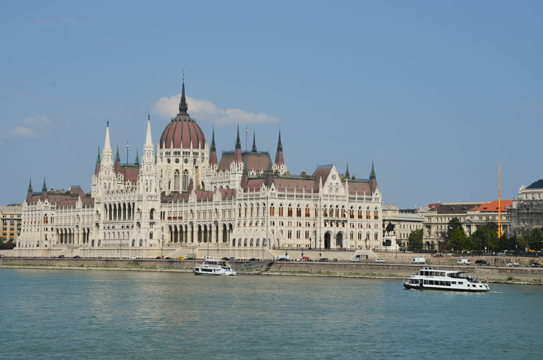
Majestic
view of the Hungarian Parliament Building along the Danube River in
Budapest. Photo by Samuel Hájnik at Pexels.
May
1 Thursday.
FLYING TO THE BALKANS. I shall spend the next 2 weeks in
Yugoslavia, Romania, Bulgaria and Hungary. I visited each embassy
last year to purchase my visas (more stamps in my passport) and have
done some reading on Yugoslavia and learned there are six Republics:
Serbia, Croatia, Slovenia, Macedonia, Montenegro and
Bosnia-Herzegovina. I chose this tour because I would be able to
visit all six areas. “Yugoslavia's problems began when the
Roman Empire was formally divided into East and West in 286
under Emperor Diocletian, who ruled from 284 to 305 to
stabilize
the vast empire by creating Tetrarchy—a system of four
rulers—and split the empire into two halves:
Maximian
ruled the
Western Empire with its capital in Rome and Diocletian ruled the
Eastern Empire with its capital in Nicomedia but in 324 Constantine
the Great chose Byzantium as his seat of power and renamed it Nova
Roma—Constantinople and it remained the capital until the fall
of the Eastern Roman Empire in 1453.
The
division was
intended to improve military defense and administrative efficiency,
so while the empire remained a single political entity in name, the
two halves governed separately. The split became permanent after the
death of Theodosius I in 395, when his sons divided the empire
between then.
I
also was excited
about visiting Hungary and Romania—one of the women at Northern
where I had taught school was from Cluj and she had mentioned it a
lot
May
2 Friday.
ARRIVAL IN BELGRADE, SERBIA. My guide, Brandy, met me at the
airport where I met the rest of my fellow travelers” Bill and
Bernadette; Peggy, a 70-something single woman and Doris, her
40-something travel companion; Ben and Sarah, John—a gay guy;
Donna and Henry Oselka from Minneapolis (Editor’s note: I
corresponded with Donna for many years); and Carlos and Juanita, a
newlywed Argentine couple. Juanita spoke no English, so Carlos sat
beside her for the entire trip simultaneously interpreting as her
guide. Brandy led us on our city morning tour along with a horrible
local guide who barely spoke English and when I asked her a question,
she had to start her patter all over again. I didn’t ask her
any more questions after that.
After
lunch, we
visited the Kalemegadan Fortress which sits on the confluence of the
Danube and Sava Rivers and was originally built by the Celts. It
surprised me how much the ancient tribes traveled—because I
have an Irish grandmother.
The
Turks ruled from
here when they controlled the area, but later the Austrian-Hungarians
refortified it in the 18th Century and used it
to protect
their realm.
The
Danube is the
home of three world capitols: Vienna, Budapest and Belgrade
(editorial note, I have visited all three—and, in subsequent
trips, traveled the length of the Danube from its origins at Europe’s
continental divide to Vienna). The word Danube means river in Celtic
and is Europe's second longest river after the Volga. That evening, I
stayed at the Hotel Inter-Continental.
May
3, Saturday.
BELGRADE. We visited the Petrovaradin Fortress, dating from
Roman
times, which is the mightiest on the Danube! I also visited St.
Michael the Archangel's Cathedral, the burial place of the Serbian
kings and the first church built after the expulsion of the Turks.
Yugoslavia has been a warlike nation for thousands of years. More
than 1.7 million Yugoslavs were killed In WWII and at one point 11
armies roamed the country, stalking one another.
After
breakfast,
while still getting to know each other, we all gathered by the bus
and talked while Brandy loaded our luggage on the bus before we had a
chance to make sure he had ours. Unfortunately, Brandy was new at his
position and, I believe, had never led a tour group before. We didn’t
realize the value of a well-seasoned guide until we arrived in
Budapest. Brandy had marked Ben and Sarah’s bags as going to
Bucharest and the bellboys had placed them beside the wrong bus. Ben
and Sarah made do in their same outfits for nearly a week. They
smelled “riper” and “riper” as the trip
progressed and graciously sat toward the rear of the tour bus until
they finally reunited with their clothes in Bucharest. They were the
nature of several good-natured jokes, of course, and the whole
experience made our group “closer” in more ways than one.
We were fortunate on our trip—there were only 12 of us
traveling but the bus easily accommodated 30, so we frequently spread
out—which was good because we ended up traveling over 2,000
miles in the bus in the ensuing two weeks. From that moment on, the
rest of us learned to be by our bus in the mornings to make sure our
bags were with us! [editorial
note: this is a lesson I have never
forgotten—I always identify my bag before I get on a bus or
plane—good guides sometimes even double check as their
“charges” get on board.]
May
4 Sunday.
YUGOSLAVIA TO SUBOTICA TO BUDAPEST. President Tito died
shortly
after we left Belgrade. Brandy asked for a moment of silence, and we
all complied but just as we got deathly quiet, Peggy started talking.
She was partially deaf and didn’t seem to know what was
happening and blurted out something or another. In a sense it was
very ironic because she very seldom said anything during the entire
two weeks. The sad thing is that Brandy told us there would be a
month of mourning in Yugoslavia and we would have no entertainment or
dancing when we returned to Yugoslavia for the last week of our tour.
After
traveling
northward to the border town of Subotica, we ended up waiting several
hours to cross into Hungary. [editorial note: The only other time
this has happened to me was when I was on the border of Guatemala and
Honduras later that same year during my Christmas vacation to the
Yucatan, Costa Rica, Honduras and Guatemala—there we had to
wait until we could find a guard to bribe ($1.00 or so) and, since it
was siesta, we ended up waiting 2 hours before we could cross over
into Honduras.]
John
was very
jittery and made me nervous; he was also a chronic smoker and hovered
around the rear of the bus, blowing his smoke out the window—although
the bus was supposed to be smoke free—no one complained. I
usually sat on the right-hand side of the bus, about two or three
seats from the front door. Carlos and his wife sat on the front left
and the little old lady and her friend sat behind them. We all had
our places and seemed very comfortable—it was a great group!
Finally, we reached Budapest late in the afternoon and stayed at the
brand new Hilton next to the Fisherman’s Bastion and St.
Stephen's Basilica at one of the most awesome city sites I have ever
visited. We could see the entire city below us—since we
literally slept in the ruins of an ancient castle. Late that night we
ate at the restaurant there—it was a fantastic place—they
even put bibs on us and had a Gypsy violinist play. We heard
violinists almost every night for the next week or so and each one
seemed to get better than the one before! It was a wonderful evening,
even though and I asked Bernadette, who was a music teacher, to
identify several songs but she was very tired and snapped at me. John
tried to hit on me in the evening—but I was so dumb I didn’t
know what was happening—he knocked on my door and acted very
strangely [editorial note: I didn’t come out until the
following year. I had just left my teaching job a few months before
and was still trying to come to grips with myself] Most of the people
in the group became great friends [editorial note: I wrote to Donna
at Christmas until 2005, exchanging cards and letters, when I assumed
she died. Bernadette and I wrote to each other for about a dozen
years after this trip—not bad in the pre-email era.] I avoided
John, however: he was like a walking smoke cloud and it was difficult
for me as a man who had never smoked to be anywhere near him.
The
view from my
hotel was fantastic I just wish I could share some photos with you
but go online and check out the marvelous cities of Buda and Pest.
May
5 Monday.
BUDAPEST. I awoke with a glorious view from my window in the
Fisherman’s Memorial Hilton Hotel and that view shall forever
be etched in my mind and then walked around the ruins of our castle
in the sky and of all the places I’ve ever stayed, this one
place has to be way at the top of the list as it’s difficult
for me to think of any other place on earth like it. We ate breakfast
and then spent the day touring Budapest!
May
6 Tuesday.
BUDAPEST. Again, I stood at the Fisherman’s Bastion and
looked across the Danube toward Parliament which is on the other side
of the river in Pest—what a sight! I, of course, was in Buda.
The only other time I had as exciting a view was when I was standing
on the bridge across the Black Sea at Istanbul—because that
bridge is the longest in the world. Why? You ask! Well, it starts in
Europe where I was and ends in Asia.
As a lifetime
philatelist, who specializes in US, Hungarian and German stamps, I
can assure you that the Parliament building is perfectly presented on
their stamps. Both are exceedingly beautiful—as is the Danube,
that river of song—that river I’ve sailed on and walked
along. It flows through 10 countries, and I’ve seen it in the
first 8: Germany, Austria, Slovakia, Hungary, Croatian, Serbia,
Bulgaria; and Romania—perhaps one day I shall view it from the
final two: Moldova and the Ukraine.
We
then visited
Matthias Church, which was built from the 13 to the 19th centuries
and then visited the Peles Castle, and saw the crown jewels at the
Hungarian National Museum before journeying to the Millennium
Monument. I rode the metro in Budapest and I try to ride metro in
each city I’ve visited (London, Paris, St.
Petersburg-Leningrad, Moscow, Tashkent, Beijing, Hong Kong, Santiago,
Rio de Janeiro, Mexico City, San Francisco, Boston, NYC, Washington,
Chicago, Sydney (sky train), Vienna, Vancouver, Rome, and I’m
sure a few others that I cannot remember right now.
Then
we rode to the
top of Gellert Hill for the view and listened to a folklore
presentation that night.
May
7 Wednesday.
TRANSYLVANIA TO CLUJ, ROMANIA. We left Hungary for Romania,
passing the site of Plevna’s Defeat where the Romanians beat
the Ottoman army and saved Europe from their onslaught. Then we drove
through the Transylvania Alps, and I don’t think I’ve
ever seen anything as beautiful in my life! It seemed as though each
time we crossed a mountain range the view literally became more and
more beautiful—until it literally took my breath away—and
then we rolled up and down from one side to the next and the next and
the next. Along the way, we saw the shepherds and their animals as
they came down from the mountains until we ended up at Count
Dracula’s Castle!
There,
we saw a
wedding procession before visiting Castle Bran, the palace in which
Count Dracula was born. I wore my Count Dracula teeth but received
strange reactions. The people in Romania revered Dracula. The truth
is that Count Dracula impaled the Germans who lied and cheated the
people. Since Bram Stoker, the author of Dracula, was a German, we
have an entirely different picture of the man—Dracula was no
vampire—but a hero comparable probably to our own George
Washington or Abraham Lincoln. As am author I know how much power I
exude so I try my best to ensure I am as fair especially when I have
a political statement to make re: gun control (as in Porcupines
Forever, which opened in gun Country North Carolina and was, perhaps
because it is a knock your socks off comedy, became an instant hit.
My first off-Broadway play on 42nd street in New
York was
about female teenage suicide—which is one of the 3 leading
causes of deaths for young women 13-25.
After
a long bus
ride and walk through the castle and exploration of the castle and
dinner we lodged at the Napoca Hotel in Cluj.
May
8 Thursday..
CLUJ TO BRASOV TO PLOESTI AND BUCHAREST, ROMANIA. I had
really
wanted to see the Ploteski oil fields since I learned how important
they were to the Germans during the Second World War—they were
like the Strait of Hormuz today, however I was so sleepy from the
rocking action of the bus that by the time we arrived, I was barely
able to lift my head up from the seat of the bus and look out the
window. There were thousands of oil rigs, but I couldn’t look
more than a few moments, before I fell back to sleep. We spent the
night in Bucharest. And the good news is that Sarah and Ben finally
got their luggage—they dressed for dinner, much to the relive
of the rest of us!
May
9 Friday.
BUCHAREST,K ROMANIA. Here we saw the Mausoleum and Memorial
to
the Heroes of the Revolution and the Arch of Triumph. Others are:
The
Arc de Triomphe,
completed in 1836, is the most famous example, honoring those who
died in the French Revolutionary and Napoleonic Wars.
The
Cinquantenaire
Arc in Brussels marking the 50th anniversary of Belgian independence.
Mexico
City,
Mexico – The Monumento a la Revolución, in
Mexico City, which is the tallest triumphal arch in the world at 67 m
(220 ft).
The
Narva Triumphal
Arch in St. Petersburg, Russia, I saw it there when the city was
still Leningrad.
Wellington
Arch in
London
Marble
Arch in
London
The Washington
Square Arch in New York City.
The
India Gate in
Delhi India, which is a war memorial commemorating soldiers who died
in World War One.
The
Arch of Triumph
in Pyongyang, North Korea modeled on the Paris arch and is slightly
taller at 60 m (197 ft).
The
Triumphal Arch
of Orange, in Orange, France is one of the oldest surviving
Roman-style triumphal arches, built during the reign of Augustus.
Later,
we visited a
Romania village, which was a recreation of all the house styles in
Romania. There we saw a Castranovan house, a Dragon Resti House, a
windmill, and houses from the west, north and south. The village was
unlike anything in Europe (although I later saw one similar to it in
USSR and in other countries,). Later that day we visited the art
gallery.
May
10 Saturday.
SOPHIA, BULGARIA. We saw the Church of Alexander Nevsky, the
largest church in the Balkans—from the outside it looks a
little like the Blue Mosque in Istanbul. The interior is highly
decorated with many fine murals including: the Wedding at Cana, the
beheading of John the Baptist and the resurrection of Lazarus. The
altar is impressively decorated with large lions. The interior of the
dome shows a picture of God in heaven surrounded by his angels.
We
also visited
Freedom Park, which has a large monument shaped in an obelisk like
ours back home in Washington. Then we went to the beautiful National
Academic Theater, which is in Georgian in style with massive columns.
There’s a lovely spraying water fountain in front of the
building. I went shopping and bought a Bulgarian bear by pointing at
it [editorial note: he is one of my prize possessions and sits on the
shelve overlooking me as I type this.) I took a cab home—and
the driver had a picture of Misha, the Olympic bear that I had in my
wallet. I showed him my picture and we both smiled. I gave him a
Washington DC postcard and I bet he has it to this date.
As
I sat in a park
watching the young women, I was very impressed with the Bulgarian
people—they seemed very sophisticated and mature unlike the
giggling teens I’ve seen at home.
May
11 Sunday.
SOPHIA TO MACEDONIA, MONTENEGRO AND DUBROVNIK. We returned to
Yugoslavia. But first, we went to Macedonia, the birthplace of
Alexander the Great and then to the capital at Skopje, where we saw
the Church of St. Panteleimon (Nerezi) built in the 12th century. We
saw the Franciscan Monastery built in 1321, Roman Baths, a mustard
field and dozens of colorful people. Then we went on to Montenegro,
where we visited the Monastery of Nikita (14th
Century)
and again marveled at the icons and mosaics. We also saw the Church
of the Holy Savior, the Kurchumli and the Sarcophagus for
Mustafa-Pacha (15th Century) and dozens of great mosaics in the
Monastery of Grachanitza. We drove on to Dubrovnik, stopping off at
St. Stephen for photos, before spending the night in Babin Kuk,
outside Dubrovnik.
May
12 Monday.
DUBROVNIK. We met our city guide, but I quickly broke away
from
her and walked the entire length of the wall. [editorial note:
starting on the 2nd or 3rd
day of our tour, one
by ne, we all “broke away” from our local city guides—we
found them too confining. Then, at the end of the day, we’d get
together at dinner and discuss our adventures. The next day, if we
remained in the same town, we’d take advantage of those travel
descriptions and go out again reliving our friend’s journeys
the previous day. I’ve been traveling for over 40 years and
never been with a group quite as adventurous as this one. We all did
our own thing, and no one complained about anything.] On my walk, I
watched the boys run through the ancient city gates, hiding from
their moms, as they climbed the dangerous rocks outside the city.
When I reached a place mid-way through my walk, I felt as though I
had been killed there in defense of my city, many centuries before—I
saw the ships attaching my city and heard the guns blasting away.
I’ve never before or since had such an experience. Have you?.
When I returned to the hotel, I learned that everybody on the tour
had broken away. The guide started to cry, claiming that this was her
first tour and she’d be fired. Ben and Sara—the last of
our group with her, who’d planned to get away, were stuck with
her all day. That night we shared our stories.
May
13 Tuesday.
LEAVING DUBROVNIK FOR HOMEWhat an absolute wickedly crazy
day. I
flew from Dubrovnik to Lubjana to Geneva to Paris to Gandor in Nova
Scotia to New York City to Philadelphia to Baltimore and took the
shuttle home to Capitol Hill, DC.
I’ve
been to
100 countries and met thousands of people, made scores of new friends
and fallen in love with so much of our beautiful world. I hope
reading this story makes you fall in love with part of it, as well.