Golden Rules And The Game Reserve
Sarah Nash
©
Copyright 2026 by Sarah Nash

|
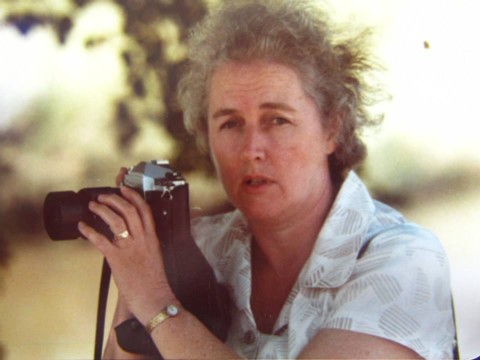
Photo courtesy of the author. |
Some of my earliest
childhood memories involve my gran's hands.
Sitting next to her
at her dining room table, feet dangling, I would watch as she trimmed
the ends off beans. Precision-wrapped a present. Cut around a pattern
pinned to a piece of fabric with decisive strokes of her fabric
scissors - which you were, under no circumstances,
to touch. (Note: The purpose of this rule was not for the safety of small
children. It was for the safety of the pristine scissors in the hands
of children who could not be trusted to use their heads.)
There was something
so capable about her hands, so no-nonsense. It was the way her nails
were always short and neat. The way her wedding ring lay flat against
her finger, like it was part of her hand somehow.
If I think about it
now, the wide, almost masculine ring was perhaps unusual for a woman
of her time. But, then again, so was she.
There were three
“golden rules” that she baked into our family lore.
One: Your time will
come. Do not withhold joy in celebrating others when it’s their
time. Be generous in your delight at other people’s wins. Your time
will come.
Two: If something is
lost, and it is meant to find its way back to you, it will. You just
have to trust.
Three: The Kruger
National Park (South Africa’s most famous game reserve) is a sacred
place.
Ok, that last one
was less of a rule than a feeling that was passed down through a
combination of osmosis and regular pilgrimages to the Park. But it’s
felt so deeply in our bones that it may as well be one of her tenants
still woven into our lives long after hers.
This story is about
rules two and three (although rule one lives quietly between the
lines too).
On one long ago
Kruger trip when my mom was little, the family Kombi pulled into the
sandy parking area of the Timbavati picnic spot (a name I never
really remembered whenever this story was told) as the sun started to
get hot. Tradition (aka, my gran) dictated that you left the camp at
dawn as the gates opened, and had your first cup of coffee or tea
when you came upon a good sighting, whatever that happened to be. If
luck dictated that you only saw something worth cutting the engine
for a couple of hours into your morning drive, well, that was the way
the Ouma rusk* crumbled (just kidding – my gran obviously baked her
own rusks).
Breakfast was
something you really had to hold on for. It wasn’t until you made
it to a chosen picnic spot, where you could alight from the vehicle
and pull out the picnic basket and Kadak camping stove, that you
could finally eat.
(As an adult,
whenever I break this rule – i.e. always – and take a sip of
coffee from my pre-prepped flask as we exit the
camp gates at
sunrise, I feel an interesting twinge of guilt.)
I imagine the picnic
spot they chose that day hasn’t changed a whole lot since my mom
and her three siblings climbed out of the hot Kombi, looking forward
to a final bush breakfast before the long drive back to Johannesburg.
A winding dirt track
leads up to a decent sized clearing in the bush where a handful of
tables and chairs sit under shady trees and a few little thatched
roofs. There’s a tiny “kitchen” area with a sink where you can
wash your dishes as you chat to the picnic caretaker. Apart from a
bathroom and the caretaker’s bungalow hidden by some rocks down
near the river, that’s it. A beautiful, isolated little spot which,
even these days, has no phone signal.
On that morning all
those years ago, my gran stood at the sink, cleaning the remnants of
an excellent breakfast off the plates. When she got to the pan,
particularly greasy after a full fry-up, she removed her wedding ring
and placed it on the side of the sink, not wanting to coat it in
bacon fat as she scrubbed the dishes.
It wasn’t long
before the picnic basket was loaded back into the car and everyone
climbed in, ready to head home but hopeful for a last lucky sighting
on their way out of the Park.
I don’t know if
they did see anything that day, because one thing eclipsed everything
else: at some point on the journey home, too late to turn back, my
gran realised that while she methodically packed the clean dishes
back into the basket, she had left something on the edge of the sink:
her wedding ring.
When they got home,
calls were made to whoever they could think of: the closest gate, the
closest camp. Her details were taken and she was reassured that if
they found it, they would let her know, but… you know how these
things go.
I never actually
asked my gran how she felt about this, but it’s not hard to guess.
She was pretty good at getting on with things, though, and I imagine
she made her peace with it eventually.
Years later, she
found herself back at that same little picnic spot in the middle of
nowhere. Towards the end of their stop under the shady trees, she
struck up a conversation with the caretaker – the same man who had
been there all those years ago, it turned out. A solitary existence.
“You know,” she
said, “I think about this place sometimes because I did a stupid
thing here once. I left my wedding ring next to the sink after
washing dishes, and I only realised long afterwards when it was too
late.”
He looked at her for
a long beat, nodded his head, and said, “Will you wait here?”
My gran watched him
make his way down the narrow path leading away from the clearing,
around a large rock. It was a little while before she saw him
returning, walking slowly up towards her. As he drew level with her,
he wordlessly held out his hand.
Sitting in his palm
was her wedding ring.
She was gobsmacked.
“It’s been
years!” she said.
The man nodded. “I
knew,” he said, “that whoever left it here would come back one
day. So I kept it safe.”
As I type this, that
same ring now sits on my right hand. It’s one of the most precious
things I own, not just because of the connection to my gran, but
because of this story. And this strange little addendum…
My gran never got to
know my husband, Joe. She died before I met him, and I often think
how much she would have liked him. He has his own family lore when it
comes to Kruger – a place that’s equally precious to them. A
place that, over the years of our relationship, became our place
in its own way, with our own new traditions.
One January
afternoon after a crazy storm, Joe and I went for a sunset drive in
Kruger. We stopped at a lookout point where you could get out the
car, and, one moment Joe was taking a photo of me looking at a
brilliant rainbow, and the next, as I turned around, he was down on
one knee, asking me to marry him. To say that I had less than zero
inkling that this was going to happen would be an understatement. In
fact, it was several moments before I could even form words.
The following
morning, after we found a spot with signal to call family and
friends, Joe suggested that we take a slow drive to a picnic spot
he’d seen on the map and have a champagne brunch (as he’d
sneakily packed a bottle under the seats). In full passenger princess
mode, wrapped up in the last 24 hours, I was very happy to let the
day unfold as he liked.
As I stood, a couple
hours later, looking at the sign at the picnic spot, I had the
strangest feeling. I sent a message to my mom that I knew would only
go through once we were in signal range again.
“What was the name
of the picnic spot where gran lost – and found – her wedding
ring?”
Her message came
through a few hours later as we drove through the Park with the
windows open, not really minding that we weren’t seeing much.
“Timbavati,” she
said.
Isn’t life
strange?
*A
rusk is a South African staple: a dry biscuit that is generally
dunked into a cup of tea or coffee before being eaten. Ouma is a
famous rusk brand.
(Unless
you
type
the
author's name
in
the subject
line
of the message
we
won't know where to send it.)
Sarah's
story list and biography
Book
Case
Home
Page
The
Preservation Foundation, Inc., A Nonprofit Book Publisher