Sara Etgen-Baker

© Copyright 2026 by Sara Etgen-Baker
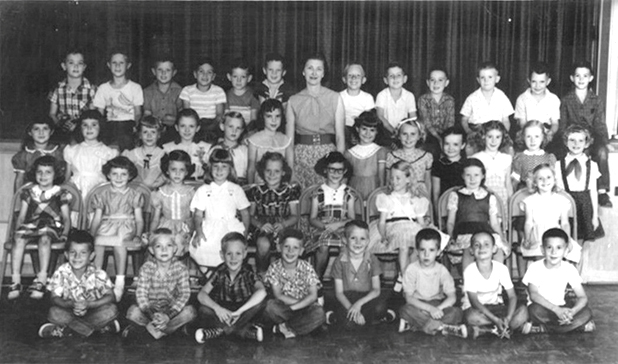
Mrs. Fletcher's first grade class, 1958. Photo courtesy of the author.
| To
Mrs. Fletcher With Love Sara Etgen-Baker © Copyright 2026 by Sara Etgen-Baker |
Mrs. Fletcher's first grade class, 1958. Photo courtesy of the author. |
"Mrs. Fletcher, I think I broke it," I whispered, staring down at the tiny porcelain teacup in my hands. The handle had snapped off when I’d squeezed it too tight during our afternoon tea party. My stomach twisted—this was a special set, one with tiny pink roses that she kept on the top shelf.
Mrs. Fletcher didn’t even glance at the cup. Instead, she leaned in, her perfume soft like vanilla.
"Oh, sweetheart," she said, plucking the broken pieces from my fingers with a chuckle. "That’s why we have glue." She winked, tucking the pieces into the pocket of her cardigan like they were treasure.
That was the thing about her—nothing ever seemed ruined—not the wilted dandelions we presented her in grubby fists, not even the time Tommy Phelps spilled an entire jar of purple paint down the front of her dress. She just smiled and said, "Well, now I’m royalty," spending the remainder of the day in her lavender-stained sweater.
Our first grade classroom wasn’t like the others. Mrs. Fletcher’s room had a rug on the floor the color of moss; and above it, a clothesline stretched wall to wall, pinned with our drawings dangling like little flags. But the real magic was the cardboard house in the corner—a lopsided palace we students built together, with a roof that sagged in the middle and wallpaper made from grocery bags we had painted ourselves. Mrs. Fletcher called it the Dream House, and every afternoon, she allowed two of us to move in, with strict instructions to share the one toy we were allowed to bring. That day, it was my turn. I clutched my Tiny Tears doll under one arm and watched as she knelt to straighten the crooked curtains she’d hung in the window—real curtains, with little blue flowers.
She caught me staring and smiled. "You know, houses aren’t about being perfect," she said, adjusting a potted fern beneath the sill. "They’re about being yours." I didn’t understand then, not really. But when I stepped inside and saw the walls covered in our fingerprints and smudged paint, something warm and tingly settled in my chest.
One day, she gathered us in a circle on the rug, holding a jar of cream, fresh from Buhler’s farm. "Who wants to make magic?" she asked.
Of course, we all did, shouting “Me! Me!” We passed the jar around, shaking it with both hands while she read aloud about Laura Ingalls churning butter in a snowbound cabin in the woods. By the time the cream thickened into pale yellow clumps, my arms ached, but I didn’t care. Mrs. Fletcher spread the butter onto crackers with a plastic knife, and when I took my first bite, it tasted like cold mornings and something impossibly rich.
Some years later while standing in line at the grocery store, a woman in line behind me notice the cartoon of heavy cream in my basket. “Did you ever shake cream until it turned into butter?" I blinked, jarred out of my thoughts.
"Well, uh…yes and no," I stuttered. "When I was six."
The woman’s eyebrows lifted quizzically. I hadn't meant to say it out loud, but the memory surfaced anyway—cold glass pressed between small hands, the slow, stubborn thickening of cream as we passed the jar around the circle listening to Mrs. Fletcher reading about churning butter in Little House on the Prairie, her gold bracelet catching the light every time she turned a page.
The woman in line was still perplexed, so I added, "It was for a class project,” stopping short of explaining how the butter had tasted like salt and soda crackers and something else, something I couldn’t name back then; how Mrs. Fletcher had smiled when I’d licked my fingers clean; and how she said, “Patience makes good things."
I paid for my groceries and stood in the parking lot, the afternoon brittle with winter light. My car keys jangled against the cream in my bag—the kind in a plastic carton, already pasteurized, easy and ready to use. It was nothing like the thick, yellowish farm cream Mrs. Fletcher brought into class, poured carefully from a glass milk bottle with a crimped metal cap.
I slid into my car, salty tears streaming down my face. Memories curled warm in my chest, and I suddenly wondered where Mrs. Fletcher was and if she still taught first grade in that same room with the wallpaper scraps and the cardboard house we’d all crammed into, giggling, our winter coats puffed around us like colorful cocoons.
Mrs. Fletcher undoubtedly was one of those rare teachers—one who comes once in a lifetime. I was fortunate our paths crossed, for she was the cornerstone of my love for learning and later teaching, a love that stayed with me my entire life.