Sara Etgen-Baker

© Copyright 2026 by Sara Etgen-Baker
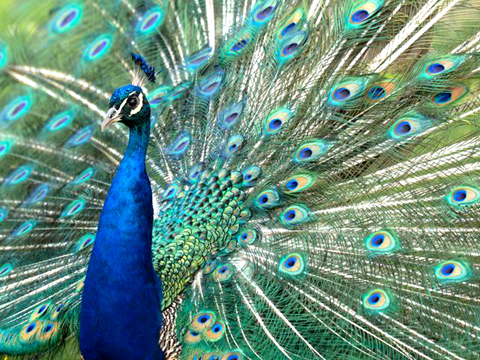
Photo by Jana Brenner at Pexels.
| Summer
Of The Peacock Sara Etgen-Baker © Copyright 2026 by Sara Etgen-Baker |
Photo by Jana Brenner at Pexels. |
My suitcase was Mother’s, a timeworn leather thing that had survived her college days and her move from Kansas to Texas after World War II. I grabbed the handle and stared across the street at the oyster-painted house—Aunt Betty’s place, the only address on the map that ever felt like a promise. Even before I knocked, Aunt Betty opened the door. She was a petite, stylishly dressed woman in her mid-40s, her hair styled into a flipped bob with a Western Union badge pinned to her cardigan. When she saw me, the smile that broke across her face was effervescent and welcoming. “You made it! I’ve been watching the arrival board all morning, just to be sure you weren’t lost in some sort of time warp. |
 Aunt Betty working at the Western Union office in Cape Girardeau, Missouri. Photo of courtesy of the author |
I grinned, setting my suitcase down onto the worn carpet. Her home smelt faintly of Chanel No. 5 and fresh laundry—her version of a warm, Missouri welcome.
The next morning we loaded her Barracuda sports car with two coolers, a sack of peanut butter sandwiches, and two bottles of lemonade. She handed me a folded map of Missouri’s highways, country roads, and byways. We drove out of town, the interstate unfurling like a ribbon of gray under a sky that seemed to stretch forever. The radio hummed low, a Patsy Cline ballad mixing with the rhythm of the tires. After a few miles, Aunt Betty turned off the radio and asked, “Have you ever seen a peacock up close?”
“No, Aunt Bet. I’ve only seen pictures of them in the encyclopedia.”
“Well, there’s a peacock farm off Route 63 past the corn and soy fields—worth every mile. Peafowl Acres, I think.
I’d never seen a peacock, let alone a farm of them, so the idea felt like stepping into a storybook. As we drove, the landscape shifted from the city’s industrial warehouses to rolling hills dotted with silos and windmills. On the byways, the roads were lined with wildflowers; I heard the faint buzz of bees and smelt the scent of fresh earth rising whenever we passed a ditch. Aunt Betty leaned towards me, pointing at a low-lying shrub. “That’s a lilac bush. Peacocks don’t like lilac; it’s too sweet for them.”
She laughed, a soft, unguarded sound that made the car feel cozy.
The farm we pulled into was tucked behind a weathered red barn, its roof sagging under the weight of summer heat. A wooden sign, faded to the color of old denim, read Peafowl Acres. The gate creaked as we pushed it open, and the world seemed to tilt. A wooden fence surrounded a large open field where a dozen or so peacocks strutted, each displaying an array of iridescent blues and greens that seemed to flicker even in the late afternoon sun.
A man in a straw hat, his hands speckled with feathers, stepped forward. “Welcome! I’m Carl—owner, caretaker, and occasional peacock whisperer.” He tipped his hat, the brim catching a flash of iridescent blue. Carl led us through rows of enclosures. In a low reverent tone, he introduced each bird by name and discussed how he raised each peacock from birth.
“We start them as chicks, barely the size of a thimble. They’re blind, so we keep them warm with heat lamps and hand feed them until they can peck at the grain on their own. By their first molt, they start showing little spurs—precursors to the grand fan you see in older males.”
I watched a baby hatchling push its way out of a nest, its downy feathers still trembling.
Awestruck, I noticed a fully grown male spread his tail in a slow, majestic arc. The eye-spot patterns looked like a galaxy, each one a distant star. The air shivered with the rustle of his feathers; and for an instant, I believed the entire world had paused to admire this living tapestry.
Wide-eyed, Aunt Betty and I leaned in close enough that I could smell the faint musky scent of the bird’s feathers, a scent that mingled with the sharp tang of citrus that a nearby lemon tree was shedding.
Did you know,” Carl continued his peafowl discussion, “peacocks hate the smell of citrus, vinegar, and pepper—anything that cuts through their regal aura. So, I intentionally planted that lemon tree to keep them away from our house.”
I stared at the bird’s tail again, the colors deepening as the sun began descending. The moment felt ceremonial, almost surreal. When we finally left the farm, the sky was bruised with the first hints of twilight. Carl handed me a small, velvet-lined box as a parting gift. Inside was a delicate silver necklace, its pendant a miniature peacock, its feathers etched with such precision that they captured the iridescent sheen of the real thing.
“For you, to remember that beauty can be both loud and quiet,” he said, his voice muted, as if fearing the peacocks might hear.
Aunt Betty squeezed my hand, her eyes soft. “You’ll wear that when you’re far from home. It will remind you that there’s always something worth pausing for, even on the busiest highways.”
I thanked Carl and slipped the necklace over my head, feeling the cool metal against my skin. The remainder of the summer rolled like a river through small towns, county fairs, and late-night conversations with Aunt Betty sipping lemonade on her back porch. When I heard the distant rattle of a bus or the hum of the highway, I remembered the crackle of the peacock’s tail, the Carl’s reverent words, and the scent of citrus that made a bird turn its head in disdain.
My two weeks with Aunt Betty were a pilgrimage into a world where a single bird taught me about patience, pride, and the fleeting nature of splendor. For decades, the necklace sat upon my chest, a quiet compass pointing me back to that summer in Missouri, back to the moment when I learned that even the most regal of creatures can be offended by a whiff of citrus and that sometimes, the most profound lessons arrive on a silvery bus and end under a fan of iridescent feathers.