Legacy Of The Forest: The Ohiaeriaku Lineage


Sally Bonn-Ohiaeriaku



© Copyright 2026 by Sally Bonn-Ohiaeriaku
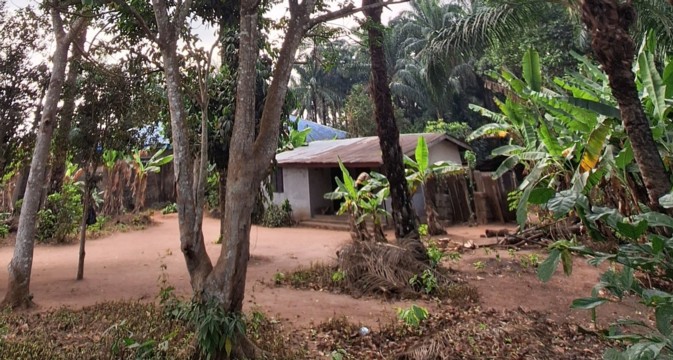

Photo courtesy of the author.

I remember standing outside the examination hall, waiting to take the compulsory West African Examination Council (WAEC) exams for final-year secondary school students. When the exam invigilator called my name, he struggled with my surname, OHIAERIAKU, attempting to pronounce it as a non-Nigerian might. After several failed attempts, I stepped forward, enjoying the moment and his discomfort, and he remarked, “Why do you have all the English vowels in your name?” It then dawned on me that my surname contained all the English vowel sounds: A, E, I, O, U. He was fascinated and asked about the meaning of my name, which I shared after the exam. I was unaware of its full story and felt compelled to learn more, so when I got home, I asked my late father to explain. He proudly shared its history as I listened closely, settling in beside him.
                                                                                                  ***
Many years ago, in the village of Ogwuaga Abba, an Igbo-speaking community in Nwangele Local Government Area, Imo State, Nigeria, there lived a man named Obubu. He had multiple wives, but none bore him a son; he only had daughters. At that time, having a son was essential for continuing a man’s lineage and identity. For the people of Ogwuaga Abba, lineage was more than blood—it was the foundation of their heritage. Each man kept his wealth, riches, and destiny sealed in spiritual native bags hidden deep in the forest, watched over by a Dibia, a seer, spiritual doctor, and chief priest who communicated with the spirits and gods of the land. The villagers worshipped many gods, which today might be regarded as pagan by Christians.

As Obubu aged, he wrestled with a sense of unfulfilled purpose. His heart was haunted by the silent pleas of his ancestors. In his despair, he confided in his close friend, the Dibia, expressing his wish that upon his death, his destiny and possessions be released into the wild forest—that the gods had deemed him unworthy of a son. This was his desperate attempt to confront the void of worthiness that consumed him. He felt like a failure, not only to himself but to his heritage, having started giving away his physical possessions—his house, lands, and other valuables—to friends, neighbours, and strangers.

The Dibia, moved by compassion, encouraged Obubu to make one last attempt to conceive a son before releasing his spirit and wealth into the forest for reincarnation elsewhere. This belief was common among the Igbos then and persists today. When a child is born, a diviner is sought to identify whose incarnation the child is. Obubu, having given up on seeking help from the gods or multiple wives, found the solution radical: sleep with his youngest daughter. Marriage rites were swiftly performed, and he took her into his home. If she did not bear him a son within a specific period, he planned to proceed with relinquishing his wealth and destiny to the forest. It was an act of faith—and madness—hovering between hope and resignation.

After a full moon, Obubu was awakened one night by the cry of a baby. He learnt that his youngest wife had given birth to a son. Neighbours and friends gathered in his compound, celebrating with ululations and preparations for a feast. At that moment, Obubu’s heart raced as he remembered that his wealth had begun to disperse into the forest a year earlier. He clutched his chest and hurried to the Dibia’s home, stopping along the way to call on neighbours and friends, requesting them to return his prized possessions now that he had a son and heir. Obubu implored the Dibia to summon his spirits back, exclaiming in Igbo language:

Ohia — bush/forest,
Aga – will not,
Eri – eat,
Aku’m – my wealth!” 

This proclamation was a declaration against the destructive forces of the forest and an assertion of belonging. In that era, women did not inherit property, making the birth of his son a significant turning point for Obubu. He named his newborn Ohiagaeriakum, later shortened to Ohiaeriaku. The Dibia congratulated Obubu and departed to carry out his instructions in the forest.

With the birth of his son, Ohiaeriaku, a new lineage was established, symbolizing hope and renewed potential after a history of despair. As he grew, Ohiaeriaku navigated the complexities of his identity and cultural tradition. He became the envy of his peers and the village, especially those from whom his father had retrieved possessions when he doubted he would have a son. Following his father’s example, Ohiaeriaku married multiple wives to prevent history from repeating itself, as was customary in their days.

One of his wives bore my grandfather, Daniel Adugba Ohiaeriaku. Daniel served in World War II, drafted by the British colonizers and fighting in Germany. After returning injured, he married one woman and remained with her until his death. He had three sons, including Bonn Uzoma Ohiaeriaku, my father and ancestor. Christianity had started to take root in Ogwuaga Abba through Catholic and Anglican churches, leading to the adoption of English names after baptism.

Bonn Uzoma Ohiaeriaku married only once and fathered me, along with my siblings. I am the fourth generation of the Ohiaeriaku family—tracing a lineage of four generations from Obubu, with an extended five generations recorded. As a new generation, my existence bridges the past and the future. The family, once marked by exclusion, now begins to write a new story. Through Obubu’s desperation, I embody the potential of engaging with otherness. I honour a legacy that reflects the evolving nature of identity, tradition, and family heritage.

Women, previously marginalized, are now forging their own paths, inheriting property and rights within the Ohiaeriaku family—testaments to changing gender roles and inheritance practices. Igbo feminist women have pushed further, legally securing their right to inherit property through the court system and in accordance with the Nigerian constitution.

Family Tree:
Obubu (deceased) → Ohiaeriaku (deceased) → Daniel Adugba Ohiaeriaku (deceased) → Bonn Uzoma Ohiaeriaku (deceased untimely) → Sally Nneka Bonn-Ohiaeriaku (living).                                                                                      

Sally Bonn-Ohiaeriaku is an Igbo woman from Eastern Nigeria who is passionate about the arts. Her work has been featured on Storyhouse.org,  themanifeststation.net, and others.  She also volunteers with NGOs in her community as an environmentalist. 


Contact Sally
(Unless you type the author's name
in the
subject line of the message
we won't know where to send it.)
*****
If the link to the letter doesn't work you can copy
 and paste in this address: preserve@storyhouse.org


Another story by Sally

Book Case

Home Page

The Preservation Foundation, Inc., A Nonprofit Book Publisher