|
Ode
To Fountain Ferry Ronnie Dee
(c)
Copyright 2026 by Ronnie Dee |
|

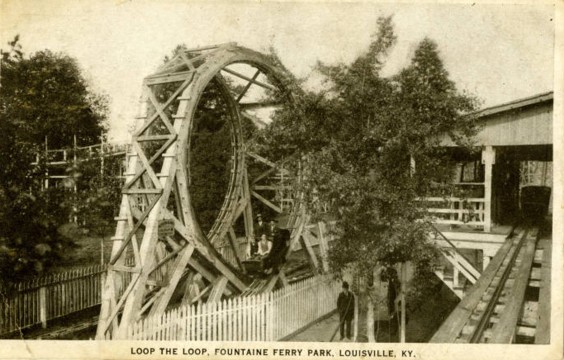
Fountain Ferry. What great memories and what great fun! Fountain Ferry was actually Fontaine Ferry Park, an amusement park in the West End of Louisville, Kentucky. It was built in 1905 and closed down in 1969.
I was born in the West End in 1939 and moved out in 1964, having moved around a lot as a youngster, but spent most of my time in the West End. People came from all over to visit Fountain Ferry, but us West End kids only had to hop on our bikes and pedal to it, or even walk on a nice day.
For those of you who don't know, it was a sixty four acre amusement park with a swimming pool, a dance hall and a carousel, or a merry-go-round, as we called it. It was located at the foot of Market Street and Southwestern Parkway on the Ohio River.
It sat right at the northern end of Shawnee Park. Shawnee park had ten baseball/softball diamonds, tennis and basketball courts and plenty of picnic tables and trees. It had a pond and it sat on the banks of the Ohio River. It was one more thing that made the West End such a great place to live. You could go right down to the riverbank as a road ran along beside the river and there was a lover's lane parking area down there, too.
There was another place, a cutoff, which featured an old cannon where one could park and easily detect the police or whomever might enter the cutoff. The police would patrol and chase necking couples out of the area from time to time.
Across
Broadway and down Southwestern Parkway a bit was Chickasaw
Park. Shawnee was all white and Chickasaw was all black.
To
the northeast of Fountain Ferry along Northwestern Parkway is the
Shawnee Golf Course.
I can still smell the tanbark. It was spread out all over Fountain Ferry. One of the main attractions was the pool. It was always crowded on a summer day. The merry-go-round was a wondrous thing with antique horses and music playing constantly. There was "The Whip," the "Tilt-A-Whirl," the bumper cars and many other rides.
The premier ride, besides the carousel, was "The Comet," the wooden roller coaster. I don't remember if the merry-go-round had a special name but it was something special. We couldn't ride it enough. The skating rink was very popular as was the Gypsy Village nightclub.
The whole park was awash with lights every night and it was quite a spectacle. The Hilarity Hall was right in the middle. It was an amusement park inside an amusement park. I think it cost about fifteen cents to get into the park and then you paid for the rides as desired. The Hilarity Hall cost, I believe a quarter, but all of the attractions inside were free. It was a fun house, with slides and trick walkways with hidden electric buzzers and blow holes in the floor to blow up girl's skirts. It featured the "Sugar Bowl." It was a huge bowl that spun around faster and faster, pinning its occupants to the sides. We would always try to crawl up the sides as high as possible.
Jack and I frequented the place, mostly sneaking in, which wasn't too hard to do. Likewise the Hilarity Hall. There was no way I could have paid a quarter to get in there all the time. We would save our nickels and dimes to ride the Comet as often as we could. We would sit in the last car, after surmising that it was the fastest car. The lead car is doing all of the pulling, while the last car is the last one to come over the risers and by the time the lead car has just started to speed up, the end car is flying over the rise at full speed.
I don't believe it had seat belts. It was constructed to keep you in the car, by undulating just enough to make you feel threatened and then it would surge up again, pushing you down in the seat again. Jack and I figured this out and we would get in the last car and stand up. That is, we would wedge our feet under the seat in front of us and stand up, leaning against the top of the backrest of the seat and hold our arms up high. When the coaster rolled over the top and plunged down the track, you could feel yourself starting to lose your grip and just as it seemed like you were going to go flying over the seat somewhere in space, the coaster would surge upward and push you back down in the seat. You could actually feel and hear the rear wheels lift slightly off the track and clack back down.
It was very exciting and the first time I did it, I thought I was a goner, but I had to do it.
We were Chastised and banned from riding a number of times, but we would always figure out a way to ride again after a few days.
As a teen, my sister spent many hours at the skating rink. I was not a good skater and so I didn't spend much time there. The West End was such that she would walk to the rink and back home at night, sometimes by herself and think nothing of it. It was about a mile and a quarter walk.
I had my first, bought-out beer in the beer garden. One evening Jack asked, "Want a beer?"
I said "Sure," so he went up to the bar and brought back two bottles of beer. We sat down amidst the tanbark and drank our beers. He may have been eighteen. I was sixteen. No one said a word.
The swimming pool was at the end of the lot and we could ride our bikes right up to the chain link fence to talk with our friends and watch the girls. It was there where our friend Steve's brother drowned.
There was a picnic area on the grounds and many birthdays and holidays were spent there.
I had no idea the whole time we went there that it was actually segregated. That is a sad state of affairs but I just never gave it a thought. I was raised in segregated cities and never asked why. I mean, I was in a situation about which I pretty much had known nothing my entire life. I wore hand-me-downs and lived off of the "kindness of others" until I was almost twenty. I just wasn't very sympathetic to the plight of others or the affairs of the world.
But in 1964, the park was integrated, as it should have been all along. Shortly thereafter protests naturally ensued and in1968, riots. I was visiting friends in Florida when we saw the riots on TV. It was national news. One would have thought that the whole of Louisville was on fire. But it was pretty much contained to the Fountain Ferry area.
Anyhow,
there were a couple of fires, the park closed down in 1969, then
opened as a couple of ill-advised ventures and closed for
good
in 1975. A Louisville institution lost forever, but it was
time.