From Japanese Classrooms To Indian Palaces
Rickesh Advani
© Copyright 2026 by Rickesh Advani

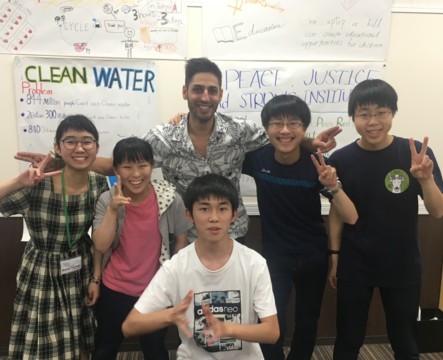
Photo courtesy of the author.
From Japanese Classrooms To Indian PalacesRickesh Advani © Copyright 2026 by Rickesh Advani |
Photo courtesy of the author. |
I had imagined something more straightforward. A few weeks teaching, plenty of travelling, some interesting people and probably a few questionable decisions along the way. I've always been quite good at the last two.
The whole thing happened while I was at Cambridge. I'd arrived there as a mature student after a rather unconventional life, which included leaving school at fourteen, making money very young, losing an awful lot of it, selling The Big Issue and running a charity. So I wasn't your typical undergraduate looking for a nice line on a CV. I wanted to get out and experience things. Japan was somewhere I'd always wanted to spend proper time, not just a couple of days running between landmarks with a camera.
And there was this summer education project. We would travel around Japan and deliver courses to small groups of schoolchildren. Six courses in total, one week each, usually four or five students in a group. They were about thirteen or fourteen years old. We were supposed to help them with confidence, communication, aspirations and life plans. It sounded wonderful.
Then I began to understand the economics.
We had paid to be there. The parents, meanwhile, were being charged more than £1,000 per child per week. So there I was, in one of the most fascinating countries on earth, doing the mental arithmetic on a programme where the staff had paid for the opportunity to work and the customers were paying handsomely for the privilege. Somebody was doing very well out of it. Unfortunately it wasn't the students doing the teaching.
I couldn't help finding that cheeky. I'm an entrepreneur, I understand that programmes cost money to organise and that businesses need to make a profit. But there's a difference between a fair exchange and a situation that makes you raise an eyebrow. I raised both. Then got on with it, because the children weren't responsible for any of that and they deserved a good experience.
What bothered me more was what we were asking them to do. These kids were barely teenagers and we were encouraging them to set out these incredibly definitive plans for their lives. Which university? Which profession? What steps would they take to achieve their goals? There were all sorts of exercises designed to make them sound confident about the future.
Now I know there are strong educational expectations in many Japanese families, and I wouldn't pretend six weeks gave me the authority to explain an entire culture. But I did find it a little heartbreaking at times. I was looking at a thirteen year old being asked to talk as if the next thirty years were already mapped out.
At thirteen I certainly didn't know what I wanted to do. At fourteen I left school. If someone had shown me a plan of my actual life, I would have thought they'd written a rather implausible film. And I hadn't even got to the part involving a princess yet.
So I tried to bring a different perspective to the sessions. I would ask the children what they actually enjoyed, rather than what sounded impressive. What would they do if they weren't worried about disappointing their parents? What were they curious about? What would they like to try before deciding what they wanted to become?
Some were shy, some incredibly serious, some much funnier than they initially let on. Often the most rewarding moment wasn't when a child delivered a polished presentation. It was when somebody who had hardly said a word suddenly started talking excitedly about something they loved.
I remember thinking that confidence isn't necessarily knowing the answer. Sometimes it's being comfortable enough to say you haven't worked it out yet.
Before leaving Britain I'd learnt about omiyage, the Japanese custom of giving gifts, often things brought back from a journey or a particular region. I liked the thought behind it. Gift giving is something I've always enjoyed, not because it has to be expensive but because it tells someone you've thought about them. So I'd taken gifts for the children I was going to meet.
It made packing slightly ridiculous. Most people calculate how many shirts they'll need. I was trying to work out how many presents I could carry without abandoning my own belongings. But I was glad I'd done it. The little exchanges gave us something human to connect over, something beyond another exercise about their future career prospects.
And outside the classrooms, I had Japan to explore. Tokyo was extraordinary. I could stand in a station and be fascinated just watching people move. There was this amazing sense of order inside an enormous amount of activity. The trains, the crowds, the packaging, the little courtesies, the way people made space for each other. My brain is always looking for patterns, and Japan gave it more than enough to do.
I have ADHD and autism. For me that can mean noticing tiny details while simultaneously trying to understand the entire system they're part of. It's a wonderful way to travel, although it does mean that somebody can ask whether I'm enjoying the view and I'll start explaining why the pedestrian flow at a railway station is so interesting.
Kyoto felt completely different. Temples, gardens, traditional streets, places where you could suddenly escape the urgency of modern life. Then we travelled to places further up in the mountains, where the pace changed again. I loved that. Japan wasn't one thing. It was a hundred different worlds, and every time I thought I'd started to understand it, another place showed me something new.
The food was another education. I like trying things, and I'm quite happy eating somewhere simple if the food is good. In fact some of my favourite meals in life have been in places with absolutely no pretension. A beautifully prepared meal can make you stop and appreciate the moment in a way that an expensive restaurant sometimes fails to do.
By the time the project finished I had spent weeks moving through a country I could easily have stayed in for months more. I felt lucky, inspired and a bit annoyed at the commercial arrangement, all at once. That's fairly typical of me. I can love an experience and still have an opinion about how it could have been run better.
But the next part of the summer was going to turn everything upside down.
I was heading to India with friends from university. There were about seven of us, and in my head I had a very particular picture of what the trip would look like. I'm of Indian heritage, and I wanted to connect with the country in a way that felt personal. I imagined busy streets, markets, eating street food, talking to people, wandering around and getting slightly lost. I didn't need luxury. I wanted to feel part of the place.
Instead I ended up staying with billionaires.
I know. It's difficult to make that sound normal because it wasn't. One introduction led to another and suddenly the version of India I was seeing was almost comically far removed from the one I'd pictured. We were guests of extraordinarily wealthy people, living in homes that were closer to palaces than anything I'd previously known as a home.
One of the places was next to Birla House in Delhi, now known as Gandhi Smriti, where Mahatma Gandhi was assassinated. I found that particularly strange. Here was a place associated with someone who had made simplicity and moral conviction central to his public life, and I was staying beside it in an environment of extraordinary private wealth.
The contrast wasn't subtle. There were staff, drivers, arrangements made before we'd even thought about what we wanted to do, and armed security when we went out. I'm used to getting around independently. I like negotiating my own way through a place, working out where to go, finding food and seeing what happens. Suddenly there were people organising everything.
It was wonderful hospitality, and I don't want to pretend I didn't enjoy it. Of course I did. Who wouldn't be fascinated by a level of luxury that most people will never experience? But I was also very conscious of the strange bubble it created.
I had come to India wanting to walk the streets and understand everyday life. Instead, I was being driven through those streets in a world where practically every difficulty had already been removed for me. It made me wonder what I was actually seeing. Was I getting closer to India or further away from it?
We spent time together as a group, visiting places, meeting people, sharing meals and trying to take in the whole experience. There's something lovely about travelling with friends from university because you already have a shared language of jokes and memories, but you're all seeing things for the first time. One person is fascinated by the history, another by the food, someone else is already asking what we're doing that evening. It becomes its own little travelling community.
And then there was the princess.
I met a woman connected to the royal family of Patiala, and she took a romantic interest in me. Which is the sort of sentence I never expected to be able to say about a holiday. I had travelled to India expecting samosas and chaotic taxi rides. Somehow I'd found myself in a story involving royalty.
What struck me wasn't just the title. It was how ordinary the human side of it felt. You can be sitting with someone whose family history and financial circumstances are almost impossible to relate to, but you're still talking, laughing, trying to work out what the other person thinks of you. Wealth doesn't remove the awkwardness of human relationships. It just gives them a more impressive backdrop.
I've never been especially intimidated by famous or wealthy people. I once asked Bill Gates what his favourite animal was, which probably tells you something about my approach to important people. If I'm curious about someone, I'll ask them a question. The title is interesting, but the person is more interesting.
India made me think about that constantly.
I'd already experienced extreme changes in my own financial circumstances. When I was younger I had been very focused on money, status and what success looked like from the outside. Then I lost everything and ended up selling The Big Issue in Covent Garden, surrounded by people with tremendous wealth while I had almost nothing. That period changed me. I met people with very little who were incredibly generous, and I started to think about what I called the inverse correlation between wealth and humanity.
It's not a scientific law, obviously. I've met wonderfully generous wealthy people and unpleasant people with nothing. But it was a pattern I'd noticed, and one that made me question my old assumptions about success.
Now here I was in India, being welcomed with extraordinary generosity by people who happened to be billionaires. It challenged my own generalisations again, which was good for me. It reminded me that people are never as simple as the categories we put them into.
But there was another side to it. The privilege was so complete that it became easy to forget the world outside the gates. When you have drivers and security and people taking care of every arrangement, you can spend a day in a city without really encountering the problems most people living there face.
I found that both fascinating and uncomfortable. Not because anyone had done anything wrong by being hospitable, but because I knew how different my experience could have been without those connections.
I kept thinking about the India I'd imagined before arriving. The food stalls, the street conversations, the ordinary people. I still wanted that. I didn't want to leave having seen only the extraordinary wealth of a very small part of society.
And yet I wouldn't trade what I experienced. I'd seen a side of India I hadn't known existed, met remarkable people and learnt about the country through friendships and hospitality that money alone couldn't have arranged. It was real, even if it wasn't the reality I'd expected.
That's something I came to appreciate. There isn't one authentic India, just as there isn't one authentic Japan. A country belongs to the people living all the different versions of it. The street vendor and the billionaire are both part of the story. The mistake is thinking that meeting one means you've understood the other.
Looking back, the two parts of my summer make a rather strange pair.
In Japan I was helping children make plans for their lives, while privately wanting to tell them that some of the best things in life are completely unplanned. In India I was living proof of that. I had arrived with one idea of what the trip would be, and found myself in a world that I couldn't have predicted in a hundred attempts.
In Japan I was thinking about ambition before it has really begun. In India I was looking at what happens when ambition and wealth reach a level most people can barely imagine.
And in both places I found myself coming back to the same thing. People.
The children who relaxed when somebody gave them permission not to have all the answers. The friends I travelled with. The families who welcomed us into their homes. The conversations that made me reconsider something I thought I understood.
For me that's always been the real value of travel. Not collecting countries, not the nicest hotel and certainly not having the most impressive photograph to show somebody afterwards. It's the opportunity to see a completely different way of living and then question some of the assumptions you've been carrying around your whole life.
I also learnt something about my own neurodivergence. For years I'd thought about my ADHD and autism partly in terms of the difficulties they could create. But travelling reminded me how much I enjoy being somewhere unfamiliar, having to observe, adapt and connect. My mind is always working, sometimes too much, but it also helps me find interest in almost everything. A conversation, a street, a cultural custom, a strange business model. There's always something to understand.
And I learnt that being adaptable doesn't mean never feeling uncomfortable. I was uncomfortable with parts of the Japanese programme. I was uncomfortable with aspects of the privilege in India. But those feelings made me ask better questions. I didn't need to reject the experiences to learn from them.
When I eventually came home, I didn't feel I'd completed some grand personal transformation. That's not really how life works. I was still me, still curious, still opinionated, still capable of getting distracted by something ridiculous when I should probably have been concentrating on something sensible.
But I'd brought home a few things that mattered. A greater appreciation for the freedom to change your mind. A deeper understanding of how wealth can both open doors and put distance between people. And a reminder that the most interesting experiences often begin when the trip stops going according to plan.
I went to Japan expecting to teach children about life. I went to India expecting to reconnect with my heritage. Instead, Japan taught me something about freedom, and India taught me something about privilege.
And somewhere along the way, I apparently became the sort of person who can say he spent one summer teaching Japanese teenagers, staying next door to the place where Gandhi was assassinated, travelling with armed security and being courted by a princess.
Which still sounds ridiculous when I say it out loud.
But I suppose that's why I travel. If I already knew what was going to happen, I probably wouldn't find it nearly as interesting.