What Her Sari Covered
Renesa Lalchandani

© Copyright 2026 by Renesa Lalchandani
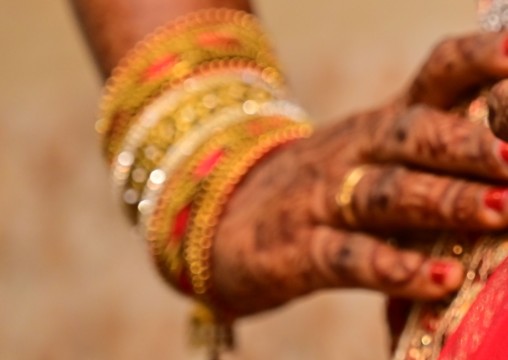
Photo by BANU FILM ADS at Pexels.
What Her Sari CoveredRenesa Lalchandani © Copyright 2026 by Renesa Lalchandani |
Photo by BANU FILM ADS at Pexels. |
Her bangles came first, a dozen thin, colorful bangles stacked on each wrist, clinking together as she crossed the room towards the kitchen. Then her voice, calling out a greeting in Hindi to my grandmother. Then her face, already smiling.
Her name was Simran, and she was the woman who cooked and cleaned and kept my grandmother’s home running. Every visit to India, she was the first person to notice I had arrived. She would come down to my height, say “Hello, beta” in her broken English, and reach out to pinch my cheeks. “Khana khaya?” she would ask before I had even set my bag down – have you eaten, as though nothing else could be discussed until that was settled.
I must have been six the year I first saw why she kept her sari pulled close around her arms, even in the boiling heat.
It happened by accident, a gust of wind or a sleeve slipping as she reached for something, and just for a moment I saw the scars. They ran the length of her arms. I remember pressing myself against my grandmother’s leg and staring the way children stare, before they learn that it is rude. For the rest of that day I tried to stay away from Simran.
Children are not secretive about fear. I flinched when she fixed my clothes. I refused the food she offered me from her own hands, and waited instead for my grandmother to feed me. I did not have words for what I was afraid of. It was not her. It was what had happened to her.
Simran never made me feel bad for it. She kept smiling at me anyway, calling me beta, caring for me.
She spoke very little English, and what she had was broken: a handful of words to cover everything she needed to say. Eat food. Sit, sit. No, no, careful. She filled in the rest with her hands and her face, and with those bangles, which never stopped moving. I understand now that the sari pulled close around her arms was not modesty. It was a woman deciding, every single morning, how much of her life she was going to uncover.
My grandmother told me the rest in pieces, over the years. Simran had come from a small town, the kind of place where education was not meant for girls. She had never learned to read or write, not in Hindi and certainly not in English. She was married off young to a man who hit her, and she had two children with him. She had worked in my grandmother’s house for a long time, and she had built herself a second life there, separate from whatever waited for her at home. I do not know exactly what happened in that house. I only know it was enough to leave marks that never faded.
What I remember most is that none of it showed in the way she treated me.
There was one afternoon when I fell running across the courtyard and split my knee open on the stones. I do not remember the fall so much as I remember the aftermath. Sitting on the kitchen floor, crying from the shock, and Simran kneeling in front of me before my parents had even reached the door. She did not say much. She did not need to. She held my leg still and dabbed at the cut with a wet towel, making the soft clicking sound with her tongue, the one that means I know it hurts; hold still. Her bangles were cool against my skin. When she finished cleaning me up, she pressed the bandage down tight and pinched my cheeks.
It was the first time I let her touch me without flinching.
After that, something in the house shifted, at least for me. I noticed how closely she paid attention to things no one had told her to notice. There were dishes I hated, and rather than forcing me to eat or scolding me for wasting food, she would appear a few minutes later with something else. A handful of peanuts, a few chips, or a fruit she had kept aside for me.
One afternoon it was karela, and I pushed the plate far enough away that my grandmother noticed. Simran said nothing, but ten minutes later she caught my eye from the kitchen doorway and pressed a fistful of peanuts into my palm, warm from her sari pocket, where she must have been keeping them all morning. She never made it a big deal. She never told my grandmother. It was just between us, a small gesture that I still remember.
I think now about how easy it would have been for her not to do that. She had no obligation to notice a slightly spoiled child’s food preferences. She had her own children in a town far from the city, children she saw only rarely, and only after asking my grandmother’s permission to go. And yet she spent some part of every day making sure a visiting grandchild who was not even hers felt cared for.
I have spent a long time since then trying to understand what I actually felt in that house.
It would be easy to describe Simran as an angel, the smiling, patient woman who suffered but never let it show. But I do not think that is honest, or fair to her. I think what I actually witnessed was a woman who had decided, firmly, that her suffering would not be noticeable. It would not become someone else’s fear, someone else’s flinch, someone else’s inheritance. That is not the same as saying she was not in pain. The bangles were loud enough to announce her in every room. The sari pulled close in the Mumbai summers. The silence when my grandmother spoke about her husband. Those were not the habits of a woman who had made peace with her life. They were the habits of a woman managing it, day in and day out.
I often think about what her life would have looked like if just one thing had gone differently. What if someone, when she was a little girl, had walked her to school instead of into the kitchen? What if her marriage had actually been her choice? I will never know, and it hurts to admit that, because it means I will spend the rest of my life wondering about a woman who deserves so much more.
My grandmother was not a cruel woman; she asked after Simran’s children by name, sent food home with her on festival days, and would have been genuinely puzzled if anyone had asked her why Simran ate in the kitchen.
I think about my grandparents’ house all the time. My grandmother’s own children, and eventually her grandchildren, were sent to good schools without anyone thinking twice about it. Nobody asked whether we deserved it. It was simply assumed. But Simran, who woke up earlier than anyone in that house and went to bed later than anyone in it, never got the same assumption. She was expected to work, serve, smile, and ask permission to see her own children. I do not think anyone in my family meant for it to be that way. It was the way things had always been, and nobody questioned it.
I do not want this story to only be about the unfairness, because Simran was not only a victim of it. She was also one of the strongest and kindest people I have ever known. She had every reason to take her anger out on one of us. She had every reason to shut down and stop caring about a child who barely spoke her language and flinched at the sight of her arms. Instead, she chose, every single day, to be soft. She chose warmth, even though warmth had not always been given back to her. That kind of strength is rare.
I still think about the sound of her bangles more than anything else. More than the sweets we ate. More than the games I played with my cousins. More than the temples we went to. I think about how she showed up smiling from ear to ear. How her voice soothed me. How gentle her hands were, unlike the ones that were laid on her. I think about her kneeling on the kitchen floor, pressing my bandage shut as though she could seal her own pain away if she pressed hard enough. I think about all the peanuts and fruit she hid away just for me, a kindness nobody had asked her for.
I will never know the whole story of who Simran really was. I was too young to ask, and she never had the chance to tell me all of it herself. But I do not think that makes what I know any less true. I know a woman who was denied an education, denied a say in her own marriage, and hurt in ways that left marks on her skin, and who still found it in herself to comfort a frightened child who had nothing to give back. I do not think that makes her an angel, and I do not think it erases what was done to her. I just think it means that somewhere underneath all of it, her kindness never broke. It kept showing up, morning after morning, in the sound of bangles crossing a courtyard, in a smile that arrived before her face even did.
When I meet someone who helps other people for a living, or someone who cannot speak the language well, or someone people just look past, I try to actually see them the way I eventually saw Simran. I try to say thank you and ensure they know how much I mean it. I try to notice small things the way she noticed my food, because I know what it feels like to be noticed, and I have seen what it looks like to be ignored. I do not always get it right, but I think about her bangles every time I try.
She taught me that without ever meaning to teach me anything at all.