The Geography Of Forced Movement
PS Ayaas
© Copyright 2026 by PS Ayaas

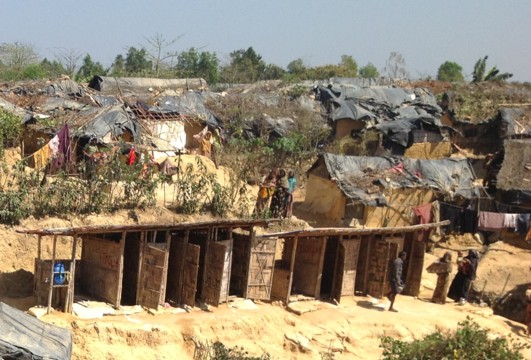
Photo of the camp courtesy of Wikimedia Commons.
The Geography Of Forced MovementPS Ayaas © Copyright 2026 by PS Ayaas |
Photo of the camp courtesy of Wikimedia Commons. |
In 2017, my family and I crossed the border from Rakhine State into Bangladesh. We were not tourists, nor were we travelers carrying luggage prepared for a seasonal stay. We carried only what could be tied in a cloth or held in a child's hand.
I remember the terrain changing as we moved through it. The familiar geometry of our home village — the green paddy fields, the broad shade of ancient trees, and the evening dust settling over packed-earth yards — gave way to the chaotic paths of flight. We walked along narrow earthen dikes dividing flooded fields where water reflected a sky broken by dark pillars of smoke. The road was not a paved highway; it was a moving river of people, all traveling in the same direction, bound by the same quiet imperative to reach safety. There was no itinerary, no chosen destination, and no certainty about what waited at the end. There was only the next step.
Crossing the Naf River remains the first major milestone of that journey. In traditional travel writing, rivers are often described as administrative borders or scenic channels winding through quiet valleys. For us, the Naf was an ocean of uncertainty. The water was wide and gray, churned by monsoon winds as our crowded wooden boat rocked against the current. Looking back toward the eastern shore, I watched the coastline of my childhood dissolve into rain and mist. Behind us lay everything familiar; ahead lay Bangladesh — a shore of dark clay and steep, unfamiliar hillsides.
Crossing that international boundary did not bring our movement to an end; it ushered us into a completely new landscape. The forested hillsides of Cox's Bazar were rapidly transformed into a vast settlement of split bamboo, tarpaulin, and packed earth. Narrow pathways climbed steep slopes, winding past shelters built on carved terraces. During the dry season, the earth turned into a pale dust that settled heavily on leaves and roofs; during the monsoon, that same soil transformed into deep, treacherous mud, making every hill a grueling physical obstacle.
The reality of this terrain became clear to me during our first monsoon season in Block D. Late one night, heavy rain breached the back bamboo wall of our shelter, sending thin brown streams of water across the dirt floor. As my younger siblings huddled on the drier edge of the sleeping mat, my mother stayed awake until dawn. Crouched on the floor, she used a small plastic dish to scoop water from the ground, her arm moving in a steady, unceasing rhythm to keep the water from reaching our blankets. When morning came and the torrential rain slowed to a drizzle, people throughout our block emerged into the mud with plastic bowls and jerrycans, stepping into line for food distribution as if this exhausting routine had always been part of daily life.
Living here forces you to observe your surroundings with an intimate, urgent attention. Travel, I have learned, is not only about reaching another point on a map. It is also about learning to read the place beneath your feet — to understand its vulnerabilities, its possibilities, and the ways human beings adapt to it.
On monsoon mornings, when rain sweeps across the hills in gray sheets and tests the stability of the slopes, community volunteers work along the steepest banks. Lacking heavy concrete infrastructure, we plant vetiver grass along the ridges. Vetiver has deep, fibrous roots that bind soil together and reduce erosion. As I press young green shoots into damp red clay, I think about how closely human survival is connected to the ground beneath us. Every root planted is a small act of environmental care and a quiet declaration that even on temporary soil, we hold a responsibility to protect the earth.
That relationship with the land became the foundation for the community work I later undertook through the Refugee Wellness Mission. Our approach to homestead gardening in the camps is simple and hyper-local: we look at what each block actually possesses — a small unused patch beside a shelter, a meter of soil that can support a seedling, or an embankment where a fruit tree might take hold. We plant where space and necessity meet. Though the scale is small, those few square feet of soil matter tremendously. In an environment built around temporary shelters, planting something that grows roots creates a deeper connection to the ground. A shelter may be designed to be temporary, but a tree, once its roots take hold, insists on staying.
We arrived in Bangladesh because we had no choice but to leave. We learned the rhythm of monsoon mud, the shape of camp pathways, and the precarious nature of unstable slopes because this became the environment in which we had to survive. Yet through that survival, we also learned to care for it.
In traditional travel literature, travelers eventually return home and reflect on how a journey transformed them. For displaced people, the journey does not conclude with a return flight; it continues inside us every day. I carry the topography of my childhood with me — the fields, the trees, the village paths, the river, and the memories anchored to them. At the same time, I have learned this new terrain — the hills of Cox’s Bazar, the narrow pathways between shelters, the red earth beneath my feet, and the young trees taking root in places that were once bare.
A place is far more than coordinates on a map or a line drawn between countries. A place lives in memory, in the stories people carry, and in the quiet ways communities care for one another and the ground beneath them. Our journey began with leaving, but it did not end there. We are still moving — not across physical borders, but through memory, adaptation, and hope. The story of movement is therefore not only a narrative of loss, but also one of endurance, stewardship, and the determination to find purpose wherever the path leads.