Priye Gift Johnson
© Copyright 2026 by Priye Gift Johnson
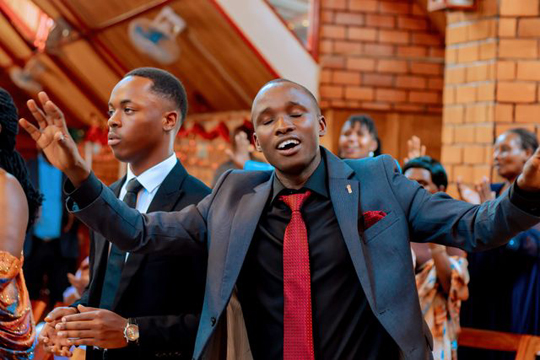
Photo by MBARAGA BERNARD at Pexels..
| Sunday's
Best Satire Priye Gift Johnson © Copyright 2026 by Priye Gift Johnson |
Photo by MBARAGA BERNARD at Pexels.. |
Christians are out in all their glory. The streets and roadsides are lined up with men who wear lofty shoulder-padded suits: white, black, red, blue or multicoloured but perfectly ironed, with sharp-pointed shoes that are capable of puncturing both snakes and low self-esteem. They march exuberantly into churches prepared for the inevitable chorus: “Satan don fall for gutter o…march am! March am! March am!” And at that point, one will almost feel sorry for the devil. The trouble-causing fellow cannot even enjoy one peaceful weekend without an entire congregation organizing a fitness programme around his downfall.
The women on the other hand, are no less committed. Every gele or beret is folded with the confidence that Angel Gabriel keeps a register of well-dressed saints. Some of them have their heads wrapped so tightly in bright turbans that there is hardly any room left for whatever gossip the devil may have prepared that morning or for any common distractions. Heaven is the real goal or so they like to admonish unbelievers around them. The children wear their own simple uniforms of reluctant holiness – Ankara and polished sandals, Ankara and sneakers, tiny suits and sneakers or court shoes. Some drag their feet behind their mothers, and fathers wearing the universal expression of children whose only crime was wanting to choose their own clothes.
Then there are the elderly folks: Iye Osakpolo and Co. These ones have no need for any elaborate fashion or extravaganza except sampling their oversized Bibles which they carry about as religious emblems. These are viewed as far greater accessories than any designer handbags or wallets. They carry scripture the way politicians carry cliché promises visibly and everywhere every four-year oscillation. Jesus is their goal and only destination, and therefore, everyone unfortunate enough to board a vehicle with them risks receiving an unsolicited sermon before the main course is served in churches.
Now, the bus I boarded rolled gently along the Benin-Sapele Road from Ring-Road. At Adesuwa Junction, a family alighted. The mother said something in Edo to her husband. He turned quickly to one of the boys with the expression of a man betrayed by his own blood. Apparently the child had stained his immaculate white jeans trousers while getting down. The mother shouted at the older son. The younger one looked relieved. Every Nigerian child knows discipline follows the law of conservation of energy: if one sibling escapes, another must absorb the punishment.
We continued our journey. Road construction had reduced traffic to a manageable crawl. I wondered when the project would finally end so that people could stop adjusting their lives around cement barricades and boulders that looked old enough to qualify for a life time pension. Then my phone rang. The melody was the Muslim Azhan I had saved on my phone audio. The man seated beside me glanced sideways obviously discomforted by the song. Slowly (very slowly), he adjusted his enormous Bible until the golden inscription, HOLY BIBLE KING JAMES VERSION, faced me directly. He was scripture bombing.
I smiled within myself and searched my purse for the phone. It was less a Bible show than a mere diplomatic statement. It appeared that I had instantly become his common enemy, an atheist than a co-passenger. But I answered the call anyway and greeted. It was my client. He wanted me to pay attention to my boxers when you are doing the laundry and please scrub the bathroom floors very well. Remove all the cobwebs as I don’t want to come home to see any unfinished work.
“Okay boss,” I replied and he hung up. The man beside me relaxed slightly. Apparently clean undergarments remained an acceptable topic across religious boundaries but not a Muslim melody. I felt embarrassed by my client’s open instructions and his harsh tone with which he had spoken to me over the speaker phone.
We drifted slowly along the road until traffic cleared around Uwa axis. The catholic cathedral along the path was already overflowing. Worshippers streamed in from different directions. In a quick glance at the arena, one woman stepped elegantly from an expensive car, wrapped in brilliant red George and blouse. She walked with the confidence of someone who had already reserved her seat in heaven before online registration closed.
Suddenly…A skreeeeeeeeech! The driver had slammed on the brakes. I nearly donated a tooth to public transport.
“Driver haba please take it easy,” I said. “I’m not hasting to my demise.”
“Sorry.” He muttered, already negotiating with another passenger.
“Country Home is eight hundred.” The passenger argued.
“My money’s one thousand.”
“If you cannot accept eight hundred, then I suggest you drop me down.”
“Drop you after I carried you to this spot? You must be joking. Madam please my money’s one thousand, no more no less.”
The woman stretched out four crispy notes. “Driver, all I have is this. If you can’t take then I’m sorry.”
He flung her a bad stare before collecting it with the expression of a tax collector funding national development from personal annoyance.
“If I search that your handbag now, will I not see another money inside?”
The woman chuckled while adjusting herself. “Why would you search my bag? Are you alright?”
Nobody defended anybody. Every passenger silently became a judge on a reality show called Who Is The Greater Wahala? The driver announced another destination with the passion of a Pentecostal Evangelist after ignoring his stingy passenger as he later concluded.
“Hey! Benin Bypass, Benin Bypass! Country Home! Please hold your one thousand o!” One passenger descended while another boarded complaining about his shaky seat.
“Driver please stop me at Santana.”
“Hello fine girl,” He grinned at me as I searched my purse for the fare. “Have you paid your T-fare? Why are you this beautiful but your money looked like it survived the civil war?”
The entire bus laughed. Even the crumpled note I handed him looked embarrassed as the driver tried to straighten them out in his other hand. That is Nigeria. I thought. We cannot fix inflation or the bad roads, but we can certainly insult the condition of the currency. I laughed too and reminded him of my own destination. He overshot it by several yards almost causing me to trip off the edge of the open drainage as I climbed down. I cursed him under my breath. But he did not apologize; instead he drove off, enthusiastically beckoning to the passengers standing by the roadside, as though nearly killing one customer was merely part of the transport service. But still, the truth is, drivers rarely apologize to their passengers when they are at the wrong. Most would make a dark joke out of it because in their constitution, every mistake automatically becomes the passenger’s misunderstanding.
I walked the remaining distance to Etete GRA where my weekly labour was to begin shortly. On that short walk, it struck me that Sunday is perhaps the only day Nigerians publicly agree on one thing. Everybody is chasing salvation. Some people pursue it through church activities. Some others through the mosque. Some through road contracts that appear to last longer than certain marriages. Commercial drivers pursue it through high transport rates. Passengers pursue it through bargaining. Parents pursue it through disciplining children in white trousers. My client pursues it through spotless boxers and cleaning out cobwebs. And I pursue it through honest work, hoping that one day’s house cleaning service will wash enough worries away to afford my own peaceful Sunday.
Perhaps
that is our greatest national religion. Not Christianity; not Islam
but survival. It is the only faith attended by every tribe, every
denomination and every social class. Its hymns are the blaring horns
in traffic. Its communion is shared suffering. Its miracles are
finding change for a thousand-naira note after the shuttle driver has
specifically asked you to enter
with your change,
arriving home before rain starts, before your stomach upsets and you
are about to disgrace your ancestors in public transport with hot
stool, and discovering that NEPA has eventually remembered your house
number. Every Sunday, Benin dresses itself in hurried Pentecostalism
as though righteousness were a change of clothes. But on Mondays,
Nigeria returns to its ugly reality.