Through The Narrow Gate
Pamella Laird

©
Copyright 2026 by Pamella Laird
|
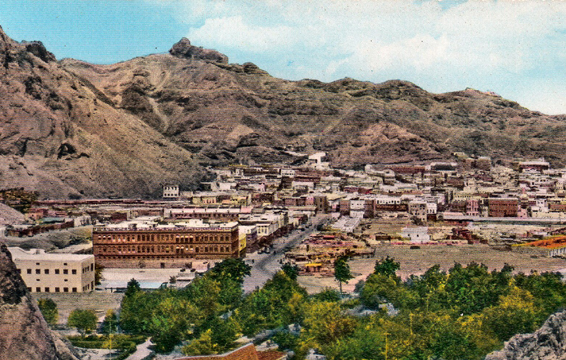
Photo courtesy of Wikimedia Commons.
|
We’d
worked on this plan for over four years; would it be the ‘trip’
of our lives? Having (more or less), saved a meagre monthly wage, we
two twenty-four-year-olds imagined, if we thought about it at all,
this would be a voyage into the unknown.
Years
ago, when travelling to another continent or country, chances were,
one journeyed by boat (or maybe camel!) For us, this particular day,
about halfway through the shipboard journey (15th
February, 1955), was a world-shaking event. What Tony and I had
decided meant plummeting into the potentially evil base of what we
hoped was an extinct volcano. We could only trust in the history
related to us on board.
In
1955, my nurse friend Zala, (who is part-Italian) and I set off from
our three little islands (known as New Zealand, at the bottom of the
world) to further our hospital work experience and, we hoped, to add
to our general knowledge of how the rest of the world lived. For the
likely two to three years ahead, we had no particular plans other
than to find work in London to save as much as we could, then do as
much travelling as we might then afford.
New
Zealand, (or the Maori name of Aotearoa, as many of us prefer to call
it), was possibly a little closer to the Antarctic
Continent than the Britain we were heading for, was to the Arctic
Continent. So,
the temperature of the
Equator and the dunking by King Neptune in the ship’s pool, would
be a whole new heated experience. At twenty-four, to us, everything
was exciting. We were young, we were ready for adventure, and nothing
was going to stop us. There was no doubt in our minds—we could cope
with anything untoward in this great big world we knew absolutely
nothing about.
I
want to tell you about one of the wildly different styles of living
that we came across during the early days of our journey. For
contrast—I had grown up on a farm in the foothills of a mountain
range where, from time to time, we children would enjoy a three-foot
snowfall and no school. In the days when cars were few and far
between, twenty-five miles to our nearest town for shopping was a
whole big adventure. Especially the delicious steak pies from the
‘Electric Kitchen.’ Zala had grown up, with no car in a small
fishing village with one small grocery store, so you will understand
our naivety (or ignorance) of the world we had only read about.
After
gaining our nursing degrees following a three-year training course,
we set off on a barely planned, so-called ‘Overseas Experience.’
Eventually, after
two or three weeks of sailing aboard the liner, Otranto
of the Orient
Line,
and
several ports of
call, we
were in the
Indian Ocean, not far from
the port of Aden.
Fortunately, during this time, (we, along with two others,) had made
friends with four boys in the cabin next to ours.
Once we arrived in
London, this proved a happy arrangement for all our social lives,
travel and theatre etc. These friendships continued through the
following two years of our work life in and around London. And in
some cases, for life. Also, Tony, (who came from a reasonably sized
city) and I, had a common interest in classical music.
Eventually,
with the ship tied up in port at Aden, and along with the knowledge we had
gained
from
those shipboard talks, Tony and I hired bicycles to climb the famed
mountain behind Aden. This ancient volcano forms part of the Shamsan
Mountain Range.
We’d
learned, that over the centuries, a city called Seera, had grown and
developed into a marketing town in the crater of this extinct
volcano. Being an extremely hot day, the wild idea that we should get
up there to look for ‘Cain’s burial place,’ suggested a
mind-boggling challenge ahead.
After
the indolence of shipboard life, we thought of it as an ‘energiser,’
especially as we not only had to climb that mountain and enjoy the
‘sights,’ we also had to be back in time for the Otranto’s
sailing at six that evening. You will have heard of ‘mad dogs and
Englishmen,’ that was us! After pushing ourselves up the four-mile
grind (so we’d been told by the locals), we passed through an
ancient man-made gap just wide enough for a small car or in our case,
two exhausted cyclists.
I
grinned at Tony, “Doesn’t this remind you of that quote?”
‘Enter
through the narrow gate. For wide is the gate and broad is the road
that leads to destruction, and many enter through it. But
small is the gate and narrow the road that leads to life, and only a
few find it.’
Oh
dear! With time being short, that sounded
like
Doomsday for us.
This
scoria-covered so-called ‘road’ opened into the crater itself.
The heat was uncaring of our circumstances, after all, this was our
idea! So, no
room for sympathy.
Above,
in an exotic (unusually to us) dark blue sky, vultures wheeled and
circled, a confronting pressure group high above. In front of us rose
a craggy rock face, that was a strange mixture of grey, pink and
fawn—an eerie and commanding scene. Our descent into the depths of
the crater was not
dignified; as we sped in jubilation, ‘way down the almost empty
road, calling to one another at the spectacle ahead.
Finally,
with a sigh of relief, we coasted into what looked to be a huge
market town as ancient as a picture in one’s Bible. Here, before us
were men in gleaming white robes, white scarves or small, round white
hats, but more impressively, some wore solid, decorated leather
‘belts’ that held menacing daggers. Surely, for some reason, a
‘dress-up occasion.’ Pedlars and sellers on street corners, some
sitting in the dust, but no apparent begging. Camels here and there
in the crowded streets, stalls displayed fruit and vegetables, many
of which we had never seen before. No ragged children clinging to
mothers, in fact, no women at all.
The
burial place of ‘Cain?’ Apparently, this had been commemorated by
some sort of rock memorial on the furthest side of the crater. We saw
a rock-built possible stone memorial, but there was no chance we
could get across there in the little time; so that remained a mystery
to us. We had was no way of knowing then, if this was a genuine
memorial. Even today, we don't know if this story is myth, or a handy
legend for the attraction of tourists.
We
were fascinated to find that despite our pale faces, fair hair, and
bizarrely, grey flannel suits (both of us) appeared to be accepted as
part of the multitude. I suppose our bicycles looked even more wacky,
but we were not bothered in any way; not even stared at. It appeared
to be a lively crowd of laughing, good-humoured men who were going
about their business, whatever that may have been. We guessed that,
as a gateway for trade in the Middle East, foreigners from all parts
would have been a familiar sight over many, many years, and we were
just two more.
Clutching
our bicycles in the middle of the cacophony of milling citizens, we
had the uncanny feeling we had stepped into a biblical panorama. The
sound or noise appeared to be coming from quaint,’ (to us) musical
instruments, combined with pedlars’ cries, animals, and
surprisingly, cars with stubborn motorists tooting or shouting. Over
it all hung a ‘flavour’ of the Middle East that neither of us
could define. Was it foodstuff, exotic perfumes, animal odour, or a
combination of all? It was different.
In
the narrow alleys and streets, surging, (or not) among the motley
crowd of men and animals were cars and carts of all pedigree. Some
of the carts were two-wheeled, some four, all in various stages of
usability. Apparently, if serviceable, they shifted the produce as
required, therefore no problem. This was a scene so far from our
backgrounds of tree-green, sometimes snow-white, quiet world. I think
we both found it almost imaginary. The montage could only be
described as strangely colourful, so far from what we ‘Kiwis’
thought of, as ‘normal.’
Tony
commented, “Auckland is nowhere near as colourful or haphazard as
what we are looking at here. This is something I shall never forget.”
In
the middle of this clamour, we were introduced to bargaining—a new
way (to us,) of financial dealings as we watched and listened to the
haggling. Especially so, as we were among roaming animals such as
bullocks, goats, camels, cats, dogs and hens that strayed along roads
and onto footpaths. In our homeland, we would have expected most of
them to be fenced into a saleyard. Despite the natural habits of
animals, the streets were neither bemired nor smelly. We bought
bananas for a light lunch, all we felt we could manage in that heat.
And, we
knew what they were, for we had been warned of unfortunate stomach
upsets with unknown food.
We
became engrossed in the dream-like quality of riveting noise and
exuberant colour that to our Aotearoan (‘Land of the Long White
Cloud’) eyes and ears, seemed unreal. Eventually, when Tony looked
at his watch, alarmed, we realised we had only a quarter of an hour
to get back to the launch to board the Otranto.
Now came the agonising push back from the inside
of the crater to
the narrow gate of our
entry of some two hours before. While panic and hard pushing
propelled us, it was with huge relief that we reached once more, ‘the
gate that is narrow.’
Laughing
with delight at what we’d seen and experienced, we
whizzed down the outside of the crater towards the harbour town. Our
rush can only be described as fast and furious, the penalty for
overlooking the time, and fear of being left in a ‘foreign place.
We could easily have been abandoned on the harbour-side, watching our
liner sail on into the Red Sea. Mobile phones hadn’t been a part of
anyone’s life at that stage, so we would have been more or less
marooned. We had no idea if there existed a British Consulate in
Aden, let alone a representative for New Zealand.
Here,
among the shops, we found a young boy of about twelve, who we hoped
might return the cycles to their owner. We showed him the receipt
from the cycle stall, and asked him to return the bicycles. Although
we were a little concerned at our inability to do this ourselves, we
buried our worries by giving, in local cash, all we had left in small
change to the boy. It seemed he spoke enough English to understand
and seemed happy to do what we asked. We were happy too, as we
watched him heading off in the right direction, adroitly riding one
cycle and towing the other with a spare hand.
Not
far ahead, we saw the Otranto
tied
up at the wharf and learned from a crewman at the bottom of the
launch gangplank that the sailing time had been delayed for an hour.
Whew! Hot and by this time really
hungry, we strolled to nearby shops. However, discretion overcame our
gnawing appetites when we cast an eye over the food exposed to heat,
uncountable flies and the baked wings and leggy ‘things’ that lay
openly on the market stalls. The ship’s dining room showed promise
for the evening ahead.
Once
back on board, we learned over the loudspeaker that the ship wouldn’t
leave Aden until after midnight, so we took the opportunity to watch
the huge volcanic skyline from the stern deck. At its feet, lit by
the harbour lights, lay a beach of smooth golden sand and white,
tumbling surf. Even then, we knew we’d never again see a city
inside and at the floor of a freaky volcano. Our friends were
incredulous, but looking back, I guess it was
a risky thing to do, but we shall have these memories sharp in our
minds for ever.
After
all, isn’t that what travel is all about?
(Unless
you
type
the
author's name
in
the subject
line
of the message
we
won't know where to send it.)
*****
If the
link to the letter doesn't work you can copy
and paste in this address: preserve@storyhouse.org
Pamella's
story list and biography
Book
Case
Home
Page
The
Preservation Foundation, Inc., A Nonprofit Book Publisher