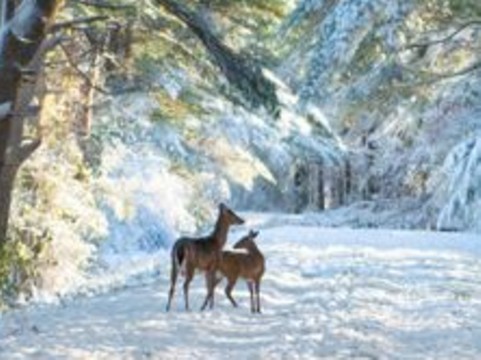
This
is a true story about a wild white-tailed deer fawn I found in the
Smoky Mountains, Tennessee, during a winter visit. I did not keep it.
It was wild, and it stayed wild.
I
was visiting Tennessee for the first time in December. I had never
seen real snow before.
My
host family lived in a small house near the edge of Great Smoky
Mountains National Park. The trees were bare and white. The air was
so cold it hurt my lungs. My shoes made a crunching sound with every
step.
The
morning had started with a quiet breakfast. My host mother had made
pancakes with maple syrup, and she had warned me to wear two pairs of
socks and a thick hat. I laughed at her, because in Bayelsa we never
need such clothes, but when I stepped outside I understood. The wind
cut through my jacket and made my teeth chatter. The world was silent
in a way I had never known. No motorbikes, no market women shouting,
no generator noise. Just the soft fall of snow and the distant sound
of a woodpecker tapping a tree.
The
trail was narrow and covered with a thin layer of ice under the snow.
I walked carefully, holding the branches to keep my balance. I saw
footprints everywhere, small ones from birds and rabbits, and larger
ones from deer and dogs. I tried to follow the deer tracks, not
because I wanted to find a deer, but because they led deeper into the
forest where the light was beautiful.
The
forest smelled different from any forest I knew. It smelled of pine
and wet earth and cold air. The trees were tall and straight, and
their branches were heavy with snow. When the wind moved them, the
snow fell down like a soft rain. I thought about my family in Bayelsa
then. My mother would have worried about me being alone in this cold
place. She would have said, be careful, do not go far. But I felt
safe there, even though I was far from home. I felt as if the forest
was watching me kindly.
I
had arrived in Tennessee three days earlier, after a long flight from
Lagos. The journey itself had been a story. At the airport in
Atlanta, I had been confused by the cold, by the escalators, by the
way people wore heavy coats even inside. My host father, Mr. Johnson,
had waited for me with a sign with my name on it, and he had smiled
and said, "Welcome to Tennessee." His daughter, Emily, was
my age, and she had shown me her room, her books, and her dog, a
large brown dog named Biscuit who barked at me and then slept on my
feet.
That
first night, Mr. Johnson had sat by the fireplace and told me about
the Smoky Mountains. He said the park was older than any city in
America, that the mountains were called Smoky because of the mist
that rises from them in the morning. He said the animals there were
wild and should be respected. He said deer, bears, raccoons, and owls
lived there, and that people from all over the world came to see
them. I listened, but I did not really understand until I saw the
forest myself.
Emily
had told me about snow. She said snow was like rain, but cold and
soft, and that you could make snowballs and snowmen. She said she
would teach me. I was excited, but I was also nervous. I had never
touched snow. I had seen it only in movies. When I woke up the next
morning and saw the white world outside the window, I thought I was
dreaming.
My
host mother, Mrs. Johnson, was kind. She made hot chocolate for me
and gave me gloves. She told me to be careful on the ice. She said,
"If you fall, get up and laugh. Everyone falls in snow." I
laughed at her joke, but I was still careful.
On
the second morning, I went for a walk alone. I wanted to see the snow
before it melted. I followed a trail behind the house, where the
ground was covered in pine needles and fresh snow.
I
heard a sound I did not recognize. It was not a dog. It was not a
cat. It was a soft, high cry, like a baby goat.
Behind
a fallen log, I saw her. A white-tailed deer fawn, no bigger than a
small dog, lying flat in the snow. Her coat was brown with white
spots. Her legs were thin and folded underneath her. Her ears were
large and trembling. She was alone.
I
thought she was abandoned. I thought she was dying. My first instinct
was to pick her up and run back to the house to get warm milk and a
blanket.
I
almost did it. That would have been the wrong thing to do.
My
host father had told me something the night before. He said, "In
Tennessee, if you find a fawn alone, leave it alone. The mother is
not far. She is watching you. If you touch it, she may not come
back."
I
did not believe him at first. How could a mother leave her baby alone
in the snow? In my mind, a good mother never leaves. But I remembered
his warning.
I
crouched behind a tree and waited. The snow was cold on my knees. The
fawn was shaking. I wanted to cry. I wanted to help.
For
forty minutes, I waited. I counted the trees. I counted my breath. I
watched the fawn.
She
did not move much. She lifted her head once and looked at me. Her
eyes were big and dark, like a child's eyes. She did not run. She did
not make a sound. She was practicing being invisible. That is what
deer do. The mother leaves the fawn in a safe place, where predators
cannot smell it, and she goes to feed. The fawn stays perfectly
still.
While
I waited, the forest changed around me. The snow began to fall again,
slowly, in big flakes. A squirrel ran up a tree and chatted with me.
A blue jay landed on a branch and screamed. I saw a red cardinal,
bright red against the white snow, and I thought it was the most
beautiful bird I had ever seen. I understood then that nature is not
loud in Tennessee. It is quiet. It whispers.
I
thought about the fawn's mother. Where was she? Was she scared? Was
she hungry? Was she waiting for me to leave so she could come back? I
imagined her standing behind a tree, watching me with the same dark
eyes as her baby. I imagined she was afraid that I would hurt her
child. I wanted to tell her that I would not. I wanted to tell her
that I was a friend. But I could not speak her language. All I could
do was stay still and wait.
I
thought about my own mother in Bayelsa. She would never leave me
alone in the snow. She would carry me on her back. She would hold me
close. I thought this was how all mothers behaved. But deer are
different. They have a different way of loving. They love by hiding
their babies, by making them invisible, by trusting the forest to
keep them safe. I was learning a new kind of love.
The
minutes passed slowly. My fingers became numb. My toes became numb. I
wished I had worn the second pair of socks Mrs. Johnson had given me.
I wished I had brought a hot drink. But I did not want to leave. I
knew that if I left, the fawn would still be there, but I would not
know if her mother came back. I needed to see it with my own eyes.
I
began to pray silently. I am not a very religious person, but at that
moment I prayed that the mother would come. I prayed that the fawn
would live. I prayed that I would not be the reason she died.
After
forty minutes, I saw a movement in the trees. A doe came slowly
through the snow. She was tall, graceful, and cautious. She stopped,
sniffed the air, and looked directly at me. She saw me. I froze. I
did not move.
She
walked to the fawn, nudged her with her nose, and licked her head.
The fawn stood up on shaky legs and followed her into the trees. In
less than a minute, both were gone. The snow was empty again, except
for small tracks.
I
stood up slowly. My hands were numb from the cold, but my heart was
warm.
That
day I learned something that changed how I see animals. Sometimes the
kindest thing is not to touch. Sometimes the kindest thing is to
watch from a distance and let nature do its work.
When
I went back to the house, my host father smiled. He said, "You
did good. Most people would have picked her up. You waited."
I
told him and Emily the whole story. Emily's eyes were wide. She said,
"You saw a real fawn? I have lived here for fifteen years and I
have never seen one so close." Mrs. Johnson made me hot
chocolate and gave me a blanket. She said, "You are a lucky
girl. The forest gave you a gift."
We
spent the evening by the fireplace, talking about deer. Mr. Johnson
explained that white-tailed deer are common in Tennessee, but fawns
are rarely seen because mothers hide them so well. He said that in
spring, many people find fawns and think they are abandoned, and they
take them to shelters, but that is harmful. He said the best thing is
to leave them alone, as I did. He said that if the fawn is injured or
if the mother does not return for a whole day, then you should call a
ranger, not touch it yourself.
He
told me about the rangers in the Smoky Mountains. They are people who
protect the forest and the animals. They know how to help without
harming themselves. He said they have a phone number for emergencies.
I wrote it down, even though I knew I would probably never need it.
The
next day, Emily and I went back to the same trail. The fawn was not
there, but we saw the tracks. We saw deer tracks, rabbit tracks, and
raccoon tracks. Emily showed me how to read them. She said the deer
tracks looked like two hearts. I thought that was a beautiful way to
see it. She taught me the names of the trees oak, pine, maple,
hickory. She taught me how to make a snowball and how to throw it.
She laughed when I missed.
That
winter, I learned many things. I learned how to build a snowman. I
learned how to drink hot chocolate with marshmallows. I learned how
to say "y'all" like a Tennessean. But the most important
thing I learned was about patience and respect.
I
learned that wild animals do not belong to us. They belong to the
forest. They belong to themselves. We can watch them, we can learn
from them, we can protect their homes, but we cannot own them. If we
try to own them, we destroy them. If we try to save them by taking
them away, we harm them. True love is letting go.
I
have thought about that fawn many times since. In winter, deer do not
need blankets. They do not need milk from people. They need us to
leave them alone and to protect their forest.
I
have told this story to children in Bayelsa. When I tell it, they
ask, "Why didn't you take her home? She was cold." I
explain that the fawn was not cold. Her fur was made for winter. Her
mother was near. She was doing what nature taught her to do. The
children listen, and some of them understand. Some of them still want
to take her home, and I tell them that is okay, because it means they
have a kind heart. But kindness must be guided by knowledge. We must
learn before we act.
In
Bayelsa, we do not have snow or deer. We have mangroves and monkeys
and crocodiles. But the lesson is the same. If you find a baby animal
alone, do not pick it up. Watch. Wait. Ask an adult who knows. Call a
ranger or a wildlife officer. Do not take it home.
I
have also told this story to my friends in America. They said it was
a good story because I listened. They said many Americans make the
mistake of picking up fawns. They said my story could teach people.
That made me happy. I hope this story does teach people.
The
fawn in the snow taught me that the world is bigger than Bayelsa and
bigger than Tennessee. It taught me that a girl from Nigeria and a
deer from America can share a moment, even if they do not speak the
same language, even if they do not live in the same place. That
moment was real. It was not made up. It was a gift.
I
did not keep the fawn. I did not name her. I did not take a photo. I
only watched her. That was enough.
If
you ever find a wild animal alone in the forest, remember the fawn in
the snow. Do not pick it up. Do not take it home. Sit quietly. Watch.
Wait. Let its mother come back.
That
is what it means to love a wild animal. Not to own it, but to let it
be wild.
I
still think about the snow. I think about the way it fell on my
shoulders while I waited. I think about the way the mother looked at
me before she took her baby away. I think about the tracks left
behind, small and perfect, like a signature. I think about the
fireplace and the hot chocolate and the way Emily laughed when I made
my first snowball.
I
hope the fawn is still alive. I hope she grew up and had her own
fawn, and that she hid her own baby in the snow, just as her mother
hid her. I hope she is safe in the Smoky Mountains, where the mist
rises in the morning and the forest is quiet and white. I hope she
remembers that a girl from far away once waited for her and let her
go.
When
I grow up, I want to work to protect wildlife. I want to tell stories
that help people understand animals. I want to be a bridge between
Nigeria and America, between the mangroves and the Smoky Mountains. I
want to tell children that every animal has a mother, every forest
has a story, and every act of patience is an act of love.
This
is my story. It is a true story. It is not about a pet. It is about a
wild animal that stayed wild because I chose to do nothing. And in
doing nothing, I did everything.
Ogbakpa
Oghenerukevwe is a student writer from Delta State, Nigeria. This is
a true account of a wild white-tailed deer fawn encountered in
Tennessee, USA. She is not a published writer.
(Unless
you
type
the
author's name
in
the subject
line
of the message
we
won't know where to send it.)
*****
If the
link to the letter doesn't work you can copy
and paste in this address: preserve@storyhouse.org
Book
Case
Home
Page
The
Preservation Foundation, Inc., A Nonprofit Book Publisher