What The File Says
Obongodu Paul Unanam

© Copyright 2026 by Obongodu Paul Unanaml
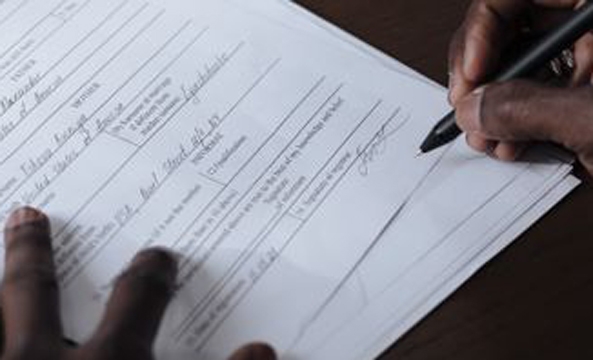
Photo by Ron Lach at Pexels.
What The File SaysObongodu Paul Unanam © Copyright 2026 by Obongodu Paul Unanaml |
Photo by Ron Lach at Pexels. |
The file says my father is a farmer.
He has never farmed anything in his life. He grew up in Port Harcourt watching his own father repair outboard motors at the jetty, grease under the fingernails, the smell of fuel and river water mixing in a way he still describes if you catch him in the right mood. When he was old enough he moved to Uyo and got a job counting money at a filling station. The station closed six months later. After that he did other things, moved between work the way most people in his position did, taking what was available, doing what was needed. None of it involved soil.
But somewhere between one government office and another, between a clerk who was tired and a form with no good option, he became a farmer.
That is what the file says. And the file, once written, does not really change.
I did not learn about this the way I learned most things about my father, by asking. He mentioned it the way he mentions most things that bother him, in passing, halfway through a sentence about something else, so that if you were not listening closely you would miss the part that mattered. I only understood later how long he must have carried it, a word attached to him by someone who had never asked what he actually did with his days, filed once and repeated every time afterward without anyone checking whether it was still, or had ever been, true.
I have been thinking about this for years without knowing I was thinking about it. It only became a thought I could name when I started studying law and ran into the concept of institutional records, how they are created, who controls them, what happens when the record and the reality have nothing to do with each other. There is a word in legal theory for the gap between what a law says and what it actually does in practice. I have used that word in papers now. I have written footnotes around it, built arguments on top of it, cited scholars who have spent careers mapping the distance between legal text and human life.
But I learned it first from my father. He did not know the word and would not have used it. He only knew that something had gone wrong between him and the paper that was supposed to represent him, and that nobody in any of the offices he visited seemed to think this was their problem to fix. A wrong word on a form is a small thing to the person who typed it. It is a much larger thing to the person who has to live behind it.
The thing about a wrong record is that it compounds. It is not a mistake that stays in one drawer. It travels. It shows up when you apply for something, when you are trying to prove something, when you need the version of yourself that exists on paper to match the version that woke up this morning and made tea and knows his own history. The mismatch follows you. And if you do not have the education, the time, the language, or frankly the energy to challenge it, the file wins. Not because it is correct. Because it is there, and you are busy surviving, and the clerk has moved on to the next seventeen folders.
My father told me once, not as a lesson, just as something he said: make sure your own papers say what you are.
I did not know what to do with that for a long time. Now I think I do.
I am in my mid twenties. I have a law degree I have not yet been called to use. In Nigeria you finish your degree and then you wait for the Law School, and then you wait to be called to bar, and in the gaps between these waitings your life continues regardless. I have been using those gaps. I write about accountability. I write about the institutions that are supposed to protect people from exactly the kind of administrative carelessness that turned my father into a farmer on a government form. I write about whistleblower protection and anti corruption frameworks and the distance between what a country signs up to internationally and what happens in the offices where ordinary people bring their papers and hope for the best.
I do not know yet if I am any good at this. I do not know if my own papers will eventually say what I am, or if I will end up, like my father, as something adjacent to myself in every official record. What I know is that the gap between the document and the person is not abstract. It is not a theoretical problem that lives in journals. It lives in filing cabinets. It lives in the tired arithmetic of a clerk who has to pick one category from a list that was designed somewhere far away by someone who had never met my father or anyone like him.My father is not an angry man about this, which took me a while to understand. He does not bring it up to complain. When he says it, it sounds more like a fact he is reporting than a wound he is naming, the way you might mention a scar and where it came from without expecting anyone to react. I think that flatness is its own kind of information. A country teaches a person how much outrage a small injustice is allowed, and my father learned that lesson before I was born.
The story I can tell is this one. The one about learning what justice means not from a textbook first but from a man who watched himself become a farmer in a file and just got on with things because what else do you do.
He is still not a farmer. He has never grown anything. But he taught me to pay attention to the distance between what things say and what things are.
That distance is where I work.
~The End~
Obongodu Paul Unanam holds an LL.B from the University of Uyo, Nigeria (2025). His writing has appeared in TheCable, Global Policy Journal, International Law Blog, IntLawGrrls, Corporate Compliance Insights. He lives in Uyo, Akwa Ibom State, Nigeria.