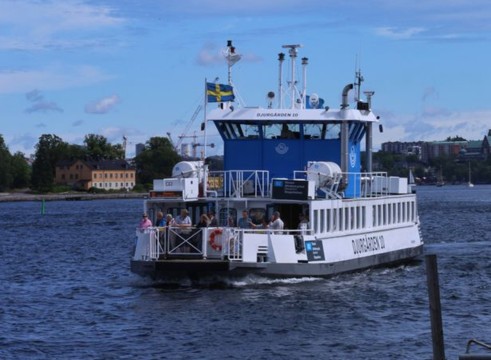
This
account follows a public
ferry journey from my
home village in the Stockholm archipelago toward the capital and
back.
I
live close enough to Stavsnäs vinterhamn that the beginning of an
archipelago journey can feel almost too ordinary. On the morning of
this trip, delivery vans were already moving near the quay,
passengers stood beside wheeled bags, and the digital board listed
boats and islands that many people around me clearly knew by heart.
Yet I had chosen to travel in the less familiar direction. Instead of
going outward toward Sandhamn and the open Baltic, I would work my
way west through the inner archipelago and continue toward Stockholm
Ström.
Stavsnäs
has two harbour names that can confuse a visitor. Sommarhamn belongs
to the older village setting, while vinterhamn is the practical
transport hub used throughout the year. Buses from elsewhere on
Värmdö meet ferries here, and the quay handles a mixture of
residents, summer visitors, workers, parcels, bicycles, and food for
the islands. I had checked Waxholmsbolaget’s current timetable
before leaving because routes and connections change with the season.
My ticket was not an invitation to rush. It was permission to notice
how an inhabited archipelago keeps itself moving.
The
first boat was built for useful work rather than romance, although
the view supplied plenty of romance without trying. The crew handled
the gangway, people found seats inside and outside, and the engines
pushed us clear of Stavsnäs. Behind us, the harbour quickly became a
collection of low roofs and vertical masts. Ahead, navigation marks
stood in the water like punctuation. The channel did not look like a
road, but the captain read it as one.
I
stayed outside while Värmdö’s wooded shoreline slipped past. Pine
roots gripped pale rock, red and yellow houses appeared between
branches, and small private jetties reached into the water. The wake
opened behind us in two white lines, then softened until the surface
looked unmarked again. That vanishing track seemed important. On
land, travel leaves roads, rails, signs, and scars. Here, a large
vessel could pass, and minutes later the sea kept almost no visible
record.
At
smaller stops, the routine was quick. The boat slowed, a crew member
prepared the line or gangway, and waiting passengers stepped forward
only when told. Sometimes one person got off with a backpack.
Sometimes several boarded with shopping bags and a dog. Boxes and
handcarts reminded me that the ferry was not a sightseeing attraction
added to island life. It was part of island life, as necessary as a
bus in a town. The beautiful view and the practical timetable
occupied the same deck.
I
changed boats at a public island stop on the Gällnö route,
following the connection shown in the timetable. There was no
airport-style confusion. I checked the destination display, watched
which quay the Stockholm-bound vessel approached, and listened to the
crew. The pause gave me time to look back east. The water widened
between islands, but land was nearly always present somewhere: a dark
strip of spruce, a rounded skerry, or a house catching the sun.
The
next vessel was larger and carried more day travellers. We passed
deeper into the inner archipelago, where the traffic gradually
increased. Sailing boats leaned into the wind. A workboat crossed at
a safe distance. Gulls followed briefly, more interested in the
disturbed water than in us. Around Grinda and the neighbouring
channels, green islands overlapped so closely that the route ahead
sometimes seemed closed. Then the boat turned, and another passage
opened.
Vaxholm
marked a change in scale. The waterfront, regular ferry movement, and
fortress in the channel made the place feel like a gate between outer
and inner waters. Passengers came and went with greater purpose. Some
consulted phones; others moved as if they could make the connection
blindfolded. I bought coffee on board and held the cup with both
hands against the vibration. The ordinary paper cup was warm, the
wind was cool, and beyond the rail stood one of Sweden’s best-known
archipelago views. Travel often joins the humble and the grand
without asking us to choose between them.
West
of Vaxholm, the waterway became busier and the shore increasingly
urban. Larger houses appeared. Commuter traffic shared the channel
with leisure boats and commercial vessels. The islands did not
suddenly end; they tightened around a city that had grown among them.
This gradual arrival is what makes entering Stockholm by water
different from arriving by road. There is no single moment when
nature stops and the capital begins. Rock, trees, apartments, cranes,
church towers, and ferries accumulate in the same view.
As
we approached Stockholm Ström, I moved to the open deck again. The
city presented its waterside face first. Djurgården lay green beside
museums and quays. Skeppsholmen and the buildings beyond it formed
layers, while Gamla stan rose ahead in stone and warm-coloured
plaster. Local ferries crossed the water with the confidence of city
buses. Our boat slowed among traffic and eased toward Strömkajen,
where the archipelago route met pavements, hotels, and the noise of
central Stockholm.
Stepping
ashore felt stranger than I expected. For hours, every arrival had
meant a small quay, a few passengers, and trees close behind. Now I
joined a stream of pedestrians. I walked along the waterfront rather
than hurrying into shops. From land, I watched boats manoeuvre in the
same water I had just crossed. Stockholm is often described as a city
on islands, but that phrase can become a slogan. Arriving by ferry
restored its literal meaning. Water was not decoration around the
city. It was one of the ways into it.
I
had time for a simple lunch and a short walk before my return
departure. I kept the day modest because the journey itself was the
purpose. That decision changed my attention. I noticed route boards,
luggage being rolled toward boats, crew members answering questions,
and families checking that everyone had the correct ticket. A ferry
terminal is full of small acts of preparation. Most are unremarkable,
but together they allow strangers to move safely through a
complicated landscape.
For
the return, I again followed the published connection toward Stavsnäs
and confirmed the destination before boarding. The afternoon light
came from a different angle, turning windows bright and leaving some
wooded shores in shadow. Places I had seen only briefly now carried a
little recognition. Vaxholm was no longer simply a landmark ahead; it
was a point after which the water would open and the pace would feel
less urban. The channels near Grinda were not an anonymous maze; they
were bends I remembered.
On
the final connection back toward Stavsnäs, there were fewer
passengers. Shopping bags rested at people’s feet, and conversation
was quiet. I thought about how differently we were using the same
boat. For me, the voyage was a chosen excursion. For another
passenger, it might have been the routine trip home, a hospital visit
completed, a work shift finished, or supplies collected. I could not
know, and I did not need to invent their stories. Their presence was
enough to show that public transport across water serves many private
purposes.
The
sun had lowered when Stavsnäs vinterhamn came back into view. The
familiar quay looked changed only because I had approached it from
the water. Vehicles waited beyond the landing place, and passengers
gathered their belongings before the crew allowed us off. Within
minutes, the boat was preparing for whatever its timetable required
next. There was no ceremony at the end of my journey.
Walking
away, I understood why that lack of ceremony suited the archipelago.
The trip had crossed a landscape celebrated in postcards, yet it had
depended on timetables, coordinated stops, careful crews, and
passengers following simple instructions. Beauty here is not separate
from daily logistics. A navigation marker can be visually striking
and still exist to prevent danger. A ferry can offer an unforgettable
view while carrying groceries.
I
had travelled from my home village toward the centre of Sweden’s
largest city without leaving the public transport network. The
journey revealed no hidden island and required no private boat. It
showed something more useful: the Stockholm archipelago is not merely
scattered land between destinations. It is a connected place, held
together each day by vessels that arrive, lower a gangway, and depart
again.
Niklas Pettersson lives in Stavsnäs, Sweden. He works in
IT support and AI enablement..