Ngerano, And Everything We Never Planned
Mursyidah
© Copyright 2026 by Mursyidah

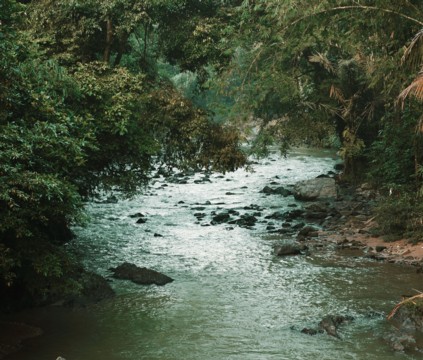
Photo by Noursakina at Pexels.
Ngerano, And Everything We Never PlannedMursyidah © Copyright 2026 by Mursyidah |
Photo by Noursakina at Pexels. |
A modest ambition, really. But on a day when one car had somehow become five motorcycles, I had been jolted off my feet more than once in the back of a truck, and overhanging branches seemed determined not to let me pass, expecting to stay dry was apparently asking too much.
I tiptoed between stones in the river. The water was so clear I could see the rocks beneath it. Perhaps that was what made me overconfident. My foot slipped on a slick surface, and suddenly I was in the water, being carried along by the current.
Fortunately, I knew how to swim. I had grown up on an island, spending much of my childhood playing in rivers. That old skill returned when I needed it most. I managed to reach the opposite bank safely.
My friends laughed at the sight of me. Once I was safe, I could laugh too, although a river with a strong current is no laughing matter. Perhaps they had not expected me to be such a capable swimmer. I was already in my forties and hardly the small, nimble child I used to be, but apparently my childhood swimming lessons had not deserted me. Ha!
But if you want to know how I ended up in a river surrounded by enormous boulders and towering rock walls, I must begin at dawn. With fried eggs. With yesterday's leftover beef-rib soup. With a work trip none of us imagined would unfold this way.
At four o'clock on the morning of October 14, 2026, I was already awake preparing breakfast. I fried eggs and reheated the beef-rib soup left over from the previous afternoon. Such is the beginning of a working mother's day: before the duties of the office, there is a household to attend to.
My two children were in the second grade of elementary school and the first year of junior high school. After they left for school at about seven, I showered and got ready. That day I would be joining four colleagues from the Environmental Agency of North Bengkulu Regency for a field survey. We were going to Aur Gading Village to collect information and assess its eligibility for recognition under Indonesia's Climate Village Program.
We had originally planned to travel in a colleague's car. Unfortunately, the colleague who owned it had another assignment that could not be postponed. The car was unavailable, but the work still had to be done.
And so the five of us set off on five motorcycles, each riding our own. Aur Gading was about forty-eight kilometers away.
Forty-eight kilometers may look unremarkable when reduced to a number. But a number tells you nothing about potholes, climbs and descents, turn after turn, or watching for oncoming vehicles while looking for chances to pass slower traffic. Some stretches were badly damaged. We crossed two large bridges. Houses and gardens gave way to one another on either side of the road.
We wanted to finish our work and get home before dark. At my age, riding that far over such uneven roads took its toll. But we had a destination to reach.
We left at around eight-thirty in the morning and arrived at the Aur Gading Village Office at ten. The village staff welcomed us warmly. After the long motorcycle ride, their friendliness was a wonderful start.
Then the village head surprised us by offering to drive us to the upper reaches of the Air Palik River in his own vehicle. We were delighted to accept.
At least we would not have to ride our motorcycles all the way to the next site. After our tiring journey, his offer sounded like excellent news.
It turned out that his vehicle was a four-wheel-drive pickup with an open cargo bed. And the road ahead was nothing like the road to the village office.
*****
Before setting off, we paused for photographs in the back of the pickup. The pictures caught us in high spirits: smiling faces, raised thumbs, and a truck bed transformed into a tiny stage for our excitement. None of us looked particularly worried about the dirt track awaiting us.
The route toward Ngerano was closer to a footpath than a road. A few short sections were covered with gravel, a little had been paved with concrete, but most of it was still earth. The track climbed and dropped over the hills, and the pickup rocked as it followed the uneven ground.
To our right lay a relatively shallow ravine and the astonishingly clear upper waters of the Air Palik. Trees and gardens filled the view on both sides. In places, branches stretched over the road from either direction until they almost met overhead. We seemed to be driving through a cave with a roof of leaves.
It was too beautiful for me to miss. Instead of sitting quietly, I stood in the back, gripping the truck while trying to record everything around me.
About a kilometer into the ride, the rough track sprang its first surprise. Despite my tight grip, a jolt sent me tumbling. With some difficulty, and with a friend's help, I stood up again and held on even more firmly.
The village head did not stop the vehicle. Up front, he was still driving and chatting with the person beside him. In the back, I was doing my best to make peace with one bump after another.
Soon I was filming again. Then came the next surprise: an overhanging branch reached far enough into the road to strike me. Down I went again.
My friends burst out laughing.
I was the one collecting the bumps and branches; they were the ones enjoying the entertainment. This trip was giving me precious little opportunity to look graceful!
Strangely, though, I was happy in the middle of it all. It felt as if a door had opened away from long hours at my laptop, office assignments, and the familiar responsibilities that usually filled my head. Here there were dirt tracks, closely growing trees, clear water, and laughter that seemed to have no end.
I remember the sound of running water, birds moving among the trees, and branches hanging low above the road. This was no neat, quiet landscape from a postcard. Nature greeted us in its own fashion, and we answered with amazement and laughter.
*****
Near the river, it seemed one more small creature wanted to join our adventure. I had no idea what kind of animal it was. All I knew was that it had been running across my clothes without my noticing.
The funniest part was that while I was making a video of myself, the little creature appeared in the recording too. It darted about as though dancing, apparently determined to be in the picture. Only when I noticed it did I start jumping in surprise and waving my hands to shoo it away.
That completed the set: tossed about by the pickup, swatted by a branch, and now teased by a creature whose name I did not even know.
Yet every mishap seemed to give us another reason to laugh. My stomach actually hurt from laughing so much on the way to Ngerano.
And then the river opened up before us.
Water flowed between immense boulders. In some places it rested in greenish pools; elsewhere it broke into white froth against the rocks. A sheer wall of stone rose beside the river, plants clinging to its cracks while trees crowded its upper edge. The sight was so magnificent that I could hardly believe such a place lay at the end of our official field trip.
This was the upper Air Palik, and we were enchanted. In our thoroughly delighted opinion, Ngerano deserved a place among the most beautiful rivers in the whole world. Admittedly, that was our own very enthusiastic ranking.
But admiring that first stretch was not enough for us. We wanted to reach another section farther upstream, which turned out to be even more beautiful. To get there, we had to cross the rocky river.
I stepped out confidently, rising onto my toes to avoid getting soaked. I was still thinking about keeping my hair dry. But the stones, so easy to see beneath the transparent water, were slippery.
I lost my footing and the current swept me along. Everything changed in an instant. Luckily, the swimming skills I had learned as a child helped me reach the other side. I was safe; only then did the incident become another story for us to laugh about.
Being in the river again brought back memories I had carried for years. I was an island child who loved swimming and searching for places to play in the water. After so much time spent on work and family responsibilities, Ngerano felt like a meeting with the little girl I had once been.
When we reached the stretch of river we had been looking for, the scenery was even more remarkable: huge boulders, rapids, high rock faces, and thick greenery that seemed to shut out the busy world we had left behind.
Already wet, we decided we might as well swim and play. We laughed, enjoyed the water, and for a little while became children again, without counting the tasks waiting on our office desks.
Oddly enough, this was the very moment for which we took no photographs. We had put our phones away because we were afraid of dropping them into the river. I had spent so much of the journey recording the scenery, yet the moment when we were happiest escaped the camera.
Not every experience needs a photograph to remain vivid. Even now, we are still talking about that day, and any mention of the river makes us laugh all over again.
*****
After we had enjoyed the water to our hearts' content, we returned to the vehicle. We were tired, and our stomachs were beginning to demand attention. Our supplies amounted to drinking water and a few cakes we had bought along the way. No rice. Apparently we had prepared brilliantly for adventure but forgotten to prepare a proper lunch!
On the way back to the village office, where our motorcycles were parked, we stopped at a dam. I had been told it dated from the Dutch colonial period. I have not verified its history or exact age, but when I saw it, the structure still appeared solid and in good condition.
A bridge with blue railings stood above the water near the dam. We took some photographs and continued on our way. By now I was growing hungrier, and we still had a long journey home.
For the return drive, I chose the seat beside the driver. After being thrown about in the back several times, I had had quite enough standing in an open truck for one day.
Our village head, I discovered, loved telling stories. While we were still surrounded by gardens and trees, he began talking about TABUTAU, or Bukit Larangan—Forbidden Hill—also known as Gunung Batu, or Stone Mountain.
This was not something I had witnessed myself. It was an account of what, according to the village head, had once happened to his father, who owned a garden not far from TABUTAU. Hearing it while we were still in the wooded countryside made the hairs on my arms stand up. I found myself worrying about what might suddenly appear around us.
According to the village head, his father had once spent the night alone in a small shelter at his garden. As dusk approached, an elderly woman walked past. In our area, greeting people we meet is a natural expression of friendliness, so his father called out to her.
“Ucu, lak mai ipe bi pelbeak lak magrib yo?”
“Auntie, where are you going? It's getting late, almost sunset prayer time.”
The elderly woman replied simply:
“Lak belek.”
“I'm going home.”
The village head's father was puzzled. The village was about six kilometers from the garden, and night was approaching. He thought about offering her a place to stay but felt awkward: he was alone in the shelter. How could he invite an elderly woman to spend the night there with him?
Instead, he warned her to take care.
“Atei-atei bae belek nak dalen, bilai bi kmalem.”
“Be careful on your way home. It is getting dark.”
The woman gave a longer reply:
“Ah coa si kmalem diye, coa bok ne, bi biaso, kalau ko tmalem nak kbun ba nidup opoi, buliak ite namen ade tun tmalem nak ponok yo.”
“I won't be caught out after dark. It's all right; I'm used to it. If you spend the night here in the garden, light a fire so we know someone is staying in the shelter.”
The village head's father acknowledged her words. He turned his face away for an instant—less than a second, according to the story—and then looked back toward the woman he had just spoken to.
The village head said his father no longer saw the old woman. Instead, he saw the back and swishing tail of a large tiger moving away toward TABUTAU.
At that point in the story, I shivered.
I do not know exactly what the village head's father saw that evening. I know only how the account reached me: told by his son while we ourselves were still among gardens and trees. Outside our vehicle lay the very kind of landscape in which the story was set. No wonder my imagination began to run ahead of me, wondering whether something might suddenly appear.
From what local people have told me, TABUTAU is a place approached with respect. There are unwritten expectations about how people should behave nearby. It is not a place to visit casually, especially not with harmful intentions or disrespectful words. I did not enter the area considered taboo. I carried home a story about it, not a claim that I had verified the extraordinary event it described.
There is a difference between reading the name of a place on a map and listening to people who have lived beside it. On a map, a hill is a shape in the landscape, and a river is a line of water. To the people who have long known them, such places also hold memories, warnings, and ways of relating to nature.
I had come that day with official duties: collect data, observe the village, and complete our survey. But I also took home a story that would never fit into an assessment form. Where an outsider might see only forests, rivers, and gardens, local people carry memories, respect, and accounts passed from one generation to the next.
*****
By the time we were on our way home, we had gathered documentation, field observations, and plenty of tired muscles. What kept returning to our conversations, though, was hardly the survey itself.
We laughed about the five motorcycles that had replaced a single car, my repeated tumbles in the pickup, the branches that had added to my list of misfortunes, and the unidentified little creature that had danced into my video. And of course, there was the river crossing that ended so differently from my plan to keep my hair dry.
Whenever I remember Ngerano, I see its clear water, enormous boulders, steep cliffs, and canopies of leaves. I remember the happiness that seemed to return me to childhood. Then I remember the TABUTAU story, heard among gardens and forest, which gave that beautiful landscape another layer of meaning.
Perhaps that is why one day could feel so full. We set out to do our jobs and came home with stories we were still talking about days later.
Strange, isn't it? After broken roads, bumps, overhanging branches, a slippery crossing, and hunger, what remained strongest was not a wish to avoid that place.
It was the wish to return.
I wanted to go back to Ngerano—not to repeat the fall in the river or the tumbles in the pickup, but because I had been so happy there with my friends, in a landscape that seemed to return a little of my childhood to me.
And as long as we can still laugh about that day together, I suspect a part of it will keep coming home with us.
Another thing I could never forget about Aur Gading was its people.
We had arrived on official business, but the village staff and residents welcomed us as far more than visitors with paperwork. The village head drove us along the dirt track to Ngerano, shared stories about his family, and showed us a place he knew so well.
I asked his permission to include his father's TABUTAU story in a writing competition. He was delighted. He even invited us to come back: he had more stories to share and offered to introduce us to village elders who knew many others.
It felt like being invited to open the next chapter of a book when I had only just finished the first.
And the invitation was not only about stories.
According to the village head, durian season was expected around December. He invited us back to eat durians in his garden. Other villagers suggested that next time we bring rice and enjoy a meal together at Ngerano.
We were thrilled. After a day exploring the upper river on the few snacks we had brought, the idea of sharing a proper meal beside the water sounded especially sensible. And there was the village head's promise of durians!
The return visit is already on my calendar. As for that durian promise, I hope the village head is ready. When December comes, we intend to remind him of it. Ha!
But before dreaming of December's durians, we had a rather urgent problem that afternoon: we were genuinely hungry.
Once we reached the village office and picked up our motorcycles, we continued toward home. The drinking water and little cakes had been nowhere near enough for a trip like this, particularly after all our excitement in the river.
So we stopped at Rajo Malim Paduko Square for ayam penyet, a Bandung-style Indonesian dish of fried chicken served with spicy sambal. After a day of potholes, muddy tracks, river water, and a tale that had sent shivers down my spine, we finally sat down to address a wonderfully ordinary problem: eating.
It would have seemed wrong to end such a journey by going home hungry. The ayam penyet was just the ending we needed for a day that had refused to follow our plans.
Only after we had eaten did we part ways and head to our respective homes.
I learned one wonderfully practical lesson from Ngerano: next time, bring enough food! Our appetite for adventure should never outrun our supply of rice.
*****
To this day, our conversation about that journey is not over. We still laugh about the motorcycles, my tumbles in the pickup, the low branches, the little creature in my video, and the hair that ended up wet when I was swept into the river.
I still picture Ngerano's water flowing between great rocks, its soaring cliffs, and its green tunnel of trees. I remember how we played in the river like children, and how the story of TABUTAU made me shiver precisely because we heard it while we were still among the trees and gardens.
I had assumed we would come home with survey notes and a handful of photographs. Instead, one day's journey gave us laughter that lasted, stories we still retell, and new acquaintances whose kindness made us long to return.
I have no wish to repeat being carried along by the current or thrown about in the back of a pickup. But I want to see Ngerano's water again, hear more stories from the people of Aur Gading, and enjoy the companionship that made the day unforgettable.
December has not arrived yet. Our invitation to eat durians and bring rice to Ngerano has not become a second journey; for now it remains a promise we have accepted with delight.
I went to Aur Gading for work. I want to return for its landscape, its stories, and the kindness of its people.
And next time, two things are certain: we must bring enough rice, and the village head must not forget his durian promise!
Durians, oh durians—I'll be coming for you in December. Ha!
*****
Mursyidah is an Indonesian civil servant at the Environmental Agency of North Bengkulu Regency, Bengkulu Province, Indonesia. Her work connects her with rural communities, rivers, forests, and the landscapes she hopes to help protect. Raised on an island, she has loved swimming and exploring rivers since childhood. She is also a mother of two. Her only previously published work is her academic thesis, “The utilization of sea water in especially designed battery (saBrine Swall Battery).” She previously entered an energy-themed writing competition organized by the Indonesian Institute of Sciences (LIPI) but has not won a writing prize. Her story recounts an unforgettable field journey to Aur Gading in October 2026.
(Editors
note. The author has let me know that her
full legal name is Mursyidah. And that in Indonesia, a person may
legally have a single-word name without a surname or family name.
Interesting. We learn something new every day!)