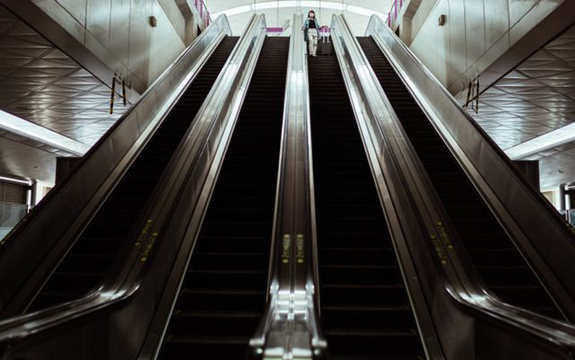
There
is a peculiar kind of family memory that refuses to fade. It survives
not because it altered the course of anyone's life, but because it
preserves someone exactly as they once were. For my family, that
memory is of my younger brother at twelve years old, suspended on the
moving handrail of an escalator, ascending helplessly through a
shopping mall while an audience of strangers looked on.
The
image has long outlived the afternoon itself. It resurfaces over
dinner, during long car journeys, or whenever someone accidentally
recreates even the smallest part of that moment. My brother still
insists that the story becomes more dramatic with every retelling.
The rest of us insist it does not.
If
you met him today, you would probably find the story difficult to
believe. He works in consulting, carries himself with a quiet
confidence, and has a measured way of speaking - of someone who
thinks before he responds. He rarely rushes to fill silence, choosing
his words with care instead. It is difficult to imagine him at the
centre of such an improbable scene.
Perhaps
that is why I return to the memory so often.
My
brother and I were never especially close as children. Three and a
half years separated us, enough for us to inhabit different worlds
despite growing up under the same roof. We became friends only much
later, when adulthood quietly replaced childhood differences with
mutual understanding. Looking back now, I realise that many moments I
dismissed as ordinary were quietly revealing. At the time, they were
simply family stories. Years later, they feel almost like pieces of a
much larger picture.
The
afternoon itself was ordinary. We had gone to a local Indian shopping
mall with the intention of buying a few things before having dinner
together. Like most family outings, the plan was simple; the
execution was less predictable. A shopping trip rarely remained a
matter of entering one store, choosing an item, and leaving. My
mother believed that objects deserved consideration. A cushion was
not merely a cushion; it was a question of colour, texture, and
whether it belonged in the space it was meant for.
This
made decor stores particularly appealing to her.
My
father, who had accompanied her on enough such excursions to
understand the process, approached shopping with remarkable patience.
He did not rush her or attempt to shorten discussions that were
clearly important to her. He simply waited, observed, and
occasionally offered an opinion when asked. His calmness had always
been one of the quiet constants in our family.
My
brother, however, did not share that enthusiasm.
For
the first few minutes, he tolerated it. Then came the familiar signs
of a twelve-year-old whose interest had disappeared: the occasional
sigh, the wandering attention, the increasingly obvious hope that the
trip would soon come to an end. It was not that he was impatient in
general. He could spend hours with a book or remain focused on a
tennis match without complaint. However, a store full of household
items demanded a particular kind of attention that he did not
naturally possess.
The
decorative bowls and carefully arranged displays had lost their
appeal. At some point, he began pointing out the obvious - we were
looking at things we might not even buy.
He
was not wrong. Eventually, my father volunteered to step outside with
him while my mother and I continued browsing. It was a practical
compromise, and one that suited everyone. My brother escaped the
world of cushions and vases; my mother was free to continue without a
soundtrack of growing impatience.
We
did not think much of it.
When
my mother and I finally finished and stepped out of the store, we
expected to find them somewhere nearby in the open concourse.
Instead, our attention was drawn upwards.
At
first, I could not understand what I was looking at.
My
brother was moving. Definitely not in the way a person normally moves
through a shopping mall. He was being carried upwards by the
escalator handrail. For a moment, I assumed I had misunderstood the
scene.
My
brother was not climbing the escalator. He was not playing around. He
was simply perched, caught in an awkward position as the moving
handrail carried him steadily upwards. His body language suggested
someone who had begun the situation without concern and then
realised, far too late, that he had made a mistake.
Only
later did we piece together what had happened. At some point after
leaving the store, he had leaned against the handrail without
noticing that it was moving. It was the kind of action people perform
without thinking - resting against something, shifting their weight,
allowing their attention to wander elsewhere.
Except
this time, the object beneath him was moving.
By
the time he understood what was happening, getting off no longer
seemed simple. His first reaction was confusion. Then recognition.
Then the quiet acceptance of someone who had realised that panic
would not improve the situation.
From
below, my mother immediately tried to solve the problem in the only
way that seemed obvious. She called out instructions, encouraging him
to step off and get down. From where we stood, it seemed like the
easiest solution. From where he was, however, the gap on the other
side of the escalator looked far less forgiving. A sudden attempt to
escape might have created a much bigger problem.
For
all the embarrassment of the moment, my brother made a surprisingly
sensible choice. He stayed still.
My
father reached the same conclusion. While my mother's concern came
out in the form of urgent instructions, his response was
characteristically calm. He did not make the situation seem larger
than it already was. He simply told my brother to remain steady and
wait until he reached the top.
That
contrast between them was something I had seen many times before. My
mother cared deeply and acted immediately. My father cared deeply and
remained composed. Between the two, my brother had both the urgency
and the reassurance he needed.
Meanwhile,
the rest of the mall had begun to notice. People slowed down as they
passed, drawn by the unusual sight unfolding in front of them. Nobody
seemed quite sure how to react. There is a particular hesitation
people have when they witness someone else's embarrassing moment:
they want to help, but they also know that sometimes the kindest
thing they can do is simply pretend they are not watching.
My
brother, meanwhile, had accepted his fate. There was no attempt to
make the situation appear intentional. No desperate effort to reclaim
dignity halfway through the journey. He simply continued upwards.
A
few moments later, he disappeared from view. Then, as if determined
to restore some order to the universe, he appeared again - this time
on the neighbouring escalator, returning to the ground in the
ordinary manner intended by its designers.
That
was when I finally laughed.
Until
then, the situation had been too confusing to fully process. But once
I saw him safely making his way back down, the absurdity of it became
impossible to ignore. The image was simply too unlikely: my
thoughtful younger brother, who could spend hours immersed in a book
or focused on a task, had somehow turned an ordinary shopping trip
into a story none of us would ever forget.
My
brother, however, was less impressed by the humour of the situation.
He was embarrassed.
Naturally,
he attempted to defend himself. There was an explanation, he
insisted. The circumstances were not entirely his fault. To be fair,
he was not completely wrong. The incident had not been a deliberate
act of carelessness. It was simply the result of a brief moment in
which he had stopped paying attention to the world around him.
My
mother's lecture lasted considerably longer than the actual incident.
It continued as we left the mall and made our way towards dinner,
moving through the familiar stages of concern, frustration, and
disbelief. My father, having confirmed that no harm had been done,
found the episode much easier to appreciate. He teased my brother
about it more than once, which only extended his embarrassment.
Years
later, the story remains one of those family memories that refuses to
disappear. Not because it was important. Not because anything changed
afterwards. Simply because it was so unmistakably him.
The
boy on the escalator and the man I know today almost seem different
people at first glance. Yet the more I think about it, the more I
recognise the same qualities beneath both versions of him.
University
changed him in ways none of us expected. Living away from home gave
him independence, widened his world, and gradually brought him out of
the reserved nature he had as a child. He formed new friendships,
discovered new interests, and became far more comfortable stepping
into unfamiliar spaces.
Sometimes,
when I look closely, I can still recognise the same person. The
curiosity is still there. The focus is still there. The tendency to
become completely absorbed in something remains, although now it is
usually directed towards a goal rather than a moving handrail.
Perhaps
that is what makes memories so valuable. They do not preserve people
exactly as they are; they preserve them as they once were. Families
have the rare privilege of remembering people in every version they
have ever been - the child, the teenager, the adult, and all the
imperfections in between.
Today,
I know a man who is thoughtful, disciplined, quietly ambitious, and
deeply committed to the life he has built for himself. Most people
know that version of him. I count myself fortunate to know another.
I
know the boy who accidentally became the most memorable attraction in
a shopping mall. The boy who tried to defend himself before
eventually laughing along. The boy who, despite the embarrassment,
stayed calm when the situation became difficult.
The
escalator story will probably follow him for many years. He may roll
his eyes when it is mentioned, and he may insist that the retelling
has become exaggerated. He will not succeed.
Because
the story was never funny simply because he made a mistake. It was
funny because, for a brief moment, the world caught him by surprise -
and we got to see a small, honest glimpse of the person he was
becoming. More than a decade later, that glimpse still makes me
smile.
Hello!
I am an Interior and Furniture Design graduate from Navrachana
University. I have worked at Sachin Patel Associates & Studio
BackinBlack. I like to keep a multi - disciplinary design approach. I
enjoy using hands on methods, exploring with various possible
techniques, crafts & materials. I believe that having an
understanding of the values, ways and narratives of the user helps to
create the strongest and most well - suited designs