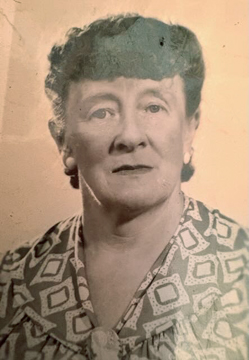
My
maternal grandmother was a difficult and demanding woman. She lived
in another seaside resort along the coast from our house. I have not
one happy memory of her to relate, except perhaps the garden. She had
a fuchsia bush and I loved to pick the flowers and turn them into
ballerinas by pulling out the extra filaments, leaving just two, like
slender dancer’s
legs. She had a narrow, square paved path running down the middle of
the lawn which was perfect for playing solo hopscotch but I had to
remember to wipe the chalk markings after I’d
finished or there would be trouble.
It
was strangely cold and dark in her house, even in summer. There was
red Linoleum in the lavatory - she called it a lavatory - and I could
hardly reach the flush chain. The paper was hard, in a box on the
floor. The kitchen was cramped, smelled of stale bacon fat and, to
protect it, the prized Robert’s
radio was covered in a dusty, crumpled, polythene bag. Curled inside
a mauve towelling shower cap in her bedroom wardrobe was an
exceptionally long rope of her plaited auburn hair, cut from her head
when she was 30. Sometimes she uncoiled it and held it against my own
head and it brushed the back of my calves. She maintained her hair
was so long and heavy she was forced to have it cut to assuage her
headaches and back problems.
She
was sour, her mouth turned down at the corners. Her small eyes
squeezed together in a constant disapproving frown. She must have
been badly wronged in her life to make her so mean, mean spirited as
well as ungenerous.
She
never read me stories or bought me sweets, or baked a cake with me.
She did teach me how to knit but the lessons were fraught, she was
impatient and would snap like a cat if I didn’t
catch on to an instruction immediately. I don’t
ever remember hugging her or her cuddling me. There would only be a
polite peck on the cheek, when I would smell that fusty, old lady
smell, a mix of moth balls, a little body odour and lavender water.
There
are letters my father wrote during WW2 where he mentions her fondly,
so perhaps she wasn’t
always miserable.
29
September 41
I
was very sorry to hear that your mother had to have as many as 16
teeth extracted–what
a horrid appointment it must have been to look forward to! It was bad
enough when I had one pulled out so I dread to think how very painful
it must have been for her.
From
time to time I was sent to stay with my grandmother when my parents
had the occasional escape from their boisterous children. I dreaded
it. I was with her on 15th
February 1971, the day the United Kingdom embraced decimalisation.
She sent me to the butchers on the parade to buy sausages for our
lunch and I ran excitedly all the way back to her house. I wanted to
show her the shiny new decimal coins I had been given as change which
jingled in my pocket. She was absolutely furious, ordered me straight
back to the butcher to insist on her change in ‘proper
money’.
I was twelve years old, shy, cowered and so ashamed of my
grandmother’s
wrath.
On
her sideboard in the dining room she had a large silver ball, about
the size of a small bowling ball. It was never dusted because the
dust that collected on top was alleged to have magic powers. Very
occasionally I was allowed to place one finger on it, wipe off a
little dust, and then make a silent wish. Needless to say the wishes
never came true: mine was probably Please
can someone come and fetch me home in the next five minutes?
2nd
October 1942
Are
you going to French classes this evening or going straight home to
finish a pullover and listen whilst Mummy recounts her experiences
that afternoon in an air raid shelter?
I
was transfixed by her underwear which consisted of layer upon layer,
summer and winter, no matter the weather. Voluminous knickers went on
first, followed by a heavily boned corset with dangling suspenders on
which were hung thick beige stockings, 60 denier, with seams up the
back. The corset ensured she always sat ram-rod straight, and walked
with the deportment of a debutante even in her 80s. Her brassiere was
satin, shapeless and offered little if any support to her sagging
breasts which lolled over the top of the high corset, and had thick
straps and multiple rows of fastening hooks and eyes at the front.
She would pull a woollen vest on top of the bra and corset and long
woollen bloomers on top of the stockings and suspenders, and finally
a silk petticoat to smooth the silhouette of whole ensemble. It took
her a very long time to get dressed and undressed each day.
We
used to visit her neighbour, an ancient paraplegic called Mrs
Goddard, who lay on a day bed in her geranium filled conservatory,
her spidery veined hands clawing at the heaps of hand-crocheted
blankets covering her skeletal body. If my grandmother perceived me
to be naughty she would pinch my thighs and order me not to cry or
you’ll
end up with legs like Mrs Goddard’s.
I never actually knew what poor Mrs Goddard’s
legs looked like, hidden as they were under the blankets, but I knew
she couldn’t
walk and I’d
seen her awful hands which was plenty enough grist for my
imagination.
June
1942
What
thousands of happy memories come back to life as soon as I give our
double bed a thought! Watching your pretty little face deep in
slumber, making love to you in the afternoons at Blakewood Court,
straining our ears for Mummy’s
unexpected arrival…
There
was another time that springs to mind. Rarely was I allowed in the
dining room with its dark wood sideboard and matching dining table
and chairs. Her knees were old and arthritic so I was given a yellow
duster, stiff with polish and a tin of bee’s
wax and told to clean the furniture, starting, crouched on the floor,
with the barley twist table legs. She watched me, upright, beady
eyed, her now salt-and-pepper hair crimped into artificial waves. I
must have been about seven or eight and I said something like,
“Mummy
doesn’t
make me polish the furniture, she just dusts it.”
“Your
mother was a harlot in the war!”
she replied.
I
didn’t
know what a harlot was. It didn’t
sound like a very nice word and I was too frightened to ask. I
couldn’t
make head nor tail of the definition in my children’s
dictionary: A woman of the night. A prostitute.
I
was born in Beirut and grew up on the south coast of England.
I’ve
spent many years sailing small boats across oceans with my children
and living
and working in the West Indies.
Returning
to the UK, after my husband’s premature death, I brought up our
four
children
alone whilst graduating in Screen Production from Southampton University
and became a filmmaker working with artists, galleries and the Arts
Council.
At the same time I began to lose my hearing.
I
wrote, shot and edited my own material for documentaries about
diverse subjects from female inmates in H.M. Prison Winchester to
bee-keeping in Africa. My short films have won awards both here in
U.K. and the U.S.. I am a graduate of the Faber Life-writing course.
My
pitches have twice been selected for feedback in the Mslexia ‘Agent
Extravaganza’.
I’m
a volunteer at the Bournemouth Writing Festival.