The
warm wind pushes strands of my greying black hair across my face
which I’m obliged to gently put to one side. This is in order to
complete my daily task as I sit on the veranda of a simple
one-bedroom wooden shack outside the boundaries of Port Jackson. I
have reached the age of fifty-two though my tragic circumstances
indicate a much older looking woman. When I glance at myself in the
mirror, I am immediately aware of my hair. It is much thinner and far
greyer than it once was, and my skin is sallow and lacking the
elasticity of youth. Official records state I am five foot three
inches tall which is keeping with my heritage. Neither of my parents
exceeded my height by more than three or four inches. I vaguely
recall that I was once bold and outward looking but that was in my
youth when, despite difficult economic circumstances, and a lowly
paid job I somehow exuded confidence though I know not from where
this misplaced positivity came from, perhaps it was one of the few
beneficial things I inherited from my father?
Now
it’s the year of their, not my, Lord 1844 for I hold no truck with
any God nor any so-called religion. Life has proven to my entire
satisfaction and beyond any reasonable shadow of doubt, despite an
upbringing in a God-fearing family, that no such omnipotent being or
thing exists.
As
I look up from the assembled manuscript with my untidy, scratchy
writings and the occasional ink blot, the sun has retreated behind
one of the large Red Cedar with its gnarled roots exposed on the
earth’s surface; the locals call it a Toona. My husband, Samuel
Denyen, says that’s a shortened version of its proper name, Toona
Ciliata or Australian Toona. Unlike me, he knows so much about the
natural history and fauna, yet he’s only been in this country the
same amount of time as myself. Perhaps it is now propitious for me to
disclose that my first seven years were confined to the prison colony
of Van Diemen’s Land just across the water to the mainland of the
British colony of New South Wales where my husband and I now reside.
My daily task, as suggested by Samuel, who seems to think the matter
worthy of recording, is to faithfully show who I am, how I got here
and why I’m writing this account.
It’s
no easy task for me to undertake such a matter, notwithstanding the
fact that I was fortunate enough to have benefited from some
education. My late father, of which much more later, was a famously
erudite man of both the printed and the spoken word and once, of
great fame and fortune stemming from his successful endeavours,
endeavours I should add that were considered by many in polite
society to be improper and immoral on several levels.
My
husband is four years my senior and at least a head taller. His pate
is hairless, as required during his time in prison, but doubtless its
continuation was caused by the great trauma and distress arising
directly from his journey from his place of birth, Manchester in
England, to Australia. The unspeakable deprivation on route was far
worse than most experienced and the penitentiary regime visited upon
the men more severe than that experienced by those of us in the
separate women’s prison. Hard labour and exacting punishments meted
out to those guilty, even of minor infractions, were, in the eyes of
good Christian reformers, inhuman. One-hundred lashes of the whip was
not unheard of; the entire prison colony was run on the hard lines of
the British navy where discipline was of primary importance. The
undoubted role of such a land-based regime was not reformation but
solely to break the will of those prisoners’ intent on
misdemeanours. In this respect the harsh process surely succeeded as
witnessed by the empty shells that purported to be men that drifted
aimlessly around; long gone was the brightness in their eyes, instead
broken bodies and broken spirts until the day they died. Far better
they had learned their lessons early and not attempted to go against
the system
.
As
I glance through that which I have already committed to paper. I see
I am accepting, not ashamed of my fleeting role in prostitution. In
all sincerity I can blame no one apart from poverty itself as to the
reason for such an inappropriate choice of career. I embarked on such
work at the age of eighteen or nineteen. However, the reason for my
now having to live so far away from my natural homeland, was larceny
whilst in domestic service when I was resident in London. The cruel
words and subsequent sentence of transportation handed down by the
magistrate still ring in my ears, hence my ability to faithfully
reproduce his utterances.
But
first let me refer, if you please, to earlier times. I was born in
Bethnal Green, East London in 1792, into a full and joyful household;
I was one of the middle children of nine, given, as my parents would
oft state, as a great gift from God to my pious mother Esther and
distinguished father Daniel. However, shortly after my tenth birthday
our family fortunes were suddenly in jeopardy due to matters which I
shall properly ascribe later. And so, my mother and those children
still living with her were unceremoniously removed from their once
nice comfortable home with servants to do their bidding, to a home
bereft of many of its furnishings by those working for my father’s
creditors. In truth I was too young to fully understand what was
taking place in our once comfortable quarters. I did, however, notice
the distress it caused my dearest mother. Her copious tears solicited
no note of sympathy from those instructed to remove once cherished
chattels with a view to their disposal and any resultant funds
returned to those with a legal claim. Yet, during such turbulent
times, our pater, the head of the household, was nowhere to be seen,
though it was always understood that he was aware of our difficult
circumstances and was supposedly using his every endeavour to remedy
the situation. Though how precisely he intended to right the great
wrongs he bestowed upon us I found difficult to fathom.
The
remnants of the family subsequently found itself split up. Initially
I was obliged to stay with my mother who managed to find lodgings not
far from our earlier abode but in a far less commodious circumstance.
I was put to work in domestic service in order to help support the
youngest in the family. Compared to some in a similar position, I
considered myself to have been fortunate in that I had the benefit of
some education which is why it is all the stranger that I conducted
myself so ill-advisedly. Tiring of domestic work and the paltry sum
placed in the palm of my hand at the end of each working week and not
possessing any particular skill or culinary ability I decided after
much soul-searching, to place my sole asset on the market and become
a prostitute. It was, I believed, the only means of putting food on
my table and keeping the landlord of my newly rented lodgings at
ease. Over a period of several years, I admit to having been
apprehended, not for soliciting but rather, on numerous occasions,
for a series of petty crimes and for being drunk and disorderly; the
punishments for both were often nothing more than a few weeks in
gaol, though, as I was to find out, the punishments could be far more
severe.
It
was through my work as a part-time prostitute that in 1810 I met up
with a Mr Ebenezer Jones and we subsequently lived as man and wife in
Stepney, East London. I even adopted his name though it was not the
result of a legal marital arrangement. Ebenezer gave the impression
of being a successful man about town in that he was well presented
and spoke well. He was about thirty-six years old when I was first
acquainted. He exhibited light brown wavy hair and sported a
fashionable handle-bar moustache. I suppose I ought to have been
suspicious from the onset, for he was totally impecunious though he
espoused good prospects which, of course, never came to anything. He
was never a client of mine though I was aware that he often used some
of the ladies with whom I was seen in the company of. Perhaps the
attraction, such as it was, was born out of a feeling of underlying
loneliness that made me gravitate towards him.
I
will not dwell further on the matter of my choice of men or work
though I realised from the onset that it was not something I wished
to continue in the longer- term. Stupidly, I had no plan to secure
training in a more respectable occupation and therefore, for some
time, I continued to occasionally sell my body. I admit to gaining no
great pleasure nor useful insights as a result of these endeavours
which, in truth, were only of a spasmodic nature, namely at times of
urgent financial need either mine or Ebenezer’s. Inevitably
pregnancy and disease stalked me almost on a daily basis, not that
Ebenezer truly cared. Fortunately, I proved to be both resilient and
lucky in that I was with child on only three occasions. Shortly after
each of their deliveries I arranged for the babies to be adopted once
the wet nurse had weaned them. But, in all honesty, I also have to
report, lacking any great bonding and receiving no encouragement from
Ebenezer, I soon lost touch with them and their whereabouts,
consequently, what the future eventually held for the poor little
mites.
I
truly realise that these comments will not solicit any great degree
of sympathy from those choosing to read this account, but my
intention is not, given my circumstances, to seek empathy but
instead, to provide an honest testimony.
Following
the birth of my third child, a boy, I succumbed to an infection from
which I was apparently fortunate to survive. The illness did however,
give me time to consider what might occur on any future occasion,
should I fall ill again and thus, in 1820, aged twenty-eight, I gave
up the work with which I was so strongly associated and, much to
Ebenezer’s alarm, I once more found a poorly paid role in domestic
service, this time as a scullery maid. Much to his
annoyance, I took this opportunity to split from Ebenezer thus
depriving him of his sole source of income.
My
role as a general dogsbody and scullery maid involved scrubbing out
kitchen pots My job provided a tiny bedroom of my own as part of my
employment which I gladly accepted thus finally cutting all ties with
Ebenezer whom I never saw again.
The
kindly butler at Pentonville Road, taking pity, trained me to
properly serve in the family’s dining room which enabled me to
better myself and, as a consequence, I began to enjoy my role in
domestic service. Unlike the vast majority of other servants, I could
competently read and write and thus I found myself further elevated
to become the mistress of the house personal maid. As part of my
role, I would take messages from Mrs Ruther to other households and,
incidentally, learned my way around the district.
I
cannot in truth explain why, but I guess old habits die hard, and
from time to time as I waited in another lady’s house for a written
reply to my mistresses’ letter, I started to remove small items,
later selling them to dishonest pawnbrokers of which there were
aplenty. My undoing however, took place whilst on a day off; these
were occasionally given to servants by the master of more enlightened
households. I took this brief freedom to travel by horse-drawn
omnibus to Stepney to visit my mother whom I had not seen for over a
year.
I
was crossing a small area of grass alongside the High Street when I
noticed a little girl fall down in some mud. By the time I had
approached, she was crying for her mother, and I determined that I
would assist. Fortunately, the child was old enough to be able to
identify where she lived and so, holding her small trembling hand, we
made our way a short distance to a road with respectable looking
houses. There I introduced myself to the lady who opened the front
door as the little girl grasped hold of her mother’s apron. The
lady was Martha Williams who initially eyed me suspiciously until,
through further sobs, my temporary charge explained my role in the
mishap. Mrs Williams asked me to tarry as she would like to thank me
more fully and disappeared upstairs with her daughter for a quick
wash and change of clothes. As I waited, I noticed a fine-looking
clock located over the fireplace in the reception hall. I was also
aware that time was marching on. If I were to stay much longer, I
would run the risk of not being able to see my mother and still
return in good time to my employers. I recall that I didn’t exactly
feel any sense of entitlement other than to assume that Mrs Williams
would wish to reward me in some tangible manner, and this thought
somehow turned into my moving into a nearby room and helping myself
to a number of items which happened to be lying about. After placing
these items in my large carry-bag I bid a hasty retreat. Once outside
the house I walked to the corner of the street and took the time to
examine that which I had taken. Had I not stopped to examine my
ill-gotten gains I might have escaped. As it was, I was speedily
apprehended when the lady of the house accompanied by her husband
caught up with me as I walked back towards the grass area where I had
first met the distressed child.
I
was taken by the pair to a constable. The following day I appeared
before a magistrate, a man with a bulbous nose and suffused skin
giving him a ruddy appearance. When he spoke, it was with an
animalistic hiss.
When
asked to answer the charge of larceny I stated my case which I had
been carefully rehearsing overnight in my cell. On a number of
occasions, the beak looked up from scribbling notes in a huge
leather-bound ledger in front of which stood a ships decanter of red
liquid and a small sherry glass from which he regularly and liberally
fortified himself. However, as I continued with my version of events
it became more and more apparent from the noisy “Tutt, Tutt” that
he was disinclined to accept my contention that Mrs Williams had been
very drunk and had given me the articles to sell in order to reward
me for my services to her daughter. The verdict was therefore
something of a foregone conclusion, the length of sentence, however,
came as a shock. I admit to having anticipated a short period in gaol
as I had in the past, to some extent this anticipation was fully born
out. The magistrate stared over the rim of his heavy metal spectacle
frame and wagged a finger in my direction as he scolded me for my
behaviour; nor was he impressed by my apparent lack of remorse as
indicated by what he described as an entire falsehood intended to
deflect blame. After a short period of reflection, he finally looked
down at the ledger before him, his quill, having been dipped into an
ink well, scratched away mechanically for a minute or so before he
looked up again. At which point he wetted his lips by licking them
with a somewhat bloated purple tongue and pronounced sentence.
“Prisoner at the bar, you are hereby found guilty of simple larceny
in that you removed goods to the value of sixteen shillings from the
home of and rightful owners without their consent of said goods. You
are therefore to be imprisoned for a period of no less than seven
years. Further, I determine that you constitute an ongoing risk to
all good people at large and therefore under the Act for punishment
for rogues of 1597, you shall serve your sentence, in banishment from
his Majesty’s realm in the penal colony of Van Diemen’s Land,
Australia”. “Gaoler” he continued in his weaselly little voice,
a contented look on his pompous face “take her back to the cells”
I
was so stunned at being deported that I felt no great emotion inside
of me, just a sickness in my stomach of what might lay ahead. I was
in my thirty-fourth year and had nothing to look forward to except
incarceration for the next seven years. And what of my family and my
employer? How could I get word to them of what had befallen me? With
great good fortune a kindly prison guard said, on the basis of a
small reward from my family, the fame of whom he had knowledge, that
he would be willing to get word to all of those whom I felt should
know of my wretched circumstances. To this limited extent my mind was
put at rest.
Early
in September 1828 I was taken from the woman’s section at Middlesex
Gaol and thence by jailer’s-cart to the docks at a place called
Tilbury. There I, and ninety-nine other unfortunates, were taken
aboard the moored ship, The Harmony, and on 9th of that month we set
sail for Australia.
If
I ever believed that my servitude whilst at Middlesex Gaol was bad
and inhumane, I was yet set for a far greater shock. The Harmony
hardly looked seaworthy and thus totally incapable of a short journey
along the Thames let alone to the other side of the world. And yet
this tired hulk was to be our transport for the perilously long
journey. All the prisoners were speedily confined to shackled pens
set deep in the dank bowels of the craft. There we competed with
large rats which would try to steal our meagre rations of stale bread
and water supplemented with boiled potatoes on Sundays. Sanitation
was almost non-existent as we were unshackled only once a day in
order to attend to our ablution. Any additional bodily needs had to
be supressed or allowed to foul the floor directly beneath where we
sat. The regular influx of seawater through the bilges and the
seepage of the oceans through the saturated timbers of the hull
ensured a regular swill around our bare feet incorporating a melange
of whatever was lying on the floor including faeces, human and rats
as well the droppings from the twenty or so horses stabled
nearby.
At night we were removed, under armed guard, to a rear section of the
same level where there were forty or so simple wooden pallets with
lumpy straw mattresses over which were strung canvass hammocks. The
prisoners agreed amongst themselves to take it in turns to enjoy the
relative comfort of the more stable pallets, particularly apparent
during the several rough passages we endured at sea. The
journey lasted some four months before we eventually stumbled weakly
and emaciated onto dry land. It was 14th January 1829.
All
the surviving prisoners, twenty-eight having died on route, together
with ten of the horses, were lined up outside a wooden palisade from
whence a striking man in full military regalia and sporting a white
beard stood on a platform to address us. I’d already heard it said
that we prisoners were fortunate. Apparently, it had only been a
decade earlier that the then governor a certain Major General Lachlan
Macquarie, had decided to try and assist prisoners to reform. This
involved the prohibition of the previous barbarity of the island’s
regime with its hard labour and strict punishments including
whippings and starvation. Instead, Macquarie had introduced a level
of freedom which could be earned by good behaviour and full
compliance with the rules. It was a course I set my mind to. However,
the full force of the law was available to be used for any
recalcitrant.
Macquarie’s
replacement, the man now standing before us, despite apparent
resistance back in England, where the majority of politicians
strongly opposed reforms, was similarly inclined to educate those in
his charge to the ways of sobriety and honest living and he said as
much as he expounded upon the King’s Regulations to us
prisoners.
Now,
I am again gazing out from the shack’s veranda, taking in the light
sandy soil, impoverished plants and trees that constitutes our small
parcel of land, given to all prisoners upon gaining their legal
freedom. The orange glow from the fast-setting sun has begun to
dissipate as the last of its rays cast long shadows back towards the
shack. From within there is a light, polite voice, it is my recently
taken husband, Samuel Denyer calling me to partake of food.
At
a somewhat late stage in my life good fortune seemed to have entered
my circumstances in that I met a man who respects and loves me. He is
my pillar of strength, and I gain great succour from his very
presence and his natural wisdom. Since he set me the task of writing
an account of my life and the life of my famous pater, he has taken
on many extra roles and household chores which has enabled me to be
free to undertake research and conduct my writing.
As
I recall, it was shortly after my release from Van Damien’s that I
met Samuel. I soon learned that he too had been incarcerated, being
freed only a few weeks before my own sentence had ended.
Through
what I believed to have been the kindness born out of a pure heart, a
prison officer, James Bourton, offered to assist me in securing
temporary living space and to seek paid work. The property to which
he directed me, was multi-tenanted. It was situated close to the
harbour and comprised a pleasant three-storey brick and stone
building exclusively occupied by former inmates. Its location and
reputation, unknown to me at the time of my moving in, was such that
sailors would expect to find ladies of an easy disposition willing to
offer services in exchange for gift and money. It soon became
apparent therefore that my thought-to-be saviour had nefarious plans
concerning my future, including a return to the ways which took me
away in the first place from my country of birth and my family. But I
had no intention of falling into his trap and at night barricaded
myself into my little bedroom by shifting all the furniture against
the door. There was, I subsequently established, an official
government office located not far away whose role was to allocate
small parcels of land to former prisoners with a view to them
becoming almost self-sufficient. They supplied both the initial seed
and simple implements and transported those prisoners able and
willing to accept the offer to their new locations.
Inevitably
there were some amongst the newly released who, despite the lesson of
imprisonment, had no intention of making something better of
themselves. but I was not so minded. Instead, I took up the offer of
a simple life and a small plot of land.
I
think it was the second or third day of attending the government
office, pending the issue of my certificate of freedom, signed by the
governor, that I came across Samuel. He had already left the little
house containing former prisoners and had, with the aid of the
authorities, started a wood carving business. I later learned that he
had already received a commission from a shortly to be consecrated
church which wanted ornate carvings for their alter.
Samuel
had sauntered into the small government office where I was waiting to
be interviewed and sat down next to me. He introduced himself as Mr
Denyen a recently released prisoner seeking a small loan from the
official sources in order to purchase additional chisels and flint
blocks which, he advised, were used to sharpen his tools. Not the
most captivating of conversations but there was something open and
honest about the man which immediately attracted me to him. I told
him my name and why I had ended up at Van Diemen’s and things
simply went from there. We agreed to meet up on a couple of
occasions, and I slowly realised that when we were not together, I
somehow missed his warm smile and companionship. I readily admit that
there was no great passion between us, but a more durable mutual
respect and friendship manifested itself to our mutual satisfaction.
We lived in the wooden building that he largely constructed with
materials supplied by the official body responsible for the welfare
of former prisoners. The land, originally allocated to me, was deeded
to us both on the understanding that we tended it to an agreed
standard. Samuel would go off every morning at around six o’clock
and undertake his tasks as a wood worker returning by around seven in
the evening. I, on the other hand, until he set me the task of
writing the journal, would clear the plot of stones and weeds, break
up the large clods of solidly baked soil, sow the seeds, mostly
maize, draw water from the well irrigate and keep the house free from
the ever-present dust blown in from the dry land. Sunday’s,
however, were a day of rest and freedom for us both, this then was
our routine.
The
food he prepared nightly was simple fayre but for all that, it is
wholesome and tasty and, after a long and arduous day either on the
land or in more recent times stuck at my writing, I was truly
grateful for the results of his endeavours. He smiled warmly as I
entered our basic main room with its bare floorboards and exposed
panels of wood that made up the walls and ceiling. I sat at the small
table towards which he had beckoned. It was his custom to say a brief
prayer of gratitude for the food we were about to consume.
This
simple act of godliness often brought back memories of when I was
very young. My father would cover his head with the familiar skull
cap, the Yarmulka, whilst my mother would draw her shawl over her
hair and bow her head as papa would intone the Jewish prayers of
thanks for the bountiful supplies that the Almighty one has graced us
with. My brothers and sisters would then be reminded by papa that
this single act of Jewish prayer was sufficient, during the days of
the Inquisition, to lead to the death by burning at the stake of
several members of his then orthodox family. But such meaningful
memories of my childhood with my parents and my many siblings
gathered around the large dining room table laden with sabbath food
and wine quickly faded as if it were the morning mist evaporating
under the heat of the rising sun.
Wearily
I put down my quill, I will take it up afresh on the following
morning. I recognise that here is a need yet, to give proper context,
sequence and order to my account of events. However, in doing so it
will require me to refer to some matters that occurred long before I
was born, thus any inconsistencies necessarily reflect either my poor
memory of matters passed onto me by others or inaccuracies at the
time of their telling. Furthermore, the sequences I have chosen, in
setting out my story, do not always precisely follow historic dates.
This is because the better part of what I am about to recount
properly belongs to the life, times and illustrious career of my
father. This in turn has necessitated a certain amount of flexibility
as I separate and reorientate some events. That I have been able to
embark on such a course is entirely due to the fact, somewhat
mysteriously, that a large metal box had been delivered to the prison
shortly after my release together with a letter imploring the
authorities to bring to my attention its arrival.
Safe
custody of the box was most fortuitous, not only to have survived the
lengthy journey but to have found me still alive. In short, the
material within the box comprised great insights enabling me to
undertake the task to which most of my time in recent months has been
devoted. Nevertheless, if any discrepancies, as minor as I hope they
might be, are seen, so as to sow confusion, I apologise. Be aware
however, that very little licence has been allowed to creep in. What
you will shortly read, mostly, really did occur and the vast majority
of characters are also real.
In
order to add authenticity and to preserve for posterity what I
perceive to be potentially important documents I have added, directly
and unaltered, copies of all the correspondence which appeared in the
national newspapers between my father and his greatest opponent,
Richard Humphreys. These appear at the termination of my writings.
Finally,
I have determined that the metal box and its contents, having served
their purpose of enlightenment, should be returned to the sender. The
fact that I cannot claim any knowledge of whom that party might be
shall not deter me from the task. My husband is a resourceful man
well able to assist me in such a matter. I can only hope that the box
and its contents will, one day, materialise as indeed they did here,
though I cannot say how, where and when.
Mrs
Sophia Denyen
Port
Jackson\New South Wales
Australia
September
1844
*****
AUTHORS
NOTE:
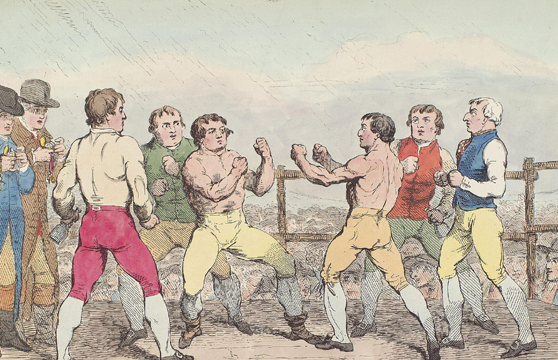
Sophia
is the genuine Christian name of the daughter of the famous 18th C
pugilist Daniel Mendoza, a blood relation of the author. I have
recently completed a 60,000 novella on Daniel Mendoza as seen through
the eyes of his daughter. This submission comprises the lengthy
forward (5000 words) to the larger work and is intended to also act
as a standalone article. There are already several books on the life
of Daniel Mendoza, recognised as the instigator of the modern art of
boxing, but this is a personal, though imagined, account told via his
daughter. Her married surname, Denyen (as in Sophia Denyen), is
however, made up.
*****
Lionel
Mendoza was born in London towards the end of the second world war.
After a lengthy career as an appraiser of commercial real estate, he
moved with his wife, Lynda, to the bucolic county of Somerset, in the
South of the UK, famous for its cheeses and cider where he enjoys his
small but productive garden, playing green bowls and cruising the
great rivers of Europe as well as the high seas. He took up writing
as a hobby after enrolling in the Open University course on ‘Writing
for Pleasure’ He is, thus far, unpublished but ever hopeful.
Contact
Lional
(Unless
you
type
the
author's name in
the subject
line
of the message we
won't know where to send it.) ***** If the
link to the letter doesn't work you can copy and
paste in this address: preserve@storyhouse.org