What We Went Looking For
Jeong Iryang
© Copyright 2026 by Jeong Iryang

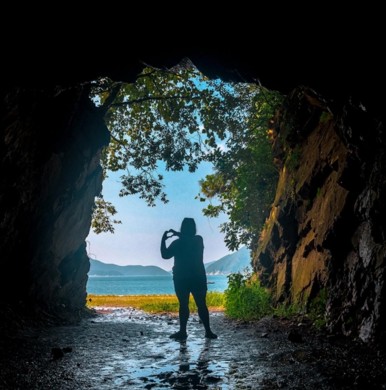
Tunnel at Geunpo at Wikimedia Commons.
What We Went Looking ForJeong Iryang © Copyright 2026 by Jeong Iryang |
Tunnel at Geunpo at Wikimedia Commons. |
The Korean word for the activity is haerujil. In English, I call it shore foraging, which brings the shoreline into the name. A shore can be a border in a photograph, dividing one expanse of color from another. Foraging asks something different of it. There is something to look for within the view. Thinking about our trip now, I am drawn to that change in scale: Geoje, the shore, sea snails, an octopus. A destination large enough to hold a journey becomes a place where two people have something particular to find.
Sea snails and an octopus make an uneven pair. One name sounds modest; the other can suggest an adventure. I like having both in the account. The octopus does not cancel the snails, and the snails do not need to become extraordinary to earn their place. Together they give our foraging its particular shape. Remembering only the more impressive noun would make the trip easier to tell and a little less like the one we took.
There is another short description in my opening sentence: someone junior to me in military service. It explains how I know the person who went with me. It also places that person in relation to me before saying anything about what we did together. The word is useful, but I do not want it to do all the work. On Geoje, we went foraging. The plural matters to me. A relationship that takes several words to introduce fits easily into that small word, we.
I also visited the tunnels at Geunpo. An entrance gives the coast a dark border, enclosing a view without enclosing the coast itself. The Korea Tourism Organization describes them as a destination for silhouette photographs: the darkness of a tunnel sets off the figure against the view outside. The opening supplies a ready edge. A person, a stretch of coast, a bright space beyond the dark—there is an immediate appeal in the arrangement. Even before considering what lies outside the picture, I can appreciate why someone would want that picture.
The frame does something generous. A coastline can seem too large to hold in mind, while an opening gives the eye somewhere to begin. It makes the view approachable. Looking for a photograph and looking for sea snails both give a person something to search for. Each brings a purpose to the view. Both make a particular place answerable to a small intention. The difference interests me most at the point where the intention has been satisfied: the picture made, the creature found. How much of the place is still there to consider?
At Geunpo, the opening has a history that the outline alone cannot tell. Geoje City's account describes five tunnels behind the village, including a connected pair with an H-shaped passage. According to that account, Japanese military excavation for artillery positions began in 1941 and stopped with Korea's liberation in 1945. The same opening that can give a visitor a picture its edge thus belongs to a different plan for the coast. The place holds an interrupted military purpose as well as the present invitation to make an image.
I find the connecting passage particularly suggestive: an H, two lengths joined across the middle. In a picture, an opening can look self-contained, a complete dark boundary around a view. The city's description gives the tunnels an interior relationship that this single outline cannot convey. There is more than the entrance, and more than one entrance. The line across the H joins spaces that an image of one entrance holds apart. Remove that joining line from the letter and two separate marks remain. Put it back and the shape changes without either of those marks moving.
The silhouette and the account of the excavation occupy the same place. A visitor can approach the opening for a picture; the city's history gives that opening another beginning. The two purposes remain distinct. What changes is the kind of place I am thinking about. A scenic opening becomes an opening made for a purpose, then used within another kind of visit. The coast has not simply become a backdrop to whichever story I prefer. It gives me something that resists being gathered into a single version.
That brings me back to our catch. Sea snails and an octopus give the trip a result, and I like the plain satisfaction of those names. Something sought, something found: the activity comes to rest in that little balance. Alongside it is the shared activity, which began before there was a result to name. Before the catch becomes a list, it has already been a reason for two people to be occupied with the same place. The sea snails and the octopus belong to that larger sentence too.
What I want to keep from Geoje is room around that result. There is a pleasure in saying what we found, and another in staying with the place where we went looking. The catch has an ending. The shore remains large enough to hold the people who searched it and the questions I bring back to it.
When I think of Geoje now, the tunnels and the foraging remain separate parts of the place, but each keeps the other open. The tunnels give the coastline an edge; our search gives it things too small for a whole coastline to show. Between them is the companion named so briefly at the beginning, included again whenever I say we. We went looking on Geoje. We gathered sea snails and caught an octopus. I can end with what we found and still leave room for the two of us who went to find it.
*****
Jeong Iryang is a third-year computer engineering student at Changwon National University. His interests include software engineering. He lives in Changwon, Republic of Korea.