Oxen
Fred Cheney
© Copyright 2025 by Fred Cheney
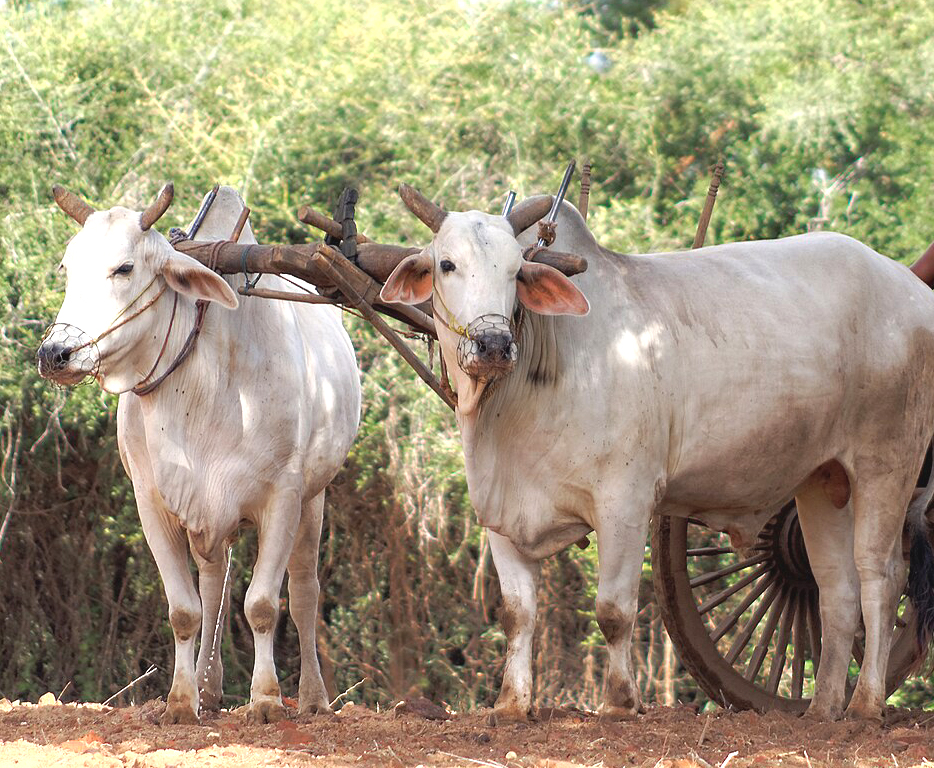
Photo courtesy of Wikimedia Commons.
OxenFred Cheney © Copyright 2025 by Fred Cheney |
Photo courtesy of Wikimedia Commons. |
I went to school for five years. I could read most things. I could add, subtract, and multiply. But I was growing stronger and could do more farm work. Farm work did not require me to read, and seldom to add or subtract. So I left school. Nicolai, my father, said he only stayed in school for three years, but he was happy that I stayed for more years than he. At the time, I was not sure whether to believe him or not, but he was my father. We lived well, and I was part of it all. I did not miss school. But he had his doubts about other matters.
Several years passed, and our family did well. I added a wife to our whole family, and my sister added a husband. Every need was met for many years. My sister had children, and I had children, and they all grew and somehow moved away—some to the military, some to jobs in cities. They told us the young generation behaved in their own special way.
But I stayed with my father. Influenza killed my mother, and he needed someone to be there. My sister and her husband moved away, and we had only ourselves to care for. We worked every day, and we met our humble needs.
I mentioned my father’s doubts about other matters. While he had only three years of schooling, he became an ardent reader. And his habit of constant reading progressed him well beyond the skills of year three. Also, his increased reading prompted him to write, sometimes to his daughter and sometimes to more remote readers, and the press. He was reading and writing about our government and its practices.
One day, two cars drove into our yard before we were about to start our day in the fields. One car had soldiers with rifles who stepped out and stayed by their car. One car had a man with a military cap and just a military overcoat. He walked to my father.
He confirmed who my father was, and the men with rifles moved me and my wife around the corner of the barn.
When
they allowed me to come back to the yard, I saw my father get into
the car with the man in the military cap. I never saw him again.
The next weeks were difficult. The farm had too much stock for one man. My wife helped with milking, gathering, and shearing. I did tilling and wood harvesting. Our children with their new jobs were not able to help. We sold all unnecessary stock. I missed my father greatly.
Then one day, another two cars pulled into the yard. From one of them came one who looked like the man who last spoke to my father. He came to me and told me that our land was now a government property. I asked him to explain.
He signaled to the men in the other car. They were clearly soldiers, and they went into the barn and the sheds and the sties. Shots rang out as they killed all our stock, even the hens. The man told us we had fifteen minutes to gather what we could carry and leave.
We had some time together in the house, but we spent to most of it trying to make sense of it all. It didn’t. The sense of what we gathered would come to us in the coming weeks. As we walked away, we heard the crackling of the fires in what once had been our home. We did not look back. Neither of us.
My daughter told us to ask for amnesty to the United States. They were not showing any tendency to enter into a war with Germany, what would surely be a world war. And Russia was an ally of sorts.
With what I had saved, and help from our children we were granted admission to America. Where we were assigned was not only rural, it was an area not important to the rest of the country. I looked forward to that. Also, a few other emigres on the boat were headed to the same place. We would have friends.
Then, I lost my best friend. My wife took sick aboard the ship. She behaved much like mother with influenza. No one would talk to me about influenza, and my wife was in quarantine. I did not see her until the time they told me she had passed.
I
arrived in Richmond alone.
My new country had purchased some repossessed property which I was expected to repay. However, the little money I had, I could use to start a life, and pay the government back later. I bought two impregnated cows. As luck would have it, I got two males. After they fed their offspring, I still had enough milk for me and to sell for money. I bought seed and hens, and the bulls grew. Until I made them oxen.
As they grew and changed shape and size, I carved three different yokes for them over time. They always heeded me. They learned. They worked hard. I worked hard. We became very close.
We had what they called six acres on both sides of the road out of town of Richmond. It was a bit more than I had in Belarus. I had some field for hay to feed my oxen. I had rough land to plow to grow vegetables to feed myself and sell. Goats and sheep grazed and got fat thanks to the efforts of my oxen.
I missed my wife and my children. My only solace was that pair. I had never known a team to take so readily to a new task, to work on at the end of a hard day, to show so much appreciation for a meal of hay at the end of a long time. I became one with them.
Quite often, when I came in from across the road, a woman stopped for me and smiled. She had a long rounded car; it was green--the color of pea soup. She always had a young boy in the front seat who seemed to talk with excitement to his mother. I thought that talk was about me. I don’t know why.
One night, the wind was especially loud. I slept fitfully. Just after midnight, I heard an explosion. It was my barn. I pulled on my clothes and raced to my oxen. In the dark, I could not find any comfort. I called to them, knowing they could not, would not, answer. I heard some cries of pain. I did not know what to make of that.
I spent my time pulling boards out of my way finding the center of the barn.
The sun rose, and the fire department came to help. No one spoke to me by name. But they were a true crew, and they had some earth moving equipment. One of them pulled me aside and offered me a coffee. I’ve always preferred tea to coffee, but the coffee was very good that time. Then they told me both oxen were dead.
I rode with my mother home from school. She taught in Gardiner, and because my father was on the road selling, I went to school in the town where she taught. Lots of times when we went through Richmond on the way back to our house in Bowdoinham, we got stopped by Vanya. We made up the name Ivan between us. We knew that he was a White Russian, like many in Richmond. He would bring us to a stop leading his oxen and whatever they were towing to the barn across from his house. We waited. It was a welcome break on the ride back to the stress at home where my aging grandparents waited.He never looked at us, or thanked us for waiting for him and his oxen. But I saw a peace among the three of them.
He reminded me some of my grandfather at his best moments. I wished I could get to know him more.
One
day we went by, and the barn was flat, just a pile of rubble. Ivan
was not in sight. I asked my mother what it all meant. She just
shrugged. About a week later she told me that the barn collapsed in
the windstorm and had killed his oxen, and two days later he had died
of heartbreak.
I
can’t grow crops. I can’t store crops. I am no more. I
have nothing but that strange youthful face in the car the color of
pea-soup. But they are not with me, nor are my oxen. I cannot lose
any more.