When The Wild Came To The Fence
Emerole Clinton

©
Copyright 2026 by Emerole Clinton
|
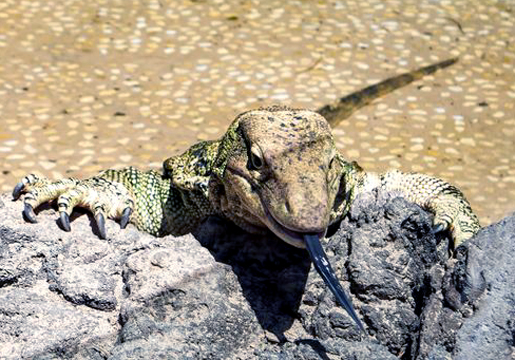
Photo by Marian Florinel Condruz at Pexels. |
The
fence at the back of the compound was four feet of concrete block,
which seemed like enough. It had always seemed like enough. I had
grown up understanding the fence as the boundary between the
compound's order — the swept yard, the generator housing, the
guava tree in which both my grandmother planted and my mother had
pruned every March — and whatever the land beyond it did on its
own time. The land beyond the fence was scrub and elephant grass and,
further back, the kind of secondary growth that moves in when
farmland is left alone for a decade. I had never thought much about
what lived there. The fence made not-thinking-about-it easy.
The
monitor lizard arrived on a Thursday morning during the rainy season,
which I remember specifically because the gutters were still running
from the previous night and I had come outside to check the drainage
channel before breakfast.
It
was on top of the fence.
My
first thought, genuinely, was that it was a piece of equipment. It
was that still. A full-grown adult water monitor — Varanus
niloticus, though I didn't know the name then, only the shape —
gray and patterned and four feet long from the blunt triangular head
to the thick lateral tail, sitting along the top of the wall with the
patience of something that had been somewhere long enough to stop
needing to hurry.
I
stopped walking. I was maybe five meters from it.
The
lizard turned its head towards me with the slow, unbothered rotation
of a creature that does not experience surprise in the way I was
experiencing it. Its tongue came out — the long, forked, dark
tongue that I had seen in photographs and had not understood, until
that moment, was a sensory organ rather than a threat. It was tasting
the air. It was reading me through chemistry.
I
stood very still. I had no plan because there is a particular absence
of plan that arrives when an animal is large enough and present
enough that your mind stops producing options and simply observes.
The
lizard held its position on the wall for what I estimated was three
minutes, though time during encounters like this is not reliable. It
watched me. I watched it. The gutters were still running somewhere
behind the house. A kite circled once overhead and then moved off.
Neither of us moved.
Then
it dropped, without apparent urgency, off the inside of the wall and
into the compound. Not into the scrubland — into my side of the
fence.
It
walked, with the specific rolling gait of a large varanid, across
approximately six meters of swept yard, under the guava tree, and
disappeared through the gap at the base of the side gate that we had
been meaning to fill with concrete for two years and hadn't.
The
whole thing took less than four minutes. I went inside and ate
breakfast and thought about what the fence had been protecting me
from, which turned out to be much less than I had assumed.
Emerole Clinton is a writer based in Owerri, Nigeria. His work
has appeared in Busted Halo and Youth Today. He writes about the
natural world, urban spaces, and the places where human order meets
everything that ignores it.
(Unless
you
type
the
author's name
in
the subject
line
of the message
we
won't know where to send it.)
Book
Case
Home
Page
The
Preservation Foundation, Inc., A Nonprofit Book Publisher