Danielle Price
© Copyright 2026 by Danielle Price
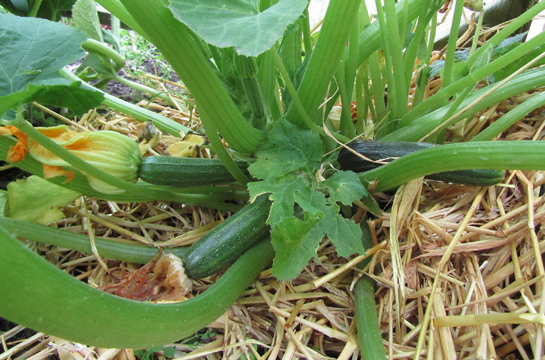
Photo courtesy of Wikimedia Commons.
| The
Zucchini Story Danielle Price © Copyright 2026 by Danielle Price |
Photo courtesy of Wikimedia Commons. |
I don’t remember everything she planted, but I know she planted zucchini. She said it was “encouraging.” My brother and I soon learned that “encouraging” meant that zucchini will grow for anyone, in any type of soil or weather. It’s a very forgiving crop—fail to give it enough water for a while or do something stupid, like live in a state that gets blizzards in March and seventy-five-degree weather on Christmas, and it’ll recover once you give it the barest amount of TLC. Give it more than the bare minimum, and it’ll grow like kudzu. The bare part of the garden where my brother and I made fairy huts out of mud was soon overtaken by zucchini. My dad complained about the vines getting in the way of the lawnmower.
My mom loved it. Our grandpa had a thumb so green that the only reason he wasn’t diagnosed with advanced radiation poisoning is that the thumb never glowed, so I think she felt like her thriving zucchini crop imposter syndromewas her way of doing him proud, or confirmation that she inherited a little bit of his gift. She’d come in from the garden with a big smile on her face, and if we asked her how the zucchini was doing, she’d practically sing her answer: “It’s doing grea-eat!” “We’re going to have zu-cch-ini!”
The first dish she made from the harvest was zucchini bread—just banana bread with zucchini instead of bananas, and a bit more cinnamon. The grated zucchini gave the bread a texture not unlike carrot cake. My brother, my dad and I ate half a loaf each, slathering the still-warm slices thick with butter. “This is great, honey,” my dad said. “Good job.”
“The zucchini you grew is really good,” I told her.
“There’s more to come!” my mom said. “One of the zucchini plants had a bunch of little baby zucchinis. We’re going to have so much zucchini!”
She grinned when she said that. I think that grin was my first introduction to the concept of tragic irony.
Her zucchini plants thrived. It seemed that every day she was bringing in a new armful of squash, deep green and plump and ready for the table. We ate it sauteed with butter, marinated and grilled with chicken or beef. We had it in cakes and cookies and muffins, moist and rich and fragrant with cinnamon. I helped my mom bake another batch of zucchini bread.
When we had more zucchini than we could use, my dad packed a grocery bag full of zucchini one Sunday morning and piled our harvest onto the table at church set aside for people to share fruits and vegetables from their gardens. Every one disappeared by the end of service. My mom beamed. Someone at church had thought her zucchini was good enough to take home. I hadn’t done a thing to help with the zucchini, but I still felt a little proud on her behalf.
By the end of that week, we had a laundry basket full of zucchini. My mom made zucchini pancakes for breakfast one morning. We baked a double batch of zucchini bread and froze what we couldn’t eat right away. She diced zucchini, laid the pieces out on baking sheets, and froze them. I’m pretty sure some of those pieces wound up in a smoothie I was handed at the breakfast table. Zucchini made an appearance at the dinner table every night. My mom baked it like butternut squash, she added it to stir-fry, she sliced it into rounds and seared it on the grill. When she was a little girl, her own mom told her the eggplant parmesan she’d made was actually chicken parmesan—a deception my mom didn’t unravel until she’d taken a bite. I’m convinced that this childhood trauma was the only reason my mom didn’t invent zoodles 15 years before the war on carbs.
We took a bigger bag of zucchini to church that Sunday. A handful of zucchinis disappeared, but we had to take the rest home. I tried hamburger soup with zucchini and was too shy to say I didn’t like it, but not even my mom ate more than one bowl. She didn’t smile when she brought another armful of zucchini in from the garden, or when she realized the laundry basket couldn’t hold any more. She had me help her with a double batch of zucchini bread.
That Sunday, we took every single zucchini we’d brought to church home with us. We had zucchini bread with our dinner every night that week. I almost cried when I saw it on the table Thursday evening, but I dutifully ate a slice anyway.
“Have another one, Danielle.”
I had another one.
One night, my mom brought out a pan of zucchini brownies. I remember liking them—I ate more than one—but I’d also just come out of a phase where my favorite secret snack was a pat of butter rolled in granulated sugar, so I think I was just a weird kid with a raging sweet tooth. But I also remember my parents regarding each other across the table.
My dad was quiet, grim, eating his zucchini brownie without comment. He looked my mom in the eye and said more than he ever could have said with words.
My mom went through the five stages of grief in under a minute. But when she reached the final stage, she hadn’t accepted that we’d be eating zucchini until Jesus returned in glory or I graduated high school, whichever came first. No, my mom had accepted that these were desperate times, and desperate measures were long overdue.
The next morning, she put the zucchini basket into the family minivan and had my brother and I take our seats. She didn’t say why. She just put the zucchini in the van and had us climb in after.
The drive downtown took less than two minutes. Almost as soon as I started to wonder what the hell we were doing, my mom pulled up to the courthouse and parked at the edge of the lot.
“All right!” You’d have thought she was about to take us to the state fair. “Let’s see who left their cars unlocked!”
I didn’t move. “Isn’t that illegal?”
“Opening cars and looking inside? Nah.” She was still so cheerful. “It’s only illegal if you steal something. We’re giving them something. Come on!”
There was no room to argue. We each went to a different car, but before I could give the handle on mine a halfhearted tug, my mom waved me and my brother over. She already had the front door open.
“Grab all the zucchini you can.”
We loaded our arms with zucchini and ran back, our mom waving to us frantically as she glanced over one shoulder. The zucchini was snatched out of my arms and piled into the passenger’s seat. Somehow, my mom managed to throw it in faster than I could have, but also set it down in a way that wouldn’t bruise the vegetables.
And then it was over. The zucchini was in a stranger’s car, my mom had closed the door, and she was leading us briskly away.
“Well,” she said. “That was fun.”
Not the word I would’ve used. I glanced over my shoulder to see if a police officer might be tailing us, or maybe the vehicle’s owner.
“Did anyone else leave their door open?”
“That guy,” my brother said, pointing.
My mom pushed his arm down. “Don’t be too obvious.”
We loaded the little sedan with all the zucchini the front seat could hold. I don’t think I was formally appointed lookout, but I wound up standing there, watching the courthouse and sidewalk for any signs of movement anyway. I did the same when we moved on to the library. This was a far trickier place for my mom to put her master plan into action, because although there’s a fair number of people who can spend hours wandering the shelves, even in a small-town library like that, some patrons pop in just long enough to pick up a hold and make a little small talk with the librarian. I kept imagining a scene where the nice librarian caught us in the act and, enraged with our blatant disregard for the sanctity of the library, banned us from my favorite place for life. Standing lookout for Operation: Unwanted Generosity in that parking lot was hell on my anxiety, but my mom and brother still managed to load a few trucks and minivans with zucchini before we decided to move on.
I think I knew, deep down, that this plan wouldn’t end when the laundry basket was empty. When my mom, sitting behind the steering wheel at one of the town’s few stoplights, let out a breath and praised my brother and I for our help, I knew that this wasn’t the only time I’d have to pretend to agree. Even so, I watched the basket refill with a mixture of hope and dread. She wouldn’t do it again. She was going to do it again.
She did it again.
My mom had spent the week strategizing. She drove us to the parking lot of a sit-down restaurant and had me stand lookout while she and my brother scouted for open cars. This being small-town Wyoming, where only tourists from cities like Albuquerque and Dallas on their way to Yellowstone locked their cars, they found one on their first try. My mom loaded the front seat with zucchini and regarded her handiwork. She looked to my brother, his arms now emptied of zucchini, and paused for a split second. I think the memory of how much zucchini was still ripening on the vines back home flashed through her head before she made her decision.
“We’ll give them a little more.”
She and my brother retrieved more zucchini from the van and loaded the back seats down. I wondered what the kids would do when they found their seats taken by vegetables—would they be happy that someone had thought to give them so much zucchini? Would they be mad that they couldn’t sit down right away? Would their parents make them hold the vegetables in their laps, or would they just push them to the floor?
We closed the doors and moved on to the next mark.
This went on for a while. We hit the courthouse, more restaurants, hotels, and the public pool. I think we might have brought a load of zucchini with us on a day trip to Ayres Natural Bridge Park, a popular natural area featuring a stone bridge formed naturally through centuries of water erosion. Creative name, I know. But the people there got zucchini. The people at the pool got zucchini. It would be a stretch to say that all 5,000 people living there in the summer of 1999 got zucchini, but quite a few of them did, and it was all delivered anonymously and in secret.
Then one day, it happened.
My mom had driven us to one of our usual lots. I want to say it was the courthouse again, but it could’ve been a restaurant. I don’t remember. I just remember her trying the door, expecting it to open, but it didn’t give.
“Let’s try another one,” she said. She was usually so cheerful on those trips, but her cheerfulness seemed to shake a bit.
We tried another one. Locked.
“We should go,” my mom said after the third try. We hurried back to the car, loaded our zucchini into the basket, and drove off.
That wasn’t the end of our zucchini deliveries, but it was the beginning of the end. More and more doors were locked, and each locked door represented an owner who did not consent to a car full of zucchini, and each owner who did not consent to a car full of zucchini represented a person who might come out of whatever public building they currently occupied to yell at us for trying to give them zucchini that they didn’t want. I’m sure I worried that someone would call the police. Even if they had, this was a small town in the late 90s. At most, the officer would’ve reprimanded us and maybe told my mom off for getting her kids involved, before driving back to the police station to hand in his gun and badge, because when you have to verbally warn a mother and her two children off of making unauthorized zucchini donations to private vehicles, you have officially seen it all.
I want to say the story ended there, with my mom conceding defeat and going back to pickle or can the remaining zucchini in our garden. But we weren’t the only people in Douglas who planted too much of one particular crop, and we weren’t the only ones who couldn’t get the other people in our church to willingly take our surplus. I know this because one day after church, we returned to our car to find a few tomatoes, some cucumbers, and a handful of onions in the front passenger seat of the family minivan.
We started locking the car.