Beans, The Musical Fruit
A Memoir EssayChef Bobo Surles
© Copyright 2026 by Robert Surles

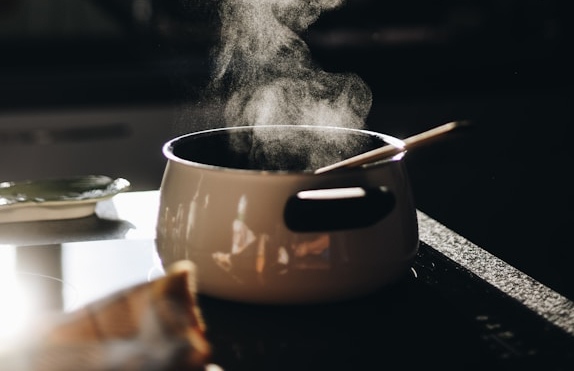
Photo by Gaelle Marcel on Unsplash
Beans, The Musical FruitA Memoir EssayChef Bobo Surles © Copyright 2026 by Robert Surles |
Photo by Gaelle Marcel on Unsplash |
The floor was red and white, like a checkerboard.
I loved that kitchen.
My sisters, Phyllis and Betty, didn’t. They liked to stay in their bedroom reading movie magazines or talking about boys. I decided they were weird. They didn’t want to cook. They didn’t want to help with groceries. And they didn’t want to help Mamo with the laundry.
The kitchen wasn’t just a fun place for cooking; it was also good for other things. My favorite place to draw pictures and color in my coloring books, do my homework, and put together jigsaw puzzles.
On Monday evenings, after dinner, I helped Mamo with the laundry in the kitchen, using the washing machine stored over in a corner, out of the way. We would push the machine over next to the sink and connect its hose to the water faucet.
On Saturdays, Mamo would work half a day and when she got home from work early in the afternoon, we would sit at the kitchen table and plan Sunday’s dinner and put together a grocery shopping list for the next week. I had fun making silly menus to put on the table for my sisters to see, those menus included such items as
“Fried Chicken, not my foot”
“Tossed Salad (in a bowl, not out the window)”
“Taters all squashed up”
“Beans, beans, the musical fruit, the more you eat the more you poot.”
Mamo taught me her style of cooking in that kitchen. The food was simple, but the flavors were big. I was always there to help her and we laughed constantly. She always said: “If you are happy while you are cooking, then anybody who eats your food will inherit that happiness. Remember, that’s your secret ingredient.” Yes ma’am.
Every Monday night we had pinto beans and fried potatoes for dinner. I called that meal “beans & taters”. We had them on Monday night because, after dinner, Monday night was laundry night, and beans and taters were easy and fast to prepare for dinner.
Preparation of the beans started early on Monday morning before Mamo left for work. She was due to be at work at 8:00 a.m., so she needed to leave by 7:30 a.m. for the 20-minute bus ride to downtown. Around 7:00, she would begin her prep of the beans so they would cook fast after she got home from work. I was up and, before getting ready to go to school, I would go down to the kitchen to help. I mostly watched.
She checked through the dried pinto beans. “Now when I’m doing this, I’m looking for little pebbles or beans that look funny.” When she was sure they were clean she put them in a pot and filled the pot with water to sit all day. That done, she put on her coat, grabbed her purse and rushed out to catch her bus. I went back upstairs and dressed for school.
Before leaving for school, I would go and look at the beans to see what they were doing. They were all gathered at the bottom of the pot – none floating. Sometimes I might see a few bubbles, but they were just waking up. I turned the pot just to let them know that I cared. Then I left for school.
Upon her return home in the evening the beans would be floating on top of the water, as if to say, “we’re ready!”. They were slightly wrinkled from being in the water all day, like my fingers would get whenever I spent too much time playing in my bath. Mamo would pour off the water through a big bowl that had hundreds of holes in it and then return the beans to the pot. They were ready for some fresh water, a whole onion cut in half, and an entire head of garlic which she smashed with the back of a pan. She sprinkled in different kinds of powders and herbs and returned the pot to the stove. She brought the water up to a boil, then turned the flame way down so the beans would simmer. The smell of all those ingredients cooking in the pot made the kitchen smell sweet and garlicky. She started testing the beans after 30 minutes to see if they were tender. Each time she tasted the beans, she also gave me a taste and asked me, “What do you think, chef?”
“I want more hot sauce”, I would answer.
She sprinkled a few drops of Tabasco Sauce in, just for me. When she was satisfied, she gave me one more taste. It was a small pillowy cloud--everything good all at once. I closed my eyes and told myself, “I want to remember this forever!”. Then she turned the flame off and covered the beans with a lid or plate. They were ready!
One Monday, Mamo overslept and was running late. She didn’t have time to put the beans up to soak. After she left, I decided I could do it. I would mimic her routine. I checked through the beans; I found two small pebbles. I threw out the pebbles and put the beans in a pot and added water. I wanted to play hooky from school that day so I could watch the beans all day. I could make a list of which bean floated first and how fast the next bean joined it. Then each bean after that. It seemed more interesting than sitting in a circle reading about Dick and Jane and their dog Spot. “Run Spot, run!” But I didn’t stay home. I went to school.
When I got home that day I rushed to the kitchen. I wanted to see if the beans were wrinkled and swimming. They were. Just like when Mamo did them. I poured the water off the beans, explaining to them they would be getting some clean fresh water. I filled the pot with water.
Just like Mamo did with her sharp knife, I sawed an onion in two using my plastic serrated knife, ragged pieces that weren’t even but I was sure that was okay. When I smashed the head of garlic with a frying pan the cloves went flying everywhere. I gathered them up and added both the onion and garlic to the pot. I turned on the flame high and when the water started boiling, I reduced it very, very low. The beans began to send up bubbles, blubble, blub, blub, blub.
The water got lower and turned dark brown. The kitchen was filled with that same homey aroma as when Mamo cooked them. I knew they were almost ready. After 30 minutes had passed, I tried one of the beans and it was done! Soft and pillowy and creamy, like Mamos. I did it! I wanted to do more but didn’t know what to do. So, I washed some potatoes for Mamo to cook and tore up lettuce for a salad.
Finally, a little before 6:00 p.m. Mamo arrived home from work. She sighed with exhaustion as she took off her coat and hung it in the closet. She was about to go upstairs to change her clothes when she stopped suddenly as if she heard something strange.
“Robert, what is that I smell? Is something cooking?”
When she came into the kitchen, there I stood. Grinning. Wearing an apron that nearly reached the floor and looked more like I had on a skirt. She looked at me with a curious eye and walked over to the stove. She raised the lid and saw the pot of fully cooked beans. She looked at me. Her eyes filled with tears. She pulled out a kitchen chair to sit down. “Robert, come over here”, she said. She looked at me right in my eyes as those tears were now rolling down her cheeks, “my little chef, you did something quite sweet and thoughtful here.” Then she pulled me into one of her loving hugs. I could feel her body shaking. That hug lasted for a long time.
“Mamo, I didn’t add any salt or pepper or any of the other things you like to put in the beans. I don’t know how much to add. And it probably needs a little more Tabasco sauce.”
She laughed as she dabbed at her eyes with a napkin that she picked up from the table, “I’m sure they are going to be delicious.”
Mamo finished preparing the dinner of Pinto Beans, Fried Chunky Potatoes and a Tossed Salad. She called my sisters in and told them to wash up for dinner. Then we all sat down to eat. As was my normal routine on Monday nights, I recited my “Beans and Taters” poem.
“Beans and Taters had a fight.
Beans knocked taters out of sight.
Taters said, ‘now that’s all right,
Meet me on the corner tomorrow night.”
My sisters rolled their eyes. Betty told me that the poem was supposed to be “beans and cornbread had a fight”, but I didn’t care, I liked “taters” better, so I recited it again, louder and with annoying movements, moving my arms and legs around like I was a puppet
Phyllis had seconds of the beans.
Betty said, “I don’t really like beans.” (But I knew she did.)
Mamo said, “those beans were the best I’ve ever eaten.”
After dinner, the girls cleared the table and washed the dishes while Mamo and I got the laundry ready.
That was the first time I cooked something all by myself.
After that, I wanted to cook everything.