All In The Brain?
Bob Kaill
© Copyright 2026 by Bob Kaill

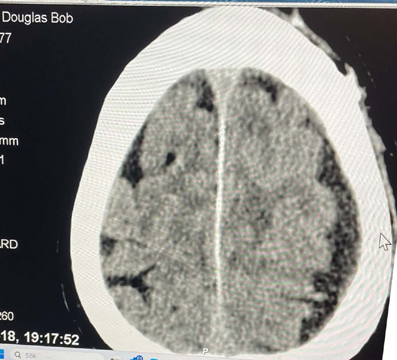
Brain image courtesy of the author.
All In The Brain?Bob Kaill © Copyright 2026 by Bob Kaill |
Brain image courtesy of the author. |
In the summer of 1982 after O’ringens 5-day orienteering competition in Luleå, Sweden, I heard Lars-erik Unestähl’s lecture on mental training. During the few years afterwards I helped Lars-Erik a little, mostly by editing some of his books such as The Mental Aspects of Gymnastics (1983), Örebro, Veje Publ.
| During that year or two, I tested (non-scientifically) some of Lars-Erik’s ideas on myself. For example, I tried to learn to draw human faces and after a short time did draw this picture and learned to hold a snowball in my barehand and feel it warm up my hand. To test an extreme, I decided to try to grow a ball in my stomach. I didn’t know how this would work, but after a half year or so, I persuaded a doctor to ex-ray my stomach because of pain. The x-ray showed something there, so the doctor decided to schedule a gastroscopy Gastrogastroscopy operation 3 months later. When they went in, they found a growth too big to take out through my throat, so they opened my abdomen and my stomach and took out a non-malignant ball. I do not have the ball, but I do have the scar. | Scar |
During the years 1982-2021, I coached a large number of good athletes in Sweden and Australia and almost all used some of my mental training programs. My theory in mental training builds a great deal on my theory that the brain controls most of what occurs in the body, although a large percentage of the control is done at a subconscious level. For example, a great number of our likes and dislikes for different foods is subconscious. Sometimes we may think we like something because it is sweet, but why do we like sweet things, and sometimes salt things.
We have thousands of nerve chains attached to our brains. How does the brain know where a particular chain starts from? If we injure our left hand, why do we experience some of the impulses to our brain as pain in our left hand? From earlier experience, we have probably learned that the impulse comes from our left hand, but why do we interpret the impulse as pain? I maintain that we could learn to interpret the impulse as pleasant. However, since pain impulses often indicate that something is wrong and needs to be treated, I didn’t teach my athletes how to reinterpret pain impulses as pleasant, but I did teach myself how to make this interpretation in certain circumstances and the following is such an example.
In March, 2009, in Italy, I won the European Veteran (65 year) indoor track championships in 800 m with the time of 2:35.3. Five years later in March, 2014, I went to Spain, hoping to once again take a medal. The day before the 800 meter, in the final for the 400 meter, I stumbled in in 4th place with an injured left knee. The following months, I mostly sat on the soffa and did no training..
In July 2014, I had a arthroscopy operation on my left knee, where the doctor wrote “..in the medial joint chamber where you can immediately see a severe arthrosis with exposed bone on both the thigh and the load-bearing surface of the tibia. This covers the entire load-bearing surface. A minor degenerative rupture is found on the border of the posterior and middle third of the medial meniscus. This is removed with a forceps. You move on to the notch where the eminence is exposed. You also see the empty hole sign where the anterior cruciate ligament attachment hill is located, the notch is filled with overgrown synovitis.”
|
Later in October, the ambulance took
me to the hospital
where the doctor’s, decided that I was having a heart attack.
They operated and put in a coronary stent and the doctor decided
that when feeling better I should have another operation to improve
the flow in some other partially blocked blood vessels in my heart.
In February, 2015, they went in and inserted another 3-4 of these
expandable wiremesh tubes and I found it very interesting to watch on
the video screen as they performed the procedure. Probably my heart
attack was caused by a combination of my diet and sitting still on
the sofa for 6-7 months. |
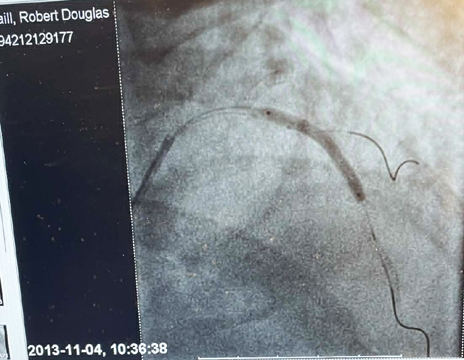 Heart stint |
In August, 2016, I went to the hospital, hoping that they would decide to operate in a new knee joint in my left knee, but the doctor said I wouldn’t be satisfied with that and wrote in the journal: If the patient is to be operated on, it would probably be a total knee replacement considering the anterior cruciate ligament, but this is not an option. The patient has high expectations of being able to run again, which is not recommended with the prosthesis. Cartilage transplantation is not an option, nor is a kiloosteotomy operation at the patient's age. However, a well-aligning knee joint orthosis can be tried...”
I went to an orthopedic engineer, who built a special brace which had a screw to tighten the outside of the knee to spread the junction of the bones on the inside of the knee. The brace was however too cumbersome to run with, so I drew up a mental and physical training program to have my body widen the gap on the inside of my left knee and take away any pain nerve signals from that area. 7 weeks later, I was able to run faster than the other men in the Swedish Masters 800 meter championship for 75-year-olds and won the championship. I also came 3rd in the triple jump.
I continued to run on flat surfaces with no pain until a few years later, in 2022, I fell and struck my head on a sharp corner. After an hour at the hospital they sent me home. Then, 6 days later, I went down on my knees in the backyard, as I phoned to my wife saying that she should call for an ambulance.
|
According to my wife what happened
after that is the
following. The ambulance took me to the hospital in Skövde. Then
they flew me by helicopter to the hospital in Gothenburg. One doctor
told my wife not to expect me to wake up again as the blood bleeding
between my skull bone and my brain had compressed my brain a great
deal. My wife says that 3-4 days after the operation I was playing my
guitar and singing in the hospital. Later at home, I behaved much as
usual. However, I have at the present, no memory of anything between the morning of April 16 when I went down on my knees in the backyard and 3 months later when I was in someone’s house at the end of July during the 5-day orienteering O-ringen. So, what I have written and write about those days is what my wife says happened. Very strange. But our brains are very complex and interesting. |
Brain |
My brain accident apparently removed much
of my mental
control of certain physical activities. For many months (perhaps
nearly 2 years), my control of urinating and defecating was not very
good, nor did I have much control of pain. After 3-4 years, most of
these controls returned although my left knee still gave pain in many
circumstances and I had trouble walking more than a few meters. In
May, 2026, the orthopedic surgeon recommended me for a knee operation
to replace the joint. The projected date was August or September.
| The projected knee operation apparently
motivated me to
try regaining control of pain in my left knee and the day after
seeing the doctor, I tried to run for the first time since the
accident 4 years earlier. I can’t really call that 2-kilometer
session for actual running since it was very slow, but I did use my
muscles in a running way. I am now running and strength training every 2-3 days, while trying to regain control over the “pain” impulses coming from my left knee. The operation on my left knee is to be in August or September, so I have about 2 months to make a decision: do I want to try to get rid of the pain in my left knee so I can race again or should I have the knee joint replacement. |
Knee |
It is said that it takes between 2-3 months and a year to get full use of a new knee. Perhaps I should have the operation and use my mental control to get the knee replacement to work as well as possible without pain.
By the time you read this, I will either have had a left knee joint replacement or I am continuing without one. (In February, 2027, you can see if I ran in the Swedish Master Athletics championships with or without a knee replacement or not at all.)
In any case, you should remember that pain is all in your head. It’s your interpretation of the messages from your nerve fibers that decides what you feel. Of course, most of the interpretation is probably made by your subconscious.