The Sialkot Trip - How A Workshop Meets EU Medical Standards
Arif Rehman Khan

©
Copyright 2026 by Arif Rehman Khan
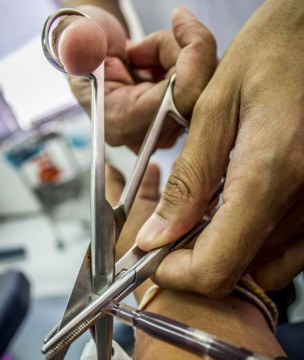
Photo by Suraphat Nuea-on at
Pexels.
|
The Sialkot Trip - How A Workshop Meets EU Medical Standards
|
|
This is a true account of a journey I took in January 2025 from Islamabad to Sialkot to find out how a small surgical instrument workshop meets international standards for export.
In January 2025 I took a bus from Islamabad to Sialkot. The bus was scheduled to leave at six in the morning. The street was foggy. I was going to meet a family workshop that makes surgical scissors.
I had been studying international goals and standards for many months. I knew codes like HS Code 9018 for medical devices, EU MDR 2017/745, and ISO 13485. I wanted to see how those codes look on a workbench, not just on paper.
That is the short summary I first wrote, 1,180 words. The real journey was much longer.
I woke at 4:30 a.m. in a cold room in G-9, Islamabad. My cousin had left a thermos of tea outside my door. January fog in Punjab is not decorative. It is a thick, damp, yellowish fog that makes streetlights look like small moons and gets into your knees and lungs. The rickshaw to Faizabad bus stand took twenty minutes. The driver drove with his head half outside the window because his windshield was fogged from inside and his wiper was broken. He charged 400 rupees.
Faizabad at 5:15 a.m. is already wide awake in a tired way. Buses idling with diesel smoke, men shouting "Sialkot, Sialkot, Gujranwala, Lahore, Pindi, Pindi," boys with trays of boiled eggs sprinkled with black salt and small plastic cups of tea that burn your hands. I bought tea for fifty rupees. The loudspeaker was crackling. A conductor in a black leather jacket was shouting names without a mic.
My bus was a local company painted to look like Daewoo. The driver was eating tea and smoking at the same time. The conductor told me it would leave at six sharp. It left at 6:40. No one complained. In fog in January, everyone in Punjab knows buses leave late. You wait.
We moved out onto the Islamabad Expressway and then the M-2 Motorway. For the first two hours we could see perhaps fifteen meters ahead. The wipers made a small arc and the fog covered the glass all over again. The driver put on Quran recitation at low volume. The man next to me, going to Gujrat for a wedding, peeled an orange and offered me half. The scent of orange peel and diesel is, for me, the scent of GT Road journeys since childhood. I keep that smell in my memory.
I had a small bag with me. In it: a notebook, a power bank, a photocopy of Annex IX of EU MDR 2017/745, which is about conformity assessment based on a quality management system and technical documentation, and a printout of the ISO 13485:2016 Table of Contents. I had underlined things. For instance, Article 27 of EU MDR says: "The UDI system shall consist of a UDI-DI and a UDI-PI." I knew UDI-DI is the device identifier, static, and UDI-PI is the production identifier, dynamic like lot and expiry. But I did not understand what that looked like when found on a small white box in a three-room workshop behind Paris Road, Sialkot.
Why was I going? I hold an AB in Chemistry from the University of Chicago, 2014. Since then I have been tracking low-carbon material diversion — how scrap, offcuts, second-grade steel, surgical waste, and packaging can be diverted, reused, and documented, instead of landfilled. Sialkot is a remarkable place for that because almost nothing is wasted. Even steel dust is collected in a tray under the press and sold to a scrap company who sells it to a foundry in Gujranwala. Even polishing dust is reused. But diversion for medical devices cannot be casual. For the EU, you cannot divert random steel. You have to show traceability under ISO 13485 Clause 7.5.9. You must show the steel's origin, its heat number, its mill certificate under EN 10204 3.1 Type Certificate. I wanted to see how a small workshop manages that, and what it costs.
We stopped at Kallar Kahar for fifteen minutes. Kallar Kahar has peacocks and a saltwater lake, but you can't see them in fog. I drank more tea. The bus driver checked his tires with a small iron hammer, a ritual. A boy offered pakoras.
By the time we passed Gujranwala, around 10:30 a.m., the fog had lifted a little. Fields appeared — wheat still small in January, mustard with yellow flowers, eucalyptus trees. Kilns burning bricks, with tall chimneys. Gujranwala is where a lot of steel comes from. Not surgical-grade steel, but mild steel and trading. Surgical-grade stainless steel, mainly martensitic AISI 410 and 420 for scissors and forceps, and austenitic AISI 304 and 316 for other instruments, comes from importers in Lahore and Karachi, who import bars from China or sometimes from European mills like Outokumpu. Ambassador Steel in Gujranwala, which Ilyas buys from, is a supplier who keeps imported bright bars.
We reached Sialkot at noon. The Sialkot General Bus Stand is chaotic in a way Faizabad isn't. Faizabad is chaotic but tired. Sialkot is chaotic and fast. Everyone is moving boxes, loading rickshaws, unloading cartons marked "Surgical Instruments - Handle With Care." Sialkot makes things — 70% of the world's footballs, a huge percentage of the world's surgical instruments, leather jackets. The whole city feels like a workshop that never closes. I took a rickshaw to Paris Road. The rickshaw driver did not know Ilyas Surgical Co. But he knew Paris Road. "Scissors wala? Paris Road pe sab scissors wale hain," he said. Everyone on Paris Road is scissors.
Paris Road is not Paris. It is a narrow commercial street, maybe twelve feet wide, with shops on both sides that are only six feet deep. One shop sells only springs. One sells only polishing wheels made from cotton. One sells only cardboard boxes, white and blue. One sells only plastic sleeves and silica gel packets. One sells only files and hammers. One sells only laser marking machines. The air has a metallic taste. You can hear power presses going thak thak thak from inside workshops. You can smell oil and steel.
I called Ilyas. He said, "You have reached? Come to the street of lathe machines, then ask for Ilyas, son of Bashir, scissors wala, near Makkah Masjid." I did. A boy of twelve pointed to a smaller alley. In the alley, there was a hand-painted sign on tin: "Ilyas Surgical Co. Est. 1982. Mfg. Of Fine Quality Scissors." Under it, in Urdu, "Tajarba 40 sala." Forty years experience. Under that, a small sticker, faded: "We Buy Scrap."
Inside, three rooms. I will describe them slowly because they are the heart of this story and of how standards live.
Room One: Cutting. One power press, one manual shear, two wooden benches with steel tops. Steel bars, 5 mm thick, 20 mm wide, stainless steel 410, in bundles, oily. They are cut into blanks that look like scissors but without holes and without edges. The blanks are called "forging blanks" if forged, but these are "milled blanks" cut from sheet. The press is old, maybe 1980s, green paint, with a big flywheel. Two young men work here, Bilal and Usman, both 24, both from villages near Daska, both have worked since they were 17. They wear gloves, but the gloves have holes on the fingertips. They wear safety glasses that are so scratched you wonder how they see.
On the wall, a laminated drawing, taped with yellow tape. The drawing shows a Metzenbaum scissor, 14 cm, curved, with dimensions: overall length 140 mm +/- 0.5 mm, ring diameter 22 mm +/- 0.3 mm, blade length 45 mm, tolerance on blade straightness 0.1 mm, screw hole diameter 3.5 mm. Bilal told me he learned to read this last year when a customer from Lyon, France, sent back 500 pieces because the rings were not round and the tolerance was out. The customer sent a photo with a red circle. After that, Bilal's elder brother taught him how to read tolerance. He now keeps a metal ruler and a vernier caliper on his bench. He showed me the caliper — 2,800 rupees, Chinese, but with a small sticker. He checks ten pieces from each hundred. He writes the numbers in a school notebook with a blue cover, bought for 120 rupees. That notebook is not a school notebook anymore. Under ISO 13485 Clause 7.5.1 — control of production and service provision — and Clause 7.5.6 — validation of processes — it is a production record. It must be retained. He does not know clause numbers, but he knows the auditor will ask for it and will take a picture of it.
Usman showed me the register of heat numbers. This is critical for traceability. Each lot of steel comes with a Mill Test Certificate, MTC, under EN 10204 3.1. The MTC lists chemical composition: Carbon 0.08-0.15%, Silicon max 1.0%, Manganese max 1.0%, Chromium 11.5-13.5%, and so on for AISI 410. The register is a thick ledger with green lines, perhaps ten years old. The entries list: Date, Supplier Name, Heat No., Grade, Invoice No., Quantity, Signature. Example: 02-Jan-2025, Ambassador Steel Gujranwala, Heat No. 84291, AISI 410 Bright Bar 5mm, Invoice 1192, 150 kgs, Received by Usman. Stapled to that line is the MTC copy, with mill stamp. Without that link, European customers will not accept the lot. Under EU MDR and ISO 13485 Clause 7.4 on purchasing, you must have purchasing data and verification. I asked Usman, "What if you lose the MTC?" He said, "Then we cannot sell to Europe. We sell to the local market in Lahore or to Africa without paper, at half price. Or we sell as scrap." That is material diversion, but forced diversion downwards.
Room Two: Shaping and Heat Treatment. This room is hotter, smaller, with soot on the walls. There is a small electric muffle furnace, with a digital controller showing 1020°C in red LED. For AISI 410, hardening is done at 950-1050°C, then oil quenching, then tempering at 200-300°C to get 42-46 HRC. HRC is Rockwell Hardness C scale. Surgical scissors need to be hard enough to cut tissue but not so hard that they are brittle and break. The customer specification sheet, which Ilyas keeps laminated, says 42-46 HRC for Metzenbaum.
Ilyas checks hardness with a portable Leeb hardness tester that leaves a small dent on the tang, the non-cutting part. He also has a Rockwell tester in a larger unit on Kashmir Road where he goes once per week. He logs: Lot No. S-15/Jan/25, HRC 44.2, 43.8, 44.5, 44.0, Avg 44.1, Operator: Ilyas, Date: 14-Jan-2025, Tester ID: HRC-02. This log is required under ISO 13485 Clause 7.5.6 and Clause 7.6 for monitoring and measurement. The log must show device ID.
He told me about the failed audit in 2023. An auditor from a German notified body came, Notified Body No. 2797, a man in his forties, with a blue folder and a checklist of eighty pages. The auditor asked for calibration certificates for the hardness tester, for the caliper, for the furnace controller, for the ultrasonic cleaner timer. Ilyas had calibration for the furnace but not for the hardness tester. The calibration had expired two months earlier. Under ISO 13485 Clause 7.6, you must calibrate at defined intervals and keep records traceable to national standards. The auditor wrote a major non-conformity: "Monitoring and measuring equipment not calibrated - HRC tester." The audit failed. Ilyas had to send his hardness tester to Precision Calibration Labs in Karachi, accredited to ISO/IEC 17025 by PNAC, pay 400 euros equivalent, plus TCS courier 3,500 rupees, plus wait three weeks, during which he could not produce for Europe. Now he has a red file, labeled "Calibration" in English, inside plastic sleeves: certificates with stamps, dates, signatures, measurement uncertainty, traceability to NML Islamabad, next due dates. One sticker on the device itself: "Calibrated: 12 Nov 2024, Next Due: 12 Nov 2025, Lab: Precision Cal Labs, Karachi, Cert No. 2024-8812."
I asked him, "Is 400 euros a lot for you?" He looked at me as though I had asked if water is wet. He said, "My monthly income is sometimes 30,000 rupees, sometimes 50,000 if there is a good order. 400 euros is more than 120,000 rupees. My son's university fee is 15,000 per month. Yes, it is a lot. But without it, there is no Europe."
Room Three: Polishing, Cleaning, Passivation, Inspection, Packing. This room is brighter, with white tube lights and a wall fan. Three women work here on low stools. The main polisher is Shazia, 41, who has worked 12 years in this workshop and twenty years overall in Sialkot surgical. She polishes 80 pieces a day. She uses a cotton buff wheel spinning at 2800 RPM, driven by a motor. She holds the scissor with both hands and moves it toward the wheel in a rhythm that is like a dance. It makes a soft hissing sound. Fine grey dust flies, sticks to her hands. She wears a cloth mask, not an N95, because an N95 is 120 rupees and must be replaced daily and she can't afford that on piece rate. She checks every piece for burrs. A burr is a microscopic wire edge left after grinding. If a burr breaks off in surgery, it can cause tissue trauma and be a site for bacteria to hide, risking contamination. She runs her thumb pad along the inner shank and along the ring, a tactile inspection that isn't in ISO but is better than visual.
She told me, "Burr is enemy." She showed me a rejected piece with a visible burr under the magnifying lamp, a silver line. She keeps a small box for rejects.
After polishing, the scissors are washed in an ultrasonic cleaner with a mild alkaline solution at 50°C for 10 minutes, then rinsed, then passivated in citric acid 10% for 20 minutes to improve corrosion resistance and remove free iron, as required for stainless steel instruments under ASTM A967 and ASTM F86. Then they are dried with hot air. Then they are inspected under a magnifying lamp with 3x magnification for scratches, pits, and cracks. Then they are checked for cutting action by cutting a thin latex sheet.
Then packing. This is where standards become visible to the customer. Each scissor is put in a small LDPE plastic sleeve with a 1-gram silica gel packet to prevent rust during sea freight. Then ten sleeves go into a small white box. The box has printing, blue and black. I copied it verbatim into my notebook:
"Ilyas Surgical Co., Paris Road, Sialkot 51310 Pakistan. Metzenbaum Scissor Curved 14cm. REF: IS-METZ-14C. LOT: 15JAN25A. QTY: 10 pcs. UDI: (01) 07612345678900 (11) 250115 (17) 300115 (10) 15JAN25A. CE 2797. Non-Sterile. Reusable Medical Device. See IFU. MD. Manufacturer address. Authorized Representative: MedRep GmbH, Kurfürstendamm 14, 10719 Berlin, Germany."
The UDI is now required under EU MDR Article 27 and Annex VI Part C. The UDI has two parts: UDI-DI, Device Identifier, static, assigned by GS1 or HIBCC, and UDI-PI, Production Identifier, dynamic, like lot, manufacturing date, expiry. This must be uploaded to EUDAMED, the European Database on Medical Devices, under the Actor and Device modules. Ilyas does not upload himself. His authorized representative in Berlin does it for 150 euros per year plus 50 euros per device addition.
Inside each box, there is a folded paper — Instructions for Use, IFU, required by EN ISO 20417:2021, which replaced EN 1041:2008+A1. The IFU must have symbols per EN ISO 15223-1, must have manufacturer address, must have warnings in correct EU languages. Shazia folds it. She can read only Urdu, but she knows the English words "WARNING," "CAUTION," "Do not reuse if damaged," "Non-sterile." She folds 80 papers a day, the same fold.
I asked Shazia about her journey. She laughed, a bit shy. She said she has never been to Islamabad. Her longest journey was to Lahore once for a cousin's wedding, in 2019. Her daily journey is two kilometers from her home in Pakka Garha, Sialkot, to the workshop, walking, with her daughter who works in a sewing unit next door. She leaves at 7:45 a.m. and must be there by 8:00. "That is also a standard," she said in Punjabi mixed with Urdu. "If I am late, my piece rate is cut by fifty rupees. If I am sick, no pay. So I have to be on time, like your EU MDR."
I laughed. She was right.
At 2 p.m., we had lunch. Dal and roti in a metal tiffin sent by Ilyas's wife, and tea with milk and sugar in steel cups. While eating on low stools, Ilyas showed me his export folder. It is a simple plastic folder with many pockets, each labeled with marker.
He showed me: Commercial Invoice, Packing List, Certificate of Origin from Sialkot Chamber of Commerce, CITES certificate — not needed for scissors now but needed if he ever uses rosewood handles for other instruments, which he stopped using because CITES — Convention on International Trade in Endangered Species of Wild Fauna and Flora — controls trade in endangered woods like Dalbergia, and obtaining a CITES permit from Pakistan CITES Management Authority takes 30 days. Fumigation Certificate for wooden pallets under ISPM 15 — International Standards for Phytosanitary Measures Publication No. 15 — which says wood packaging must be heat-treated to 56°C core temperature for 30 minutes and stamped with IPPC mark and HT code. If not, customs in Hamburg or Rotterdam will reject or destroy the pallet at importer's cost. He learned this in 2019 when a shipment of 1,000 scissors on non-compliant pallets was held for 11 days in Hamburg and he had to pay 300 euros demurrage and 200 euros for re-palletization in Germany.
HS Code 9018.50 on customs paperwork — Harmonized System Code maintained by the World Customs Organization. 9018 is "Instruments and appliances used in medical, surgical, dental or veterinary sciences." 9018.50 is specifically for ophthalmic instruments and other appliances. Scissors fall under 9018.50.90 — Other — in Pakistan Customs Tariff based on HS 2022. If you write the wrong HS code, say 8211 for knives, customs duty changes from 0% to 20%, and the customer can be fined and the load seized. His customs clearing agent in Karachi, who he has used since 2010, charges 5,000 rupees per file set plus official costs.
FDA registration — 21 CFR Part 807 — Establishment Registration and Medical Device Listing — for USA. He told me the FDA facility annual registration fee for FY 2025 is 7,653 USD, too much for him, so he sells to an American distributor in Texas who has his own registration and lists Ilyas as a contract manufacturer under his 510(k) or as exempt. That distributor takes 40% margin.
For Europe, CE mark under EU MDR 2017/745 and EUDAMED. For Gulf, SASO — Saudi Standards, Metrology and Quality Organization — which requires SASO CoC and Saber platform registration and product conformity certificate. For each market, a different label. He keeps three different labels in his cupboard, each with different languages and symbols and warnings. He showed me: one for Europe with CE and UDI and Authorized Representative address in Berlin and 12 languages, one for USA with FDA statement "Caution: Federal law restricts this device to sale by or on the order of a physician" and UDI, and one for Gulf with Arabic translation and SASO conformity mark and QR code.
I asked, "How do you check when standards change? You are in Sialkot, not Brussels."
He said, "From Karachi forwarder and from WhatsApp." He showed me a WhatsApp group: "Sialkot Surgical Exporters Update" with 257 members, which includes some big exporters who have experts. Messages like "EUDAMED UDI deadline extended to 26 May 2026 for class I reusable," "New requirement for nickel release testing under REACH Annex XVII Entry 27, max 0.5 ug/cm2/week," "FDA fee increased to 7,653," "UKCA required now for UK." When EU MDR replaced MDD in May 2021, many small workshops in Sialkot stopped exporting because they couldn't afford new Technical Documentation, new Clinical Evaluation Report, new PMS and PMCF plans. The cost of a single biocompatibility test panel under ISO 10993-5 (cytotoxicity) and ISO 10993-10 (irritation and sensitization) in SGS Lahore is 180,000 rupees. A small workshop's monthly income is 20,000-30,000 rupees. You can see the math.
He also told me about low-carbon diversion, without using that term. He said, "We reuse everything. Steel offcuts we sell. Polishing waste we sell. Even cardboard we sell to a recycler. Nothing goes to waste." That is low-carbon material diversion before it was a term in Brussels. But the EU does not count that unless it is documented with traceability.
After lunch, I walked to the market behind Paris Road. The market sells steel, abrasives, gauges, laser machines. I saw a shop selling digital calipers with calibration certificates, surface roughness tester TR-200, Rockwell testers. A surface roughness tester costs 450,000 rupees. Ilyas does not have one. He sends samples to a lab in Sialkot for roughness testing once a year. Ra value must be less than 0.8 micrometer for surgical instruments to avoid tissue adhesion and to allow proper cleaning and sterilization per EN ISO 17664. The test costs 2,500 rupees per sample. A shopkeeper told me, smiling, "Bhai, standard to Europe ka hai, par gauge China ka hai. Kya karein. Humara kaam chal raha hai." The standard is Europe's, but the gauge is from China. What can we do. We are running.
I thought about international standards. On paper, they protect patients. They ensure a scissor in a hospital in Lyon does not break, does not rust, does not have a burr that causes infection, can be tracked with UDI if recalled. On the ground, they are a cost that is very heavy for a small family workshop. A single failed audit can close a business for three months. But without them, a patient can be harmed. Both are true. This is what I wanted to learn — not just code numbers.
At 4 p.m., I took a rickshaw back to the Sialkot bus station. The Sialkot bus station at 4 p.m. is louder than at noon. The fog was coming back, a low white layer over the road. My bus back to Islamabad was late by an hour. I sat on a blue plastic chair with a set of samples Ilyas gave me — two scissors, Metzenbaum 14 cm curved and Iris 12 cm straight, each non-sterile, each marked "For Demonstration Only, Not for Clinical Use" as required by FDA for samples.
On the bus back, the driver was different, more talkative, playing old Pakistani film songs by Noor Jehan. The man next to me was also a surgical instrument exporter, going to Islamabad to meet a freight forwarder to discuss sea freight rates to Felixstowe. We talked about HS codes and about the new EUDAMED requirement for Basic UDI-DI. He said, "We make the finest steel in the world in Sialkot, but we pay the most for paper in the world. Paper is heavier than steel."
I wrote in my notebook that night on the bus, with the bus light flickering and the fog outside: "Meeting a standard is a journey itself. It starts with steel from a mill in Gujranwala, with heat number 84291, goes through cutting within 0.1 mm tolerance logged in a school notebook, heating at 1020 degrees Celsius and tempering at 250 degrees to get 44 HRC, polishing by Shazia who feels a burr with her thumb, ultrasonic cleaning at 50°C, passivation in citric acid 10% per ASTM A967, inspection under magnifying lamp, plastic sleeve with silica gel, box with CE 2797 and UDI (01)07612345678900 (11)250115 (17)300115 (10)15JAN25A, IFU in 12 languages per EN ISO 20417, calibration sticker from Karachi accredited to ISO/IEC 17025, heat number register traceable to EN 10204 3.1 MTC, fumigated pallet stamped ISPM 15 HT, HS Code 9018.50.90, commercial invoice, packing list, certificate of origin, Karachi Port Qasim, Jebel Ali transshipment, Hamburg, then EUDAMED entry by authorized representative in Berlin, then finally a hospital tray in Germany or France where a nurse opens it without knowing it came from a three-room workshop behind Paris Road where a woman walks two kilometers to work."
This journey from Islamabad to Sialkot was only about 300 kilometers, six hours on a foggy road, in the end. But it showed me how international standards travel. They do not travel only in PDFs from Brussels. They travel in boxes, in files with stamps, in calibration stickers, in WhatsApp voice notes from a freight forwarder at Karachi Port, and in the hands of Shazia who polishes 80 pieces a day and walks two kilometers to work and knows the word WARNING even though she cannot read the other eleven languages.
And
I learned that compliance is not a stamp. It is a daily walk, on
time, within tolerance, every day, for years.
Contact
Arif
(Unless
you
type
the
author's name
in
the subject
line
of the message
we
won't know where to send it.)
*****
If the
link to the letter doesn't work you can copy
and paste in this address: preserve@storyhouse.org
Arif's story list and biography
The Preservation Foundation, Inc., A Nonprofit Book Publisher