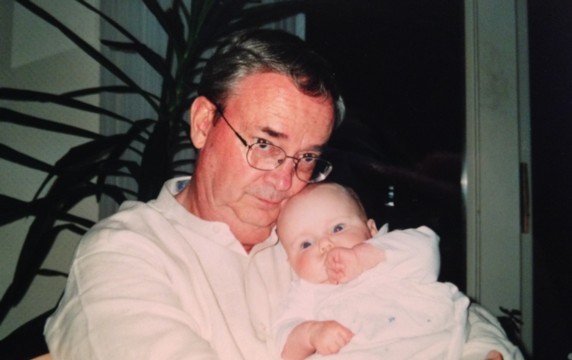
As
a toddler, Annie was obsessed with her Papa. To the extent that her
Papa would have to hide from her at adult social events. She would
walk up to everyone at the function and with varying degrees of
understandability say, “Papa?” or “Where Papa?” Maybe he
darted behind the couch or hid behind a closet door, but eventually,
she would always find him. When she did, a smile, or a knowing smirk,
rather, would spread across that older face – slightly wrinkled but
not too much yet, like a shirt that almost needs to be pressed. They
were the truest of pals. At this stage of her life, the game of
choice for the two of them was Go Fish. Easy enough for her to grasp
but complicated enough to challenge her a little bit.
Go
Fish Rules:
Players:
- One
four-year-old Annie, blonde curly afro, bright blue eyes, round face
- One
sixty-nine-year-old Papa, bald at the top of his head, grandfather
belly, with a laugh that only sounded as a few “humphs” in succession
Set-up:
- Deal each player
five cards.
- The remaining
cards go into the draw pile.
Rules:
- Player one asks
another player for a certain type of card, e.g. a 2. If the opposing
player has said card, they must give it up. Unless, of course, the
opposing player was her sneaky Papa, who often pretended he had none of
the cards she was looking for. When he would finally give it up, Annie
would laugh and laugh, high-pitched and bouncing through the air.
- Player one
receives their desired card and goes again.
- If the opposing
player does not have the cards asked
for, they say “Go Fish.” When they went fishing for cards, her Papa
would pretend the cards were all different types of real fish. “Oh, you
caught a salmon!” Papa would say. To which she would respond, “What is
a Salmon?” Eventually, it would be she who yelled out, “You got Tilapia!” and “Oh, that one’s
a nice Branzino!” To which he would reply, “Well, we will have to get a
good Sauvignon Blanc to drink with that.”
- Play sets of 4
once you have them, the game ends when the first person runs out of
cards, or, when Mama
brings them lunch, and Annie becomes distracted by the many ways
four-year-olds can play with food.
Example
of Play:
They
played at the kitchen table, a smooth white tabletop with wooden
edges and legs, big enough to seat eight people around. While the two
of them played cards, her Mama would be in the kitchen watching them
interact and making her granddaughter’s favorite snack: toasted
peanut butter and jelly sandwiches. No crust, of course. Annie was
beginning to appreciate fine culinary things, and from everything she
had tasted, these toasted PB&J sandwiches had to be the finest.
She assumed her Mama was some sort of superwoman to be able to make
something so delicious out of unremarkable things like sandwich
bread, jelly, and peanut butter.
Sometime
during their play, her grandmother would emerge from the kitchen and
set down full plates in front of them. A toasted PB&J for her,
and a decadent turkey and cheese sandwich loaded with mustard (gross,
in little Annie’s opinion), mayo, onions, tomatoes, lettuce, and,
of course, one crunchy, vinegary pickle on the side (the largest
grievance). She always considered this meal to be a sophisticated
one. She had it in her mind that as one got older, one became less
fun and was therefore forced to pretend to like things like loaded
turkey sandwiches and pickles, instead of toasted, no-crust
PB&Js.
She couldn’t say she was excited for this rite of passage, but she
also couldn’t say she was afraid of it. What she wanted the most
out of growing up was not a sophisticated palate, but an
understanding of how her Papa seemed to have the answer to every
question she would pose. She wanted to be as tall as an adult, look
them in the eye, and communicate with them in a way they would
comprehend. She wanted to pretend to like turkey sandwiches.
But,
perhaps what she wanted most of all, was to be an adult with her
Papa, so that he would share all the secrets of life with her. He
would teach her how to navigate the difficulties of life with rules
as simple as those to Go Fish. He was her friend now, but she
imagined how he was only waiting for her to reach the age of twenty,
so they could really see each other eye-to-eye.
She
was nine years old, small enough that everything still seemed big to
her. But, even if she hadn’t been small, her grandparents’ living
room would have seemed huge. It was a large room with white carpet.
Its largeness was compounded by the fact that there were no real
doors into the room but rather entrances to other areas of the house;
four to be exact. One walkway into the dining room, which was
complete with a long mahogany dining table for ten and glass cases
housing fancy China. One walkway into the foyer. This led to the
front door, always the darkest area of the house from its lack of
natural sunlight. One into her grandfather’s office; there were
doors here, but they were French doors with windows, so she could
peer into the space with his imposing dark wood desk even if the
doors were closed. The golden nameplate that read “Dr. Kelso”
always fascinated her. She wondered what it would be like to be so
important you had to have your name on a gold plate for strangers to
read. She wondered if she would ever be that important. The fourth
entrance also had a French door, but this opened to the solarium, her
favorite room in her grandparents' house. Here lived all the
beautiful plants her Mama tended to, including the elusive but
beautiful night-blooming cactus. She had never seen the
night-blooming cactus because it always opened past her bedtime. But
she vowed when she got older, and she wasn’t bound by the
constrictions of a child’s bedtime, she would finally lay eyes on
that elusive flower. And maybe, she would understand something about
the world she had never understood before.
The
living room was outfitted with a gorgeous marble fireplace, atop of
which sat a portrait of Annie’s aunt draped in pearls. Orange and
green flowered couches laid perpendicular to the fireplace with a
glass coffee table in the middle. In the corner of the living room by
the entrance to the foyer, sat an upright piano. This was her Mama’s
office. Her beautiful voice was the soundtrack for Papa’s important
gold-name-plate work. In between the solarium and her Papa’s office
was her favorite spot in the living room: a small white marble table,
perfect for two. This is where Papa and she played war.
War
rules:
Players:
- One
nine-year-old Annie, dirty blonde curlyish, wavyish hair, one bright
blue eye that tended to wander away from the other, a big gap between
her front teeth, and steel green, rectangular glasses
- One
seventy-four-year-old Papa, a little thicker in the jaw, a smile where
he almost never showed his teeth, and hands decorated with sunspots
from years on the golf green
Set-up:
- Shuffle a full
deck of cards and deal each player half.
Rules:
- Each player
flips over a card at the same time. The player with the higher card
wins both cards. Unless, you are playing a sneaky Papa, who will try to
take both cards even though he clearly played a five and you played a
ten. He then will pretend he truly believes you get to bigger numbers
by counting backward, to which Annie will exclaim, “Papa!! Don’t be a
cheater! I know you know how to count!”
- In the event the
same card is flipped over by each player, war is declared. Each player
then puts three cards face down on the table and flips over the fourth.
The higher card wins all the cards in the war. But when you play Papa,
he will try to hoard all his other cards, and will say, “No, you really
have to fight me if you want to get them.” To which Annie will stand up
and go around the table to get her rightful cards, and Papa will tickle
her until she is laughing so hard, there are tears on her cheeks. If
both players flip over the same card the fourth time, they do the war
process again. You can only imagine how dramatic this gets if you are
playing a Papa.
- The game is over
when one player has all the cards in their hand, or, when you’ve been
playing for over an hour and it is well past Annie’s bedtime.
Example
of Play:
Anne
loved playing
war. She delighted in the knowledge
that they
were about to embark on something with no time limit (and that it
often pushed back her bedtime).
She was
not a good shuffler, so her Papa took the deck. He moved the worn and
tired cards between his hands easily. She was mesmerized by the
folding of the cards between each other and the arching of their thin
spines into a bridge. She would never ask him to teach her because
she loved to watch the way his hands maneuvered the cards. His
sun-spotted hands, colored by years of playing golf and the nub on
his forefinger in place of a fingernail. She asked what happened to
his finger, and he told her it was bitten off by a dog. This scared
her, but she soon stopped believing it. She had learned how much of a
tease and goof her Papa was. This inspired her. Because even though
she was excited to reach the maturity of adulthood, she never wanted
to lose her silliness. And her serious, imposing, important
gold-nameplate Papa, showed her it was possible to speak the language
of a child and an adult.
Annie
felt like an adult. She was sixteen now and could drive herself all
over God's green earth, though she never did – she mostly drove
around Des Moines. She was a straight-A student. She excelled in her
extracurriculars. She had big thoughts about the world. She
understood the word dichotomy. She could use the quadratic formula.
She knew what a mole was (though she would forget this later). She
read classic novels, like Wuthering Heights,
answered plot
questions, and, at times, drew bigger conclusions about deeper themes
in the novel. She drank alcohol with her friends until the wee hours
of the morning without her parents knowing. She kissed boys in the
dark without her parents knowing. She talked about people behind
their backs. She spread gossip. She was the subject of spread gossip.
She was hurt by said gossip. She did not know that none of this meant
you were an adult.
Growing
up rules:
Players:
- One
sixteen-year-old Annie, freshly minted driver’s license in hand, baby
fat still hugging the edges of her face, newly braces-straightened front teeth (no gap)
that boosted her self-confidence tremendously, self-absorption
marinating in her bones
- One
eighty-one-year-old Papa, skin that sagged a little more off his arms,
seasoned, knowledgeable
eyes, a frightening understanding, that yes, he really was getting older
Set-up:
- One weekend
where Annie’s parents traveled out of town and left an empty house in
Des Moines.
- One decree from
Annie’s parents that she must stay at her grandparents’ that weekend.
- One reluctant,
devious Annie, and two unassuming, sweet grandparents.
Rules:
- The younger
player makes herself scarce over the weekend, popping in only for
meals, the occasional shower, and sleep.
- The grandparents
hope Annie will spend some time with them, a look of excitement on
their face whenever she enters the room.
- Disappointment
sets in as the grandparents realize their irrelevance in Annie’s bubble
of herself.
- They begin to
question their relevance anywhere.
Example
of Play:
“Why
do I have to stay at Mama and Papa’s?” Annie
whined.
“Because
you’re too young to stay here by
yourself,” her mom said.
“What
do you mean? I’m sixteen. I can drive! Do
you not trust me?”
“This
isn’t about trust,” her mom sighed while Annie
marched out of the
kitchen and slammed
the door into her room. “Annie, you know, it would be good for you
to spend some time with your grandparents!” She
yelled after her.
Losing
the battle with her mother, she reluctantly packed a bag and went to
stay with her grandparents. She pulled up to their townhome after
school on Friday to drop off her bags and quickly left to go over to
a friend’s before they went to the football game. She came back
well after both of her grandparents and aunt were in bed. She felt
strange being awake in their house without them. This had really
never been the case before. She walked around the kitchen and the
living room taking in small details. Like the way you could hide
behind the curtains covering the doors to the patio and pretend you
were playing hide and seek. Or how funny it was that the same orange
and green flowered couches from the big house had sleeves covering
their arms. What did they need that for? Wary of stomping around too
loudly and waking her grandparents up, she went downstairs to bed.
The
next evening, she had dinner with
her
grandparents and aunt. Her Mama made her favorite: honey
chicken. She rarely cooked anymore, but her granddaughter
was
over, it was special. Annie watched
from the
hightop chair looking
into the kitchen
as her Mama slowly walked between the oven and the prep counter and
laboriously bent down to get out pans and put them on the counter.
Annie did not offer to help.
As
the kitchen became a heavenly concoction of honeyed smells, her Papa,
Mama, aunt, and Annie gathered around the kitchen table, which Annie
did have the good sense to set, but only after being asked by her
Mama. They talked almost exclusively about Annie’s life. She
regaled them with funny stories, shared the drama between her
friends, and said naively how she couldn’t wait to be done with
high school, to be an adult.
After
dinner, Annie donned yellow rubber gloves and plunged her hands in
and out of soapy water. While she was washing the dishes, her papa
suggested they might play some cards. Annie easily said no, she was
going to a friend’s.
But she lied. She
was actually sneaking into her parents’ house and having a party.
Her friends would park down the street so as not to alert her
neighbors. They would drink her parents' liquor, but refill the
bottles with water, hoping her parents wouldn’t notice some of it
was gone. She would drink so much that night she would vomit and some
of other friends would too.
Only
later would she recall
the look on her
Papa’s face when she declined his invitation to cards. The way the
corners of his eyes dropped down as the edges of his mouth sank
slightly. The way his lips parted as if to respond in protest but
quickly closed after second thought. The way that if you were a
really perceptive individual, you could see the fear of irrelevance
bouncing around in his head, just behind the furrowed brow. She would
remember this face and think it was no big deal – she would simply
say yes next time. But what she didn’t quite understand yet was
that moments with loved ones were numbered, and you best cherish them
while you can.
It
had been a while since she last saw Papa, and she was nervous
standing before her grandparents' front door. She had heard he had
gotten worse, but she had yet to see it with her eyes. She took a
breath and walked into the house to find him sitting on his favorite
green reclining chair, blanket over the top of him, her aunt’s dog,
a black and white spotted Maltese with an underbite and proclivity to
tilt his head, Louis, right beside him.
Dementia
rules:
Players:
- One
twenty-year-old Annie, short curly, brunette hair, contacts, a
burgeoning confidence in herself
- One
eighty-six-year-old Papa, thick-lensed glasses, always dressed in khakis and a polo tucked-in, a film over
brown eyes, a weakening idea of himself
Set-up:
- The players sit in
the plush chairs by the kitchen table. Annie
stares anywhere but in
her Papa’s eyes.
Rules:
- The younger
player asks questions about the older player's life – though she knows she will not get a
straight answer.
- The older player
asks the same questions on repeat.
- The younger
player tries to get him to go on a walk, he declines.
- The players move
to the couch where they watch the endless stream of news.
- The game ends
when Mama returns home, or when Annie feels overwhelmed by the prospect
of a great, long life.
Example
of Play:
Annie
sat across from her Papa on the green loveseat after giving him a
hug.
“It’s
good to see you, Annie!” Papa said.
From
the kitchen, Mama heaved a sigh of
relief.
Annie glanced over at her and noticed a mix of terror and exhaustion
in those brown eyes. She realized Mama thought Papa wouldn’t have
remembered her. That he would’ve seen her face, the blue eyes, the
light freckles, the button nose, the medium lips and not recognized
it as his granddaughter. Annie had not known that this was what
“worse” really meant – that she could be erased from a mind
belonging to someone who had loved her from the moment he saw her. It
was comforting that the floor was still there because she felt her
spirit in freefall.
“You
too, Papa. How are you?”
“Oh,
fine, just fine.”
“That’s
good. What have you been up to?”
“Oh
nothing, much. Nothing much. Now, where are you at lately?”
She
felt a momentary sting. It had only been a year since she left. “Oh,
I’m in college. Finished
my first
year. At Northwestern, outside Chicago.” She smiled.
“Oh,
good. Well, you study hard, then.” Papa had always been a big
proponent of studying, and the familiarity of this part of his
personality comforted her. He used to joke that the
first grandchild of his to go to med school would get his 1980s baby
blue Mercedes Benz convertible. Not one of the 20
ever did.
"I’ll
be trying to.”
Just
then her cousins, aunts, and uncles walked in, and, suddenly, the
room was alive with chatter, appetizers, and cocktails. During this
fast-paced talking, Papa remained in his corner. Concentrating, it
seemed. Staring intently at these faces, listening to the words that
rattled from their tongues. Annie saw him understand he was slipping
away from himself and saw him doing everything in his power to hold
on to the threads he had left. He was trying to study his way back
into his life, convinced that with enough effort, he wouldn’t
forget the people he loved, the bodies humming warmly around him. The
fear coming from the green chair was palpable. But, perhaps, it felt
scarier to think he could be forgotten by them. That as his mind let
them go unwillingly, they would let him go, afraid of the commitment
of handling someone who was reverting. She felt ashamed. Almost no
one went up to talk to him during the before dinner hour, including
her. Because what was she to talk about? When he was gone, she would
wish she had been unafraid of silence and brave enough to simply sit
with him and hold his hand. Brave enough to let him know she would
love him even when he could not grasp he was somebody to be loved.
She
gently took the deck from him and shuffled the cards. She had learned
to waterfall the cards, but she never got the bridge. Her fingers
felt thick and clumsy as she mashed the cards together. She longed
for the ease of Papa’s shuffling, the ease of his past self.
Trash
rules:
Players:
- One
twenty-two-year-old Annie, short curly, brunette hair, wearing
light-wash jeans and a white t-shirt, in a state of uncertainty about
the future of her life
- One
eighty-eight-year-old Papa, a white t-shirt tucked into sweatpants, in a state of
uncertainty about himself
Set-up:
- Shuffle a full
deck of cards and deal each player 10.
- The players
arrange their cards on the table face down. If Annie was playing with Papa, she would
have to flip over the cards he turned up by accident.
- The remaining
cards are put in the draw pile.
- Aces are 1,
jacks are wild, and Kings are trash.
- Queens are
stealing cards, you can use them to steal another person’s card. No one
can win with a queen in their hand. Unless, Annie is playing Papa, and
he thinks he’s won with a queen in his hand, and she allows him to win
because she doesn’t have the heart to tell him no.
Rules:
- The player who
doesn't deal the cards starts the game. The first player draws
from the stock pile. If they can play the card (meaning Ace through
Jack) the player places the card in the appropriate spot on their grid.
If they drew an Ace, for instance, they would place it in the top left
position of the grid; a 10 would be the bottom right and so on. Unless
Annie is playing Papa, and he puts a two where the six should go. When
they place a card on the grid, they flip over the faced-down card
previously in that position. If they can use that card, then they do
the same thing until they get a card they cannot play (meaning a King,
Queen, or a card they have already played). Unless Annie is playing
Papa, and she has to move the cards into place for him when he tries to
discard a perfectly good ten he needs in his deck.
- When they have
an unplayable card, they place it face up beside the stockpile, forming
the discard pile, and player 2 begins their turn. If Annie is
playing Papa, she will discard his card for him when he forgets to do
so.
- Starting with
player 2's first turn, players can choose to either draw from the
stockpile or the discard pile. Unless Annie is playing Papa, and he
attempts to take a card she is using from her hand because he thought
it was his turn. She lets him.
- The first player
to fill out their entire grid wins, and the game is complete. Or, the
game is complete, when Papa loses interest and doesn’t want to move his
cards anymore. Or, when Annie loses patience and must stop. This action
is often accompanied by guilt.
Example
of Play:
She
felt his eyes watch the movement of her hands, the way they
maneuvered the cards, studying it. There is so much to be said about
memory’s importance in the process of learning. She dealt them each
ten cards, and he began to flip them over. She didn’t correct his
mistake. They played the round. She answered his questions, or maybe
not questions, but confused glances. She cherished the moments when
she saw a flicker of recognition dance in his eye. When it was time
to leave, she packed up the cards and gave him a hug.
He
grabbed her arm and said, “Keep going, you keep doing what you are
doing.” She smiled and, of course, told him she would.
Shortly
after Papa’s death, Annie returned home. She stopped by her
grandparents’ townhome unsure of what the inside would feel like.
She no longer lived where her Papa lived; he was no longer in her
daily life. Even though she saw his dead body, crinkled underneath
layers of foundation, mouth parted, lips parched, cheeks sunken, even
though she went to his funeral, the moment she flew away, her brain
put him back in her hometown. Compartmentalized him to where he had
always been. Her body thought she would simply see him when she
returned, even though, rationally, she knew she wouldn’t.
Death
Rules:
Players:
- One
twenty-four-year-old Annie
accompanied by everyone
left behind by her Papa, to be exact: one Mama, seven of Mama and Papa’s children, five spouses
of those children, nineteen grandchildren, and five great-grandchildren.
Set-up:
- One rosary
service with an open casket; a papa in that casket with a sunken mouth
looking much like the lips of a turtle, closed eyes, hands one over the
other across his chest. One great-grandchild, who ran nonstop during
this service and laughed while he went up to the coffin, not quite sure what to do
with the person who looked like they were sleeping but really weren’t.
This great-grandchild didn’t quite understand death yet; it will be
confusing for him when
he discovers he never will.
- One funeral in
the form of a Catholic
mass, which lasts about an hour. Three speeches given by grandchildren
that will move the audience to tears. About 20 minutes of music
performed by Annie and her cousin, which will distract Annie only long
enough until the hour-long service is over, after which she will break
down with her singing cousin. Crying softly into each other’s arms.
- One reception
where many of the family members will indulge in too much wine, Annie
included. One pushed back flight by Annie to stay for a few moments
longer in the world of black clothes, tears, and embraces by family.
- Many planes
taking off in different directions, spreading the family out once
again.
Rules:
Example
of Play:
She
rang the doorbell. Mama came to the door and enveloped her in a tight
hug. They exchanged pleasantries, and she asked if Annie would like
something to eat. She declined. She wondered if you could taste loss.
Because if so, she tasted it in the air. The crisp, pale air the air
conditioner blew around
the house, the
way it stripped away her saliva and made her feel as if she had been
laying in a casket for hours, playing dead, with her mouth open. She
changed her mind about the food, and together, they made one of those
splendid Turkey sandwiches. As she got older, she would understand
the brilliance of a well-crafted turkey sandwich. The subtlety and
nuance of the flavors combining, so that it wasn’t overbearing in
any way – unlike the overbearing sweetness in a PB&J. She
wished she could tell her Papa.
They
walked around the townhome admiring the collection of Mama’s plants
– something she had carried over during the move from the big
house. There was no one who could keep a houseplant alive like Mama.
Annie asked about her favorite plant, the night-blooming cactus.
“Well,
it’s the strangest thing,” Mama said. “When we moved from
Terrace Road, the plant was not happy at all. I moved it downstairs
to give it more light. It didn’t like that. I moved it upstairs for
some shade, and that was a no go. It wasn’t blooming. Well,
finally, after Papa died, I decided to move it on the deck, and now,
it’s blooming. Just like that.”
Mama
told her she could spend the night, so she could see the flower
bloom. Annie still had never seen a bloom outside of pictures on the
internet. Later, Annie came back to her grandparents’,
watched a movie with her Mama and her aunt, and went to bed. Alone,
all she could think about was the taste of the air, and how, in the
basement, two doors away, her Papa breathed his last breath.
She knew you had to breathe to live, but she had a brief moment where
she wondered if everyone was making it up. And, maybe, if you stopped
breathing, you were ‘playing’ dead, and you joined a secret group
of everyone who had ever gone before you in a glorious metropolis
underground, and you were not really gone. She felt three again and
realized she created her own distorted version of heaven (which she
didn’t believe in anyway). She cried.
After
a while, she got up to see the cactus. Tip-toeing lightly upstairs,
so as not to wake anyone up. When she got to the deck, she noticed
Mama sitting outside with a cup of tea.
“I
wanted you to see it with someone,” she said and took
Annie’s hand.
It
was magnificent. White, spiraling, pouring itself open to the night.
So incredibly vulnerable, this flower. She understood why it could
only open at night when most of the world was asleep. She remembered
her grandfather in his last days with eyes like this flower. Scared,
open, vast. She remembered how he seemed to be reaching out, trying
to find a ledge somewhere, something to hold on to. She remembered
how slippery it felt trying to catch him. She remembered how
impossible it felt to hold someone so fragile. She remembered she
only tried her best to be there for him. She wished there was some
way he could stay in her life forever, never
ceasing to be around to give his wisdom. She felt like everything she
knew about life, adulthood, and childhood had been turned on its
head. But people told her, her Papa included, that this was what life
was. To have the rules of life turned into a foreign language just
when you figured out how to read them. She cried again, but this time
she could grab her Mama’s hands and stare into her Papa’s eyes.
Anne
Elise Teeling is a professional singer and fledgling author based in
New York City. She studied creative writing at Northwestern
University. This story is about her experience watching her
grandfather slowly lose his mind, and, later his life, to dementia.
It is dedicated to his memory, and the love he never failed to show
her.
The
Rules of Life
By
Anne Elise Teeling
As
a toddler, Annie was obsessed with her Papa. To the extent that her
Papa would have to hide from her at adult social events. She would
walk up to everyone at the function and with varying degrees of
understandability say, “Papa?” or “Where Papa?” Maybe he
darted behind the couch or hid behind a closet door, but eventually,
she would always find him. When she did, a smile, or a knowing smirk,
rather, would spread across that older face – slightly wrinkled but
not too much yet, like a shirt that almost needs to be pressed. They
were the truest of pals. At this stage of her life, the game of
choice for the two of them was Go Fish. Easy enough for her to grasp
but complicated enough to challenge her a little bit.
Go
Fish Rules:
Players:
- One
four-year-old Annie, blonde curly afro, bright blue eyes, round face
- One
sixty-nine-year-old Papa, bald at the top of his head, grandfather
belly, with a laugh that only sounded as a few “humphs” in succession
Set-up:
- Deal each player
five cards.
- The remaining
cards go into the draw pile.
Rules:
- Player one asks
another player for a certain type of card, e.g. a 2. If the opposing
player has said card, they must give it up. Unless, of course, the
opposing player was her sneaky Papa, who often pretended he had none of
the cards she was looking for. When he would finally give it up, Annie
would laugh and laugh, high-pitched and bouncing through the air.
- Player one
receives their desired card and goes again.
- If the opposing
player does not have the cards asked
for, they say “Go Fish.” When they went fishing for cards, her Papa
would pretend the cards were all different types of real fish. “Oh, you
caught a salmon!” Papa would say. To which she would respond, “What is
a Salmon?” Eventually, it would be she who yelled out, “You got Tilapia!” and “Oh, that one’s
a nice Branzino!” To which he would reply, “Well, we will have to get a
good Sauvignon Blanc to drink with that.”
- Play sets of 4
once you have them, the game ends when the first person runs out of
cards, or, when Mama
brings them lunch, and Annie becomes distracted by the many ways
four-year-olds can play with food.
Example
of Play:
They
played at the kitchen table, a smooth white tabletop with wooden
edges and legs, big enough to seat eight people around. While the two
of them played cards, her Mama would be in the kitchen watching them
interact and making her granddaughter’s favorite snack: toasted
peanut butter and jelly sandwiches. No crust, of course. Annie was
beginning to appreciate fine culinary things, and from everything she
had tasted, these toasted PB&J sandwiches had to be the finest.
She assumed her Mama was some sort of superwoman to be able to make
something so delicious out of unremarkable things like sandwich
bread, jelly, and peanut butter.
Sometime
during their play, her grandmother would emerge from the kitchen and
set down full plates in front of them. A toasted PB&J for her,
and a decadent turkey and cheese sandwich loaded with mustard (gross,
in little Annie’s opinion), mayo, onions, tomatoes, lettuce, and,
of course, one crunchy, vinegary pickle on the side (the largest
grievance). She always considered this meal to be a sophisticated
one. She had it in her mind that as one got older, one became less
fun and was therefore forced to pretend to like things like loaded
turkey sandwiches and pickles, instead of toasted, no-crust
PB&Js.
She couldn’t say she was excited for this rite of passage, but she
also couldn’t say she was afraid of it. What she wanted the most
out of growing up was not a sophisticated palate, but an
understanding of how her Papa seemed to have the answer to every
question she would pose. She wanted to be as tall as an adult, look
them in the eye, and communicate with them in a way they would
comprehend. She wanted to pretend to like turkey sandwiches.
But,
perhaps what she wanted most of all, was to be an adult with her
Papa, so that he would share all the secrets of life with her. He
would teach her how to navigate the difficulties of life with rules
as simple as those to Go Fish. He was her friend now, but she
imagined how he was only waiting for her to reach the age of twenty,
so they could really see each other eye-to-eye.
She
was nine years old, small enough that everything still seemed big to
her. But, even if she hadn’t been small, her grandparents’ living
room would have seemed huge. It was a large room with white carpet.
Its largeness was compounded by the fact that there were no real
doors into the room but rather entrances to other areas of the house;
four to be exact. One walkway into the dining room, which was
complete with a long mahogany dining table for ten and glass cases
housing fancy China. One walkway into the foyer. This led to the
front door, always the darkest area of the house from its lack of
natural sunlight. One into her grandfather’s office; there were
doors here, but they were French doors with windows, so she could
peer into the space with his imposing dark wood desk even if the
doors were closed. The golden nameplate that read “Dr. Kelso”
always fascinated her. She wondered what it would be like to be so
important you had to have your name on a gold plate for strangers to
read. She wondered if she would ever be that important. The fourth
entrance also had a French door, but this opened to the solarium, her
favorite room in her grandparents' house. Here lived all the
beautiful plants her Mama tended to, including the elusive but
beautiful night-blooming cactus. She had never seen the
night-blooming cactus because it always opened past her bedtime. But
she vowed when she got older, and she wasn’t bound by the
constrictions of a child’s bedtime, she would finally lay eyes on
that elusive flower. And maybe, she would understand something about
the world she had never understood before.
The
living room was outfitted with a gorgeous marble fireplace, atop of
which sat a portrait of Annie’s aunt draped in pearls. Orange and
green flowered couches laid perpendicular to the fireplace with a
glass coffee table in the middle. In the corner of the living room by
the entrance to the foyer, sat an upright piano. This was her Mama’s
office. Her beautiful voice was the soundtrack for Papa’s important
gold-name-plate work. In between the solarium and her Papa’s office
was her favorite spot in the living room: a small white marble table,
perfect for two. This is where Papa and she played war.
War
rules:
Players:
- One
nine-year-old Annie, dirty blonde curlyish, wavyish hair, one bright
blue eye that tended to wander away from the other, a big gap between
her front teeth, and steel green, rectangular glasses
- One
seventy-four-year-old Papa, a little thicker in the jaw, a smile where
he almost never showed his teeth, and hands decorated with sunspots
from years on the golf green
Set-up:
- Shuffle a full
deck of cards and deal each player half.
Rules:
- Each player
flips over a card at the same time. The player with the higher card
wins both cards. Unless, you are playing a sneaky Papa, who will try to
take both cards even though he clearly played a five and you played a
ten. He then will pretend he truly believes you get to bigger numbers
by counting backward, to which Annie will exclaim, “Papa!! Don’t be a
cheater! I know you know how to count!”
- In the event the
same card is flipped over by each player, war is declared. Each player
then puts three cards face down on the table and flips over the fourth.
The higher card wins all the cards in the war. But when you play Papa,
he will try to hoard all his other cards, and will say, “No, you really
have to fight me if you want to get them.” To which Annie will stand up
and go around the table to get her rightful cards, and Papa will tickle
her until she is laughing so hard, there are tears on her cheeks. If
both players flip over the same card the fourth time, they do the war
process again. You can only imagine how dramatic this gets if you are
playing a Papa.
- The game is over
when one player has all the cards in their hand, or, when you’ve been
playing for over an hour and it is well past Annie’s bedtime.
Example
of Play:
Anne
loved playing
war. She delighted in the knowledge
that they
were about to embark on something with no time limit (and that it
often pushed back her bedtime).
She was
not a good shuffler, so her Papa took the deck. He moved the worn and
tired cards between his hands easily. She was mesmerized by the
folding of the cards between each other and the arching of their thin
spines into a bridge. She would never ask him to teach her because
she loved to watch the way his hands maneuvered the cards. His
sun-spotted hands, colored by years of playing golf and the nub on
his forefinger in place of a fingernail. She asked what happened to
his finger, and he told her it was bitten off by a dog. This scared
her, but she soon stopped believing it. She had learned how much of a
tease and goof her Papa was. This inspired her. Because even though
she was excited to reach the maturity of adulthood, she never wanted
to lose her silliness. And her serious, imposing, important
gold-nameplate Papa, showed her it was possible to speak the language
of a child and an adult.
Annie
felt like an adult. She was sixteen now and could drive herself all
over God's green earth, though she never did – she mostly drove
around Des Moines. She was a straight-A student. She excelled in her
extracurriculars. She had big thoughts about the world. She
understood the word dichotomy. She could use the quadratic formula.
She knew what a mole was (though she would forget this later). She
read classic novels, like Wuthering Heights,
answered plot
questions, and, at times, drew bigger conclusions about deeper themes
in the novel. She drank alcohol with her friends until the wee hours
of the morning without her parents knowing. She kissed boys in the
dark without her parents knowing. She talked about people behind
their backs. She spread gossip. She was the subject of spread gossip.
She was hurt by said gossip. She did not know that none of this meant
you were an adult.
Growing
up rules:
Players:
- One
sixteen-year-old Annie, freshly minted driver’s license in hand, baby
fat still hugging the edges of her face, newly braces-straightened front teeth (no gap)
that boosted her self-confidence tremendously, self-absorption
marinating in her bones
- One
eighty-one-year-old Papa, skin that sagged a little more off his arms,
seasoned, knowledgeable
eyes, a frightening understanding, that yes, he really was getting older
Set-up:
- One weekend
where Annie’s parents traveled out of town and left an empty house in
Des Moines.
- One decree from
Annie’s parents that she must stay at her grandparents’ that weekend.
- One reluctant,
devious Annie, and two unassuming, sweet grandparents.
Rules:
- The younger
player makes herself scarce over the weekend, popping in only for
meals, the occasional shower, and sleep.
- The grandparents
hope Annie will spend some time with them, a look of excitement on
their face whenever she enters the room.
- Disappointment
sets in as the grandparents realize their irrelevance in Annie’s bubble
of herself.
- They begin to
question their relevance anywhere.
Example
of Play:
“Why
do I have to stay at Mama and Papa’s?” Annie whined.
“Because
you’re too young to stay here
by
yourself,” her mom said.
“What
do you mean? I’m sixteen. I can drive! Do
you not trust me?”
“This
isn’t about trust,” her mom sighed while Annie
marched out of the
kitchen and slammed
the door into her room. “Annie, you know, it would be good for you
to spend some time with your grandparents!” She
yelled after her.
Losing
the battle with her mother, she reluctantly packed a bag and went to
stay with her grandparents. She pulled up to their townhome after
school on Friday to drop off her bags and quickly left to go over to
a friend’s before they went to the football game. She came back
well after both of her grandparents and aunt were in bed. She felt
strange being awake in their house without them. This had really
never been the case before. She walked around the kitchen and the
living room taking in small details. Like the way you could hide
behind the curtains covering the doors to the patio and pretend you
were playing hide and seek. Or how funny it was that the same orange
and green flowered couches from the big house had sleeves covering
their arms. What did they need that for? Wary of stomping around too
loudly and waking her grandparents up, she went downstairs to bed.
The
next evening, she had dinner with
her
grandparents and aunt. Her Mama made her favorite: honey
chicken. She rarely cooked anymore, but her granddaughter
was
over, it was special. Annie watched
from the
hightop chair looking
into the kitchen
as her Mama slowly walked between the oven and the prep counter and
laboriously bent down to get out pans and put them on the counter.
Annie did not offer to help.
As
the kitchen became a heavenly concoction of honeyed smells, her Papa,
Mama, aunt, and Annie gathered around the kitchen table, which Annie
did have the good sense to set, but only after being asked by her
Mama. They talked almost exclusively about Annie’s life. She
regaled them with funny stories, shared the drama between her
friends, and said naively how she couldn’t wait to be done with
high school, to be an adult.
After
dinner, Annie donned yellow rubber gloves and plunged her hands in
and out of soapy water. While she was washing the dishes, her papa
suggested they might play some cards. Annie easily said no, she was
going to a friend’s.
But she lied. She
was actually sneaking into her parents’ house and having a party.
Her friends would park down the street so as not to alert her
neighbors. They would drink her parents' liquor, but refill the
bottles with water, hoping her parents wouldn’t notice some of it
was gone. She would drink so much that night she would vomit and some
of other friends would too.
Only
later would she recall
the look on her
Papa’s face when she declined his invitation to cards. The way the
corners of his eyes dropped down as the edges of his mouth sank
slightly. The way his lips parted as if to respond in protest but
quickly closed after second thought. The way that if you were a
really perceptive individual, you could see the fear of irrelevance
bouncing around in his head, just behind the furrowed brow. She would
remember this face and think it was no big deal – she would simply
say yes next time. But what she didn’t quite understand yet was
that moments with loved ones were numbered, and you best cherish them
while you can.
It
had been a while since she last saw Papa, and she was nervous
standing before her grandparents' front door. She had heard he had
gotten worse, but she had yet to see it with her eyes. She took a
breath and walked into the house to find him sitting on his favorite
green reclining chair, blanket over the top of him, her aunt’s dog,
a black and white spotted Maltese with an underbite and proclivity to
tilt his head, Louis, right beside him.
Dementia
rules:
Players:
- One
twenty-year-old Annie, short curly, brunette hair, contacts, a
burgeoning confidence in herself
- One
eighty-six-year-old Papa, thick-lensed glasses, always dressed in khakis and a polo tucked-in, a film over
brown eyes, a weakening idea of himself
Set-up:
- The players sit in
the plush chairs by the kitchen table. Annie
stares anywhere but in
her Papa’s eyes.
Rules:
- The younger
player asks questions about the older player's life – though she knows she will not get a
straight answer.
- The older player
asks the same questions on repeat.
- The younger
player tries to get him to go on a walk, he declines.
- The players move
to the couch where they watch the endless stream of news.
- The game ends
when Mama returns home, or when Annie feels overwhelmed by the prospect
of a great, long life.
Example
of Play:
Annie
sat across from her Papa on the green loveseat after giving him a
hug.
“It’s
good to see you, Annie!” Papa said.
From
the kitchen, Mama heaved a sigh of
relief.
Annie glanced over at her and noticed a mix of terror and exhaustion
in those brown eyes. She realized Mama thought Papa wouldn’t have
remembered her. That he would’ve seen her face, the blue eyes, the
light freckles, the button nose, the medium lips and not recognized
it as his granddaughter. Annie had not known that this was what
“worse” really meant – that she could be erased from a mind
belonging to someone who had loved her from the moment he saw her. It
was comforting that the floor was still there because she felt her
spirit in freefall.
“You
too, Papa. How are you?”
“Oh,
fine, just fine.”
“That’s
good. What have you been up to?”
“Oh
nothing, much. Nothing much. Now, where are you at lately?”
She
felt a momentary sting. It had only been a year since she left. “Oh,
I’m in college. Finished
my first
year. At Northwestern, outside Chicago.” She smiled.
“Oh,
good. Well, you study hard, then.” Papa had always been a big
proponent of studying, and the familiarity of this part of his
personality comforted her. He used to joke that the
first grandchild of his to go to med school would get his 1980s baby
blue Mercedes Benz convertible. Not one of the 20
ever did.
"I’ll
be trying to.”
Just
then her cousins, aunts, and uncles walked in, and, suddenly, the
room was alive with chatter, appetizers, and cocktails. During this
fast-paced talking, Papa remained in his corner. Concentrating, it
seemed. Staring intently at these faces, listening to the words that
rattled from their tongues. Annie saw him understand he was slipping
away from himself and saw him doing everything in his power to hold
on to the threads he had left. He was trying to study his way back
into his life, convinced that with enough effort, he wouldn’t
forget the people he loved, the bodies humming warmly around him. The
fear coming from the green chair was palpable. But, perhaps, it felt
scarier to think he could be forgotten by them. That as his mind let
them go unwillingly, they would let him go, afraid of the commitment
of handling someone who was reverting. She felt ashamed. Almost no
one went up to talk to him during the before dinner hour, including
her. Because what was she to talk about? When he was gone, she would
wish she had been unafraid of silence and brave enough to simply sit
with him and hold his hand. Brave enough to let him know she would
love him even when he could not grasp he was somebody to be loved.
She
gently took the deck from him and shuffled the cards. She had learned
to waterfall the cards, but she never got the bridge. Her fingers
felt thick and clumsy as she mashed the cards together. She longed
for the ease of Papa’s shuffling, the ease of his past self.
Trash
rules:
Players:
- One
twenty-two-year-old Annie, short curly, brunette hair, wearing
light-wash jeans and a white t-shirt, in a state of uncertainty about
the future of her life
- One
eighty-eight-year-old Papa, a white t-shirt tucked into sweatpants, in a state of
uncertainty about himself
Set-up:
- Shuffle a full
deck of cards and deal each player 10.
- The players
arrange their cards on the table face down. If Annie was playing with Papa, she would
have to flip over the cards he turned up by accident.
- The remaining
cards are put in the draw pile.
- Aces are 1,
jacks are wild, and Kings are trash.
- Queens are
stealing cards, you can use them to steal another person’s card. No one
can win with a queen in their hand. Unless, Annie is playing Papa, and
he thinks he’s won with a queen in his hand, and she allows him to win
because she doesn’t have the heart to tell him no.
Rules:
- The player who
doesn't deal the cards starts the game. The first player draws
from the stock pile. If they can play the card (meaning Ace through
Jack) the player places the card in the appropriate spot on their grid.
If they drew an Ace, for instance, they would place it in the top left
position of the grid; a 10 would be the bottom right and so on. Unless
Annie is playing Papa, and he puts a two where the six should go. When
they place a card on the grid, they flip over the faced-down card
previously in that position. If they can use that card, then they do
the same thing until they get a card they cannot play (meaning a King,
Queen, or a card they have already played). Unless Annie is playing
Papa, and she has to move the cards into place for him when he tries to
discard a perfectly good ten he needs in his deck.
- When they have
an unplayable card, they place it face up beside the stockpile, forming
the discard pile, and player 2 begins their turn. If Annie is
playing Papa, she will discard his card for him when he forgets to do
so.
- Starting with
player 2's first turn, players can choose to either draw from the
stockpile or the discard pile. Unless Annie is playing Papa, and he
attempts to take a card she is using from her hand because he thought
it was his turn. She lets him.
- The first player
to fill out their entire grid wins, and the game is complete. Or, the
game is complete, when Papa loses interest and doesn’t want to move his
cards anymore. Or, when Annie loses patience and must stop. This action
is often accompanied by guilt.
Example
of Play:
She
felt his eyes watch the movement of her hands, the way they
maneuvered the cards, studying it. There is so much to be said about
memory’s importance in the process of learning. She dealt them each
ten cards, and he began to flip them over. She didn’t correct his
mistake. They played the round. She answered his questions, or maybe
not questions, but confused glances. She cherished the moments when
she saw a flicker of recognition dance in his eye. When it was time
to leave, she packed up the cards and gave him a hug.
He
grabbed her arm and said, “Keep going, you keep doing what you are
doing.” She smiled and, of course, told him she would.
Shortly
after Papa’s death, Annie returned home. She stopped by her
grandparents’ townhome unsure of what the inside would feel like.
She no longer lived where her Papa lived; he was no longer in her
daily life. Even though she saw his dead body, crinkled underneath
layers of foundation, mouth parted, lips parched, cheeks sunken, even
though she went to his funeral, the moment she flew away, her brain
put him back in her hometown. Compartmentalized him to where he had
always been. Her body thought she would simply see him when she
returned, even though, rationally, she knew she wouldn’t.
Death
Rules:
Players:
- One
twenty-four-year-old Annie
accompanied by everyone
left behind by her Papa, to be exact: one Mama, seven of Mama and Papa’s children, five spouses
of those children, nineteen grandchildren, and five great-grandchildren.
Set-up:
- One rosary
service with an open casket; a papa in that casket with a sunken mouth
looking much like the lips of a turtle, closed eyes, hands one over the
other across his chest. One great-grandchild, who ran nonstop during
this service and laughed while he went up to the coffin, not quite sure what to do
with the person who looked like they were sleeping but really weren’t.
This great-grandchild didn’t quite understand death yet; it will be
confusing for him when
he discovers he never will.
- One funeral in
the form of a Catholic
mass, which lasts about an hour. Three speeches given by grandchildren
that will move the audience to tears. About 20 minutes of music
performed by Annie and her cousin, which will distract Annie only long
enough until the hour-long service is over, after which she will break
down with her singing cousin. Crying softly into each other’s arms.
- One reception
where many of the family members will indulge in too much wine, Annie
included. One pushed back flight by Annie to stay for a few moments
longer in the world of black clothes, tears, and embraces by family.
- Many planes
taking off in different directions, spreading the family out once
again.
Rules:
Example
of Play:
She
rang the doorbell. Mama came to the door and enveloped her in a tight
hug. They exchanged pleasantries, and she asked if Annie would like
something to eat. She declined. She wondered if you could taste loss.
Because if so, she tasted it in the air. The crisp, pale air the air
conditioner blew around
the house, the
way it stripped away her saliva and made her feel as if she had been
laying in a casket for hours, playing dead, with her mouth open. She
changed her mind about the food, and together, they made one of those
splendid Turkey sandwiches. As she got older, she would understand
the brilliance of a well-crafted turkey sandwich. The subtlety and
nuance of the flavors combining, so that it wasn’t overbearing in
any way – unlike the overbearing sweetness in a PB&J. She
wished she could tell her Papa.
They
walked around the townhome admiring the collection of Mama’s plants
– something she had carried over during the move from the big
house. There was no one who could keep a houseplant alive like Mama.
Annie asked about her favorite plant, the night-blooming cactus.
“Well,
it’s the strangest thing,” Mama said. “When we moved from
Terrace Road, the plant was not happy at all. I moved it downstairs
to give it more light. It didn’t like that. I moved it upstairs for
some shade, and that was a no go. It wasn’t blooming. Well,
finally, after Papa died, I decided to move it on the deck, and now,
it’s blooming. Just like that.”
Mama
told her she could spend the night, so she could see the flower
bloom. Annie still had never seen a bloom outside of pictures on the
internet. Later, Annie came back to her grandparents’,
watched a movie with her Mama and her aunt, and went to bed. Alone,
all she could think about was the taste of the air, and how, in the
basement, two doors away, her Papa breathed his last breath.
She knew you had to breathe to live, but she had a brief moment where
she wondered if everyone was making it up. And, maybe, if you stopped
breathing, you were ‘playing’ dead, and you joined a secret group
of everyone who had ever gone before you in a glorious metropolis
underground, and you were not really gone. She felt three again and
realized she created her own distorted version of heaven (which she
didn’t believe in anyway). She cried.
After
a while, she got up to see the cactus. Tip-toeing lightly upstairs,
so as not to wake anyone up. When she got to the deck, she noticed
Mama sitting outside with a cup of tea.
“I
wanted you to see it with someone,” she said and took
Annie’s hand.
It
was magnificent. White, spiraling, pouring itself open to the night.
So incredibly vulnerable, this flower. She understood why it could
only open at night when most of the world was asleep. She remembered
her grandfather in his last days with eyes like this flower. Scared,
open, vast. She remembered how he seemed to be reaching out, trying
to find a ledge somewhere, something to hold on to. She remembered
how slippery it felt trying to catch him. She remembered how
impossible it felt to hold someone so fragile. She remembered she
only tried her best to be there for him. She wished there was some
way he could stay in her life forever, never
ceasing to be around to give his wisdom. She felt like everything she
knew about life, adulthood, and childhood had been turned on its
head. But people told her, her Papa included, that this was what life
was. To have the rules of life turned into a foreign language just
when you figured out how to read them. She cried again, but this time
she could grab her Mama’s hands and stare into her Papa’s eyes.
Anne
Elise Teeling is a professional singer and fledgling author based in
New York City. She studied creative writing at Northwestern
University. This story is about her experience watching her
grandfather slowly lose his mind, and, later his life, to dementia.
It is dedicated to his memory, and the love he never failed to show
her.
The
Rules of Life
By
Anne Elise Teeling
As
a toddler, Annie was obsessed with her Papa. To the extent that her
Papa would have to hide from her at adult social events. She would
walk up to everyone at the function and with varying degrees of
understandability say, “Papa?” or “Where Papa?” Maybe he
darted behind the couch or hid behind a closet door, but eventually,
she would always find him. When she did, a smile, or a knowing smirk,
rather, would spread across that older face – slightly wrinkled but
not too much yet, like a shirt that almost needs to be pressed. They
were the truest of pals. At this stage of her life, the game of
choice for the two of them was Go Fish. Easy enough for her to grasp
but complicated enough to challenge her a little bit.
Go
Fish Rules:
Players:
- One
four-year-old Annie, blonde curly afro, bright blue eyes, round face
- One
sixty-nine-year-old Papa, bald at the top of his head, grandfather
belly, with a laugh that only sounded as a few “humphs” in succession
Set-up:
- Deal each player
five cards.
- The remaining
cards go into the draw pile.
Rules:
- Player one asks
another player for a certain type of card, e.g. a 2. If the opposing
player has said card, they must give it up. Unless, of course, the
opposing player was her sneaky Papa, who often pretended he had none of
the cards she was looking for. When he would finally give it up, Annie
would laugh and laugh, high-pitched and bouncing through the air.
- Player one
receives their desired card and goes again.
- If the opposing
player does not have the cards asked
for, they say “Go Fish.” When they went fishing for cards, her Papa
would pretend the cards were all different types of real fish. “Oh, you
caught a salmon!” Papa would say. To which she would respond, “What is
a Salmon?” Eventually, it would be she who yelled out, “You got Tilapia!” and “Oh, that one’s
a nice Branzino!” To which he would reply, “Well, we will have to get a
good Sauvignon Blanc to drink with that.”
- Play sets of 4
once you have them, the game ends when the first person runs out of
cards, or, when Mama
brings them lunch, and Annie becomes distracted by the many ways
four-year-olds can play with food.
Example
of Play:
They
played at the kitchen table, a smooth white tabletop with wooden
edges and legs, big enough to seat eight people around. While the two
of them played cards, her Mama would be in the kitchen watching them
interact and making her granddaughter’s favorite snack: toasted
peanut butter and jelly sandwiches. No crust, of course. Annie was
beginning to appreciate fine culinary things, and from everything she
had tasted, these toasted PB&J sandwiches had to be the finest.
She assumed her Mama was some sort of superwoman to be able to make
something so delicious out of unremarkable things like sandwich
bread, jelly, and peanut butter.
Sometime
during their play, her grandmother would emerge from the kitchen and
set down full plates in front of them. A toasted PB&J for her,
and a decadent turkey and cheese sandwich loaded with mustard (gross,
in little Annie’s opinion), mayo, onions, tomatoes, lettuce, and,
of course, one crunchy, vinegary pickle on the side (the largest
grievance). She always considered this meal to be a sophisticated
one. She had it in her mind that as one got older, one became less
fun and was therefore forced to pretend to like things like loaded
turkey sandwiches and pickles, instead of toasted, no-crust
PB&Js.
She couldn’t say she was excited for this rite of passage, but she
also couldn’t say she was afraid of it. What she wanted the most
out of growing up was not a sophisticated palate, but an
understanding of how her Papa seemed to have the answer to every
question she would pose. She wanted to be as tall as an adult, look
them in the eye, and communicate with them in a way they would
comprehend. She wanted to pretend to like turkey sandwiches.
But,
perhaps what she wanted most of all, was to be an adult with her
Papa, so that he would share all the secrets of life with her. He
would teach her how to navigate the difficulties of life with rules
as simple as those to Go Fish. He was her friend now, but she
imagined how he was only waiting for her to reach the age of twenty,
so they could really see each other eye-to-eye.
She
was nine years old, small enough that everything still seemed big to
her. But, even if she hadn’t been small, her grandparents’ living
room would have seemed huge. It was a large room with white carpet.
Its largeness was compounded by the fact that there were no real
doors into the room but rather entrances to other areas of the house;
four to be exact. One walkway into the dining room, which was
complete with a long mahogany dining table for ten and glass cases
housing fancy China. One walkway into the foyer. This led to the
front door, always the darkest area of the house from its lack of
natural sunlight. One into her grandfather’s office; there were
doors here, but they were French doors with windows, so she could
peer into the space with his imposing dark wood desk even if the
doors were closed. The golden nameplate that read “Dr. Kelso”
always fascinated her. She wondered what it would be like to be so
important you had to have your name on a gold plate for strangers to
read. She wondered if she would ever be that important. The fourth
entrance also had a French door, but this opened to the solarium, her
favorite room in her grandparents' house. Here lived all the
beautiful plants her Mama tended to, including the elusive but
beautiful night-blooming cactus. She had never seen the
night-blooming cactus because it always opened past her bedtime. But
she vowed when she got older, and she wasn’t bound by the
constrictions of a child’s bedtime, she would finally lay eyes on
that elusive flower. And maybe, she would understand something about
the world she had never understood before.
The
living room was outfitted with a gorgeous marble fireplace, atop of
which sat a portrait of Annie’s aunt draped in pearls. Orange and
green flowered couches laid perpendicular to the fireplace with a
glass coffee table in the middle. In the corner of the living room by
the entrance to the foyer, sat an upright piano. This was her Mama’s
office. Her beautiful voice was the soundtrack for Papa’s important
gold-name-plate work. In between the solarium and her Papa’s office
was her favorite spot in the living room: a small white marble table,
perfect for two. This is where Papa and she played war.
War
rules:
Players:
- One
nine-year-old Annie, dirty blonde curlyish, wavyish hair, one bright
blue eye that tended to wander away from the other, a big gap between
her front teeth, and steel green, rectangular glasses
- One
seventy-four-year-old Papa, a little thicker in the jaw, a smile where
he almost never showed his teeth, and hands decorated with sunspots
from years on the golf green
Set-up:
- Shuffle a full
deck of cards and deal each player half.
Rules:
- Each player
flips over a card at the same time. The player with the higher card
wins both cards. Unless, you are playing a sneaky Papa, who will try to
take both cards even though he clearly played a five and you played a
ten. He then will pretend he truly believes you get to bigger numbers
by counting backward, to which Annie will exclaim, “Papa!! Don’t be a
cheater! I know you know how to count!”
- In the event the
same card is flipped over by each player, war is declared. Each player
then puts three cards face down on the table and flips over the fourth.
The higher card wins all the cards in the war. But when you play Papa,
he will try to hoard all his other cards, and will say, “No, you really
have to fight me if you want to get them.” To which Annie will stand up
and go around the table to get her rightful cards, and Papa will tickle
her until she is laughing so hard, there are tears on her cheeks. If
both players flip over the same card the fourth time, they do the war
process again. You can only imagine how dramatic this gets if you are
playing a Papa.
- The game is over
when one player has all the cards in their hand, or, when you’ve been
playing for over an hour and it is well past Annie’s bedtime.
Example
of Play:
Anne
loved playing
war. She delighted in the knowledge
that they
were about to embark on something with no time limit (and that it
often pushed back her bedtime).
She was
not a good shuffler, so her Papa took the deck. He moved the worn and
tired cards between his hands easily. She was mesmerized by the
folding of the cards between each other and the arching of their thin
spines into a bridge. She would never ask him to teach her because
she loved to watch the way his hands maneuvered the cards. His
sun-spotted hands, colored by years of playing golf and the nub on
his forefinger in place of a fingernail. She asked what happened to
his finger, and he told her it was bitten off by a dog. This scared
her, but she soon stopped believing it. She had learned how much of a
tease and goof her Papa was. This inspired her. Because even though
she was excited to reach the maturity of adulthood, she never wanted
to lose her silliness. And her serious, imposing, important
gold-nameplate Papa, showed her it was possible to speak the language
of a child and an adult.
Annie
felt like an adult. She was sixteen now and could drive herself all
over God's green earth, though she never did – she mostly drove
around Des Moines. She was a straight-A student. She excelled in her
extracurriculars. She had big thoughts about the world. She
understood the word dichotomy. She could use the quadratic formula.
She knew what a mole was (though she would forget this later). She
read classic novels, like Wuthering Heights,
answered plot
questions, and, at times, drew bigger conclusions about deeper themes
in the novel. She drank alcohol with her friends until the wee hours
of the morning without her parents knowing. She kissed boys in the
dark without her parents knowing. She talked about people behind
their backs. She spread gossip. She was the subject of spread gossip.
She was hurt by said gossip. She did not know that none of this meant
you were an adult.
Growing
up rules:
Players:
- One
sixteen-year-old Annie, freshly minted driver’s license in hand, baby
fat still hugging the edges of her face, newly braces-straightened front teeth (no gap)
that boosted her self-confidence tremendously, self-absorption
marinating in her bones
- One
eighty-one-year-old Papa, skin that sagged a little more off his arms,
seasoned, knowledgeable
eyes, a frightening understanding, that yes, he really was getting older
Set-up:
- One weekend
where Annie’s parents traveled out of town and left an empty house in
Des Moines.
- One decree from
Annie’s parents that she must stay at her grandparents’ that weekend.
- One reluctant,
devious Annie, and two unassuming, sweet grandparents.
Rules:
- The younger
player makes herself scarce over the weekend, popping in only for
meals, the occasional shower, and sleep.
- The grandparents
hope Annie will spend some time with them, a look of excitement on
their face whenever she enters the room.
- Disappointment
sets in as the grandparents realize their irrelevance in Annie’s bubble
of herself.
- They begin to
question their relevance anywhere.
Example
of Play:
“Why
do I have to stay at Mama and Papa’s?” Annie whined.
“Because
you’re too young to stay here
by
yourself,” her mom said.
“What
do you mean? I’m sixteen. I can drive! Do
you not trust me?”
“This
isn’t about trust,” her mom sighed while Annie
marched out of the
kitchen and slammed
the door into her room. “Annie, you know, it would be good for you
to spend some time with your grandparents!” She
yelled after her.
Losing
the battle with her mother, she reluctantly packed a bag and went to
stay with her grandparents. She pulled up to their townhome after
school on Friday to drop off her bags and quickly left to go over to
a friend’s before they went to the football game. She came back
well after both of her grandparents and aunt were in bed. She felt
strange being awake in their house without them. This had really
never been the case before. She walked around the kitchen and the
living room taking in small details. Like the way you could hide
behind the curtains covering the doors to the patio and pretend you
were playing hide and seek. Or how funny it was that the same orange
and green flowered couches from the big house had sleeves covering
their arms. What did they need that for? Wary of stomping around too
loudly and waking her grandparents up, she went downstairs to bed.
The
next evening, she had dinner with
her
grandparents and aunt. Her Mama made her favorite: honey
chicken. She rarely cooked anymore, but her granddaughter
was
over, it was special. Annie watched
from the
hightop chair looking
into the kitchen
as her Mama slowly walked between the oven and the prep counter and
laboriously bent down to get out pans and put them on the counter.
Annie did not offer to help.
As
the kitchen became a heavenly concoction of honeyed smells, her Papa,
Mama, aunt, and Annie gathered around the kitchen table, which Annie
did have the good sense to set, but only after being asked by her
Mama. They talked almost exclusively about Annie’s life. She
regaled them with funny stories, shared the drama between her
friends, and said naively how she couldn’t wait to be done with
high school, to be an adult.
After
dinner, Annie donned yellow rubber gloves and plunged her hands in
and out of soapy water. While she was washing the dishes, her papa
suggested they might play some cards. Annie easily said no, she was
going to a friend’s.
But she lied. She
was actually sneaking into her parents’ house and having a party.
Her friends would park down the street so as not to alert her
neighbors. They would drink her parents' liquor, but refill the
bottles with water, hoping her parents wouldn’t notice some of it
was gone. She would drink so much that night she would vomit and some
of other friends would too.
Only
later would she recall
the look on her
Papa’s face when she declined his invitation to cards. The way the
corners of his eyes dropped down as the edges of his mouth sank
slightly. The way his lips parted as if to respond in protest but
quickly closed after second thought. The way that if you were a
really perceptive individual, you could see the fear of irrelevance
bouncing around in his head, just behind the furrowed brow. She would
remember this face and think it was no big deal – she would simply
say yes next time. But what she didn’t quite understand yet was
that moments with loved ones were numbered, and you best cherish them
while you can.
It
had been a while since she last saw Papa, and she was nervous
standing before her grandparents' front door. She had heard he had
gotten worse, but she had yet to see it with her eyes. She took a
breath and walked into the house to find him sitting on his favorite
green reclining chair, blanket over the top of him, her aunt’s dog,
a black and white spotted Maltese with an underbite and proclivity to
tilt his head, Louis, right beside him.
Dementia
rules:
Players:
- One
twenty-year-old Annie, short curly, brunette hair, contacts, a
burgeoning confidence in herself
- One
eighty-six-year-old Papa, thick-lensed glasses, always dressed in khakis and a polo tucked-in, a film over
brown eyes, a weakening idea of himself
Set-up:
- The players sit in
the plush chairs by the kitchen table. Annie
stares anywhere but in
her Papa’s eyes.
Rules:
- The younger
player asks questions about the older player's life – though she knows she will not get a
straight answer.
- The older player
asks the same questions on repeat.
- The younger
player tries to get him to go on a walk, he declines.
- The players move
to the couch where they watch the endless stream of news.
- The game ends
when Mama returns home, or when Annie feels overwhelmed by the prospect
of a great, long life.
Example
of Play:
Annie
sat across from her Papa on the green loveseat after giving him a
hug.
“It’s
good to see you, Annie!” Papa said.
From
the kitchen, Mama heaved a sigh of
relief.
Annie glanced over at her and noticed a mix of terror and exhaustion
in those brown eyes. She realized Mama thought Papa wouldn’t have
remembered her. That he would’ve seen her face, the blue eyes, the
light freckles, the button nose, the medium lips and not recognized
it as his granddaughter. Annie had not known that this was what
“worse” really meant – that she could be erased from a mind
belonging to someone who had loved her from the moment he saw her. It
was comforting that the floor was still there because she felt her
spirit in freefall.
“You
too, Papa. How are you?”
“Oh,
fine, just fine.”
“That’s
good. What have you been up to?”
“Oh
nothing, much. Nothing much. Now, where are you at lately?”
She
felt a momentary sting. It had only been a year since she left. “Oh,
I’m in college. Finished
my first
year. At Northwestern, outside Chicago.” She smiled.
“Oh,
good. Well, you study hard, then.” Papa had always been a big
proponent of studying, and the familiarity of this part of his
personality comforted her. He used to joke that the
first grandchild of his to go to med school would get his 1980s baby
blue Mercedes Benz convertible. Not one of the 20
ever did.
"I’ll
be trying to.”
Just
then her cousins, aunts, and uncles walked in, and, suddenly, the
room was alive with chatter, appetizers, and cocktails. During this
fast-paced talking, Papa remained in his corner. Concentrating, it
seemed. Staring intently at these faces, listening to the words that
rattled from their tongues. Annie saw him understand he was slipping
away from himself and saw him doing everything in his power to hold
on to the threads he had left. He was trying to study his way back
into his life, convinced that with enough effort, he wouldn’t
forget the people he loved, the bodies humming warmly around him. The
fear coming from the green chair was palpable. But, perhaps, it felt
scarier to think he could be forgotten by them. That as his mind let
them go unwillingly, they would let him go, afraid of the commitment
of handling someone who was reverting. She felt ashamed. Almost no
one went up to talk to him during the before dinner hour, including
her. Because what was she to talk about? When he was gone, she would
wish she had been unafraid of silence and brave enough to simply sit
with him and hold his hand. Brave enough to let him know she would
love him even when he could not grasp he was somebody to be loved.
She
gently took the deck from him and shuffled the cards. She had learned
to waterfall the cards, but she never got the bridge. Her fingers
felt thick and clumsy as she mashed the cards together. She longed
for the ease of Papa’s shuffling, the ease of his past self.
Trash
rules:
Players:
- One
twenty-two-year-old Annie, short curly, brunette hair, wearing
light-wash jeans and a white t-shirt, in a state of uncertainty about
the future of her life
- One
eighty-eight-year-old Papa, a white t-shirt tucked into sweatpants, in a state of
uncertainty about himself
Set-up:
- Shuffle a full
deck of cards and deal each player 10.
- The players
arrange their cards on the table face down. If Annie was playing with Papa, she would
have to flip over the cards he turned up by accident.
- The remaining
cards are put in the draw pile.
- Aces are 1,
jacks are wild, and Kings are trash.
- Queens are
stealing cards, you can use them to steal another person’s card. No one
can win with a queen in their hand. Unless, Annie is playing Papa, and
he thinks he’s won with a queen in his hand, and she allows him to win
because she doesn’t have the heart to tell him no.
Rules:
- The player who
doesn't deal the cards starts the game. The first player draws
from the stock pile. If they can play the card (meaning Ace through
Jack) the player places the card in the appropriate spot on their grid.
If they drew an Ace, for instance, they would place it in the top left
position of the grid; a 10 would be the bottom right and so on. Unless
Annie is playing Papa, and he puts a two where the six should go. When
they place a card on the grid, they flip over the faced-down card
previously in that position. If they can use that card, then they do
the same thing until they get a card they cannot play (meaning a King,
Queen, or a card they have already played). Unless Annie is playing
Papa, and she has to move the cards into place for him when he tries to
discard a perfectly good ten he needs in his deck.
- When they have
an unplayable card, they place it face up beside the stockpile, forming
the discard pile, and player 2 begins their turn. If Annie is
playing Papa, she will discard his card for him when he forgets to do
so.
- Starting with
player 2's first turn, players can choose to either draw from the
stockpile or the discard pile. Unless Annie is playing Papa, and he
attempts to take a card she is using from her hand because he thought
it was his turn. She lets him.
- The first player
to fill out their entire grid wins, and the game is complete. Or, the
game is complete, when Papa loses interest and doesn’t want to move his
cards anymore. Or, when Annie loses patience and must stop. This action
is often accompanied by guilt.
Example
of Play:
She
felt his eyes watch the movement of her hands, the way they
maneuvered the cards, studying it. There is so much to be said about
memory’s importance in the process of learning. She dealt them each
ten cards, and he began to flip them over. She didn’t correct his
mistake. They played the round. She answered his questions, or maybe
not questions, but confused glances. She cherished the moments when
she saw a flicker of recognition dance in his eye. When it was time
to leave, she packed up the cards and gave him a hug.
He
grabbed her arm and said, “Keep going, you keep doing what you are
doing.” She smiled and, of course, told him she would.
Shortly
after Papa’s death, Annie returned home. She stopped by her
grandparents’ townhome unsure of what the inside would feel like.
She no longer lived where her Papa lived; he was no longer in her
daily life. Even though she saw his dead body, crinkled underneath
layers of foundation, mouth parted, lips parched, cheeks sunken, even
though she went to his funeral, the moment she flew away, her brain
put him back in her hometown. Compartmentalized him to where he had
always been. Her body thought she would simply see him when she
returned, even though, rationally, she knew she wouldn’t.
Death
Rules:
Players:
- One
twenty-four-year-old Annie
accompanied by everyone
left behind by her Papa, to be exact: one Mama, seven of Mama and Papa’s children, five spouses
of those children, nineteen grandchildren, and five great-grandchildren.
Set-up:
- One rosary
service with an open casket; a papa in that casket with a sunken mouth
looking much like the lips of a turtle, closed eyes, hands one over the
other across his chest. One great-grandchild, who ran nonstop during
this service and laughed while he went up to the coffin, not quite sure what to do
with the person who looked like they were sleeping but really weren’t.
This great-grandchild didn’t quite understand death yet; it will be
confusing for him when
he discovers he never will.
- One funeral in
the form of a Catholic
mass, which lasts about an hour. Three speeches given by grandchildren
that will move the audience to tears. About 20 minutes of music
performed by Annie and her cousin, which will distract Annie only long
enough until the hour-long service is over, after which she will break
down with her singing cousin. Crying softly into each other’s arms.
- One reception
where many of the family members will indulge in too much wine, Annie
included. One pushed back flight by Annie to stay for a few moments
longer in the world of black clothes, tears, and embraces by family.
- Many planes
taking off in different directions, spreading the family out once
again.
Rules:
Example
of Play:
She
rang the doorbell. Mama came to the door and enveloped her in a tight
hug. They exchanged pleasantries, and she asked if Annie would like
something to eat. She declined. She wondered if you could taste loss.
Because if so, she tasted it in the air. The crisp, pale air the air
conditioner blew around
the house, the
way it stripped away her saliva and made her feel as if she had been
laying in a casket for hours, playing dead, with her mouth open. She
changed her mind about the food, and together, they made one of those
splendid Turkey sandwiches. As she got older, she would understand
the brilliance of a well-crafted turkey sandwich. The subtlety and
nuance of the flavors combining, so that it wasn’t overbearing in
any way – unlike the overbearing sweetness in a PB&J. She
wished she could tell her Papa.
They
walked around the townhome admiring the collection of Mama’s plants
– something she had carried over during the move from the big
house. There was no one who could keep a houseplant alive like Mama.
Annie asked about her favorite plant, the night-blooming cactus.
“Well,
it’s the strangest thing,” Mama said. “When we moved from
Terrace Road, the plant was not happy at all. I moved it downstairs
to give it more light. It didn’t like that. I moved it upstairs for
some shade, and that was a no go. It wasn’t blooming. Well,
finally, after Papa died, I decided to move it on the deck, and now,
it’s blooming. Just like that.”
Mama
told her she could spend the night, so she could see the flower
bloom. Annie still had never seen a bloom outside of pictures on the
internet. Later, Annie came back to her grandparents’,
watched a movie with her Mama and her aunt, and went to bed. Alone,
all she could think about was the taste of the air, and how, in the
basement, two doors away, her Papa breathed his last breath.
She knew you had to breathe to live, but she had a brief moment where
she wondered if everyone was making it up. And, maybe, if you stopped
breathing, you were ‘playing’ dead, and you joined a secret group
of everyone who had ever gone before you in a glorious metropolis
underground, and you were not really gone. She felt three again and
realized she created her own distorted version of heaven (which she
didn’t believe in anyway). She cried.
After
a while, she got up to see the cactus. Tip-toeing lightly upstairs,
so as not to wake anyone up. When she got to the deck, she noticed
Mama sitting outside with a cup of tea.
“I
wanted you to see it with someone,” she said and took
Annie’s hand.
It
was magnificent. White, spiraling, pouring itself open to the night.
So incredibly vulnerable, this flower. She understood why it could
only open at night when most of the world was asleep. She remembered
her grandfather in his last days with eyes like this flower. Scared,
open, vast. She remembered how he seemed to be reaching out, trying
to find a ledge somewhere, something to hold on to. She remembered
how slippery it felt trying to catch him. She remembered how
impossible it felt to hold someone so fragile. She remembered she
only tried her best to be there for him. She wished there was some
way he could stay in her life forever, never
ceasing to be around to give his wisdom. She felt like everything she
knew about life, adulthood, and childhood had been turned on its
head. But people told her, her Papa included, that this was what life
was. To have the rules of life turned into a foreign language just
when you figured out how to read them. She cried again, but this time
she could grab her Mama’s hands and stare into her Papa’s eyes.
Anne
Elise Teeling is a professional singer and fledgling author based in
New York City. She studied creative writing at Northwestern
University. This story is about her experience watching her
grandfather slowly lose his mind, and, later his life, to dementia.
It is dedicated to his memory, and the love he never failed to show
her.
(Unless
you
type
the
author's name
in
the subject
line
of the message
we
won't know where to send it.)
*****
If the
link to the letter doesn't work you can copy
and paste in this address: preserve@storyhouse.org
Book
Case
Home
Page
The
Preservation Foundation, Inc., A Nonprofit Book Publisher