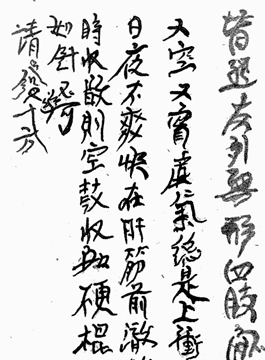
The
kitchen junk drawer holds the things a house doesn't know what to do
with: dead batteries, a tape measure, rubber bands gone brittle with
age, a church key for bottles nobody drinks anymore. Second from the
back, under a coil of twine, there is something that has no business
being there at all: a red envelope with gold characters stamped
across the front, worn soft at the corners from being handled once
and then never really acknowledged again.
It
has been in that drawer for eleven years, longer than anything else
that started out next to it.
My
grandmother gave it to me on one of the only trips my family ever
made back to China, on the last morning before we flew home. It was
one of the very few times in my life I've stood in the same room as
her. We were packing up our suitcases in her small apartment while
the morning heat was just starting to come through the windows. She
stepped out of the kitchen right before we left and pressed the
envelope into my hand at the door, in the same way you'd hand someone
something you didn't trust yourself to say out loud.
Inside
was money, which I spent within the month on nothing memorable, and a
folded slip of paper in her handwriting, which I have never spent at
all.
I
asked my mother to read it to me once, a week or two after we got
home. We were sitting in our kitchen in the afternoon light, still
tired from the flight. She held the paper beneath the bulb, moved her
lips through it twice before she spoke, and then said something like:
Grandma
used an old Chinese saying here. I don't really know how to say it in
English, but she says she loves you and wishes you the best in your
future.
She
handed the paper back to me. I remember thinking the sentence had
taken her a long time to arrive at, for how little it ended up
carrying.
By
then the paper had been folded and unfolded so many times that the
creases had gone soft and pale, a grid I could have redrawn from
memory before I could read a single character inside it. I put the
note back into its envelope and slid it into the junk drawer that
same afternoon. Not because I'd decided anything, but because I
didn't know where else a thing like that was supposed to live. It
wasn't trash. And at the same time, it wasn't precious enough, yet,
to earn a box or a frame. So it went in with the rubber bands and the
dead batteries, and quietly outlasted them all.
Every
few years I clean out that drawer. The batteries leak and get thrown
away. The rubber bands snap. Keys lose the locks they belonged to and
get tossed into the bin. Somehow, the red envelope survives every
purge.
I've
moved apartments twice since that trip. Both times, while packing up
my life into cardboard boxes, I picked up the envelope, wrapped it in
a dish towel so it wouldn't bend against the cutlery, and carried it
to the new place myself. Both times, it was one of the first things
unpacked into the new kitchen – placed right near the rear of the
drawer, beneath the twine.
I've
never asked myself, until now, why an object I've never fully
understood is the one thing I've made sure to keep safe in every move
I've made.
I
think about it more than I look at it. Some years I forget it's there
entirely, until I'm digging for a screwdriver or a spare key on a
random weekday and my hand brushes the paper. When that happens, I
straighten up a little and leave the envelope where it is.
I
have never once, in eleven years, taken it out and asked my mother to
translate it for me again. I tell myself it's because she already
told me what it says. I know that isn't really the reason. The reason
is closer to this: a fuller translation might replace the version I
already have, and I'm not sure I want to trade it. Right now the note
is allowed to mean anything I need it to mean, on any given day. A
better English sentence would close that door.
My
grandmother is very old now. She still asks about me on the phone, in
a language my mother interprets for both of us in real time,
flattening whatever my grandmother actually says into something brief
enough to carry across two languages. “She
says to eat well. She says to study hard.”
I
could take a picture of the note today, upload it to a translation
app on my phone, and have the exact meaning rendered on a screen in
five seconds. Or I could study Mandarin for years until the
characters reveal themselves to me. I have done neither. I could ask
my mother to read every word carefully this time, but I haven't done
that either.
What
I have of my grandmother, most days, is the shape of a sentence and
not the sentence itself – a translation of a translation, four feet
from where I make my coffee every morning, in handwriting that I have
never learned to read and a fold pattern I still remember exactly
from the one afternoon I looked at it closely enough to learn it.
I
don't know what would happen if I finally asked for the real
translation. Maybe it says exactly what my mother told me, plainly,
and I've built eleven years of mystery around three ordinary
sentences. Maybe it says something else entirely, something that
would change how I think about the woman who wrote it, or about
myself. I don't know, and for now, I'd rather not know than know the
wrong thing.
The
envelope stays where it's always stayed, second from the back, under
the twine. I open the drawer each morning, and it is still there in
the dark. I still know exactly how the paper is folded inside it,
though I've never learned the characters hidden between those soft,
pale creases.
Sometimes
I think that's the only part of her letter I've ever truly learned to
read.
Angela
Luo is an emerging creative with roots in figure
skating,
dance, and photography. A lifelong lover of the written word, she
enjoys writing short fiction and poetry that explore the intricate
nuances of family, identity, and coming of age.